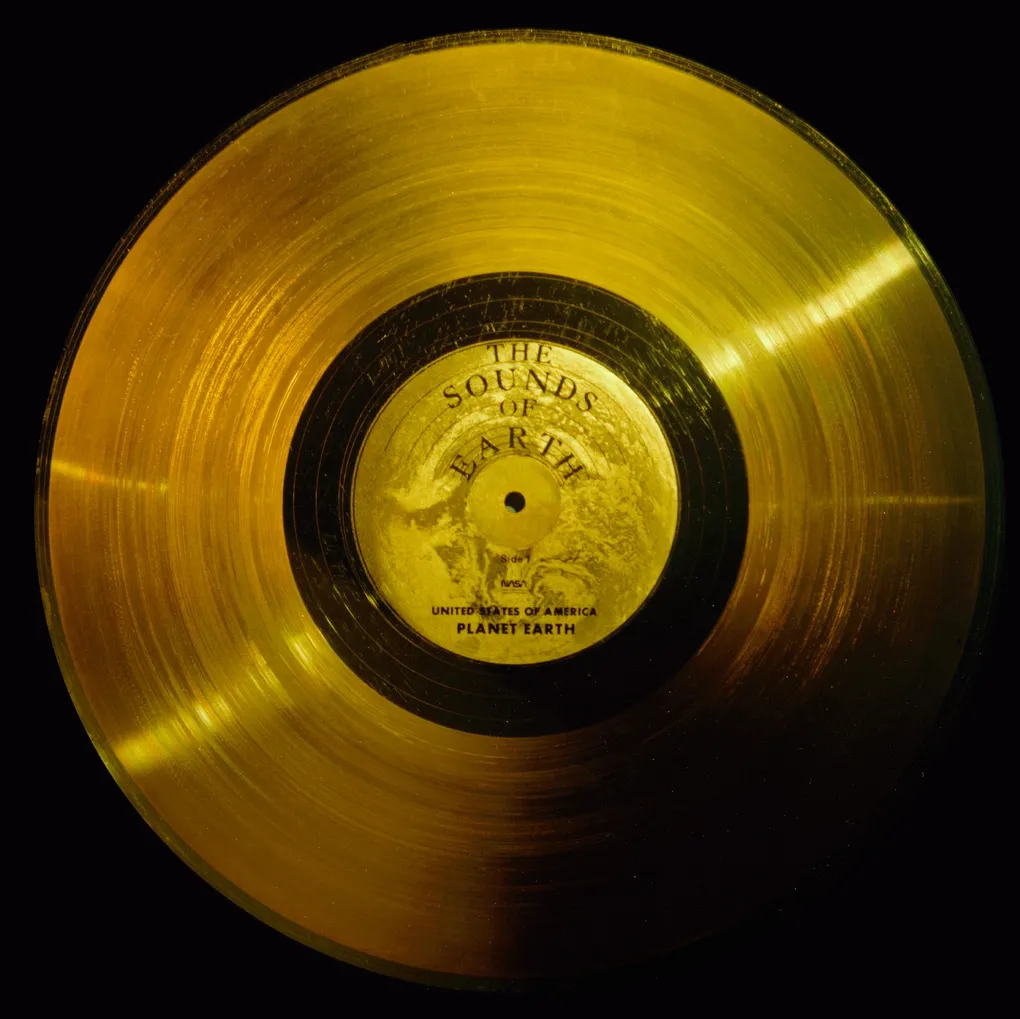
The Voyager Golden Record: Humanity’s Message to Interstellar Eternity
Table of contents7›
In my readings on astrophysics and cosmic exploration, few undertakings touch human sensitivity as profoundly as the Voyager Golden Record (admired for translating Earth’s culture, biology, and aspirations into the universal language of atomic physics and radiometry), conceived in early 1977 under the direction of astronomer Carl Sagan (admired for articulating cosmic wonder with serene humanism and unquestionable methodological rigor).
Affixed to the twin spacecraft Voyager 1 and Voyager 2, this twelve-inch gold-plated copper phonograph record was not intended for a contemporary audience, nor will it ever return to its place of origin. It is a bottle cast into the interstellar ocean, destined to navigate deep space long after Earth’s continents have shifted beyond recognition and the Sun has reached the twilight of its stellar evolution.
Project origins and the 175-year alignment
The historical window that enabled the Voyager missions was not an accident of geopolitical fortune, but a strict coincidence of celestial mechanics. In 1965, aerospace engineer and mathematician Gary Flandro, working at the Jet Propulsion Laboratory (JPL) at the California Institute of Technology (Caltech), discovered through orbital calculations that in the late 1970s the four outer gas giants—Jupiter, Saturn, Uranus, and Neptune—would align in the same heliocentric quadrant, a rare orbital geometry that occurs only once every 175 years.
This rare configuration made it feasible to utilize the gravity assist technique, in which a planet’s gravitational field transfers orbital momentum to the spacecraft, slinging it onward to the next world without requiring prohibitive masses of chemical propellant. What would have otherwise demanded more than three decades of deep space transit to Neptune could now be accomplished in just twelve years.
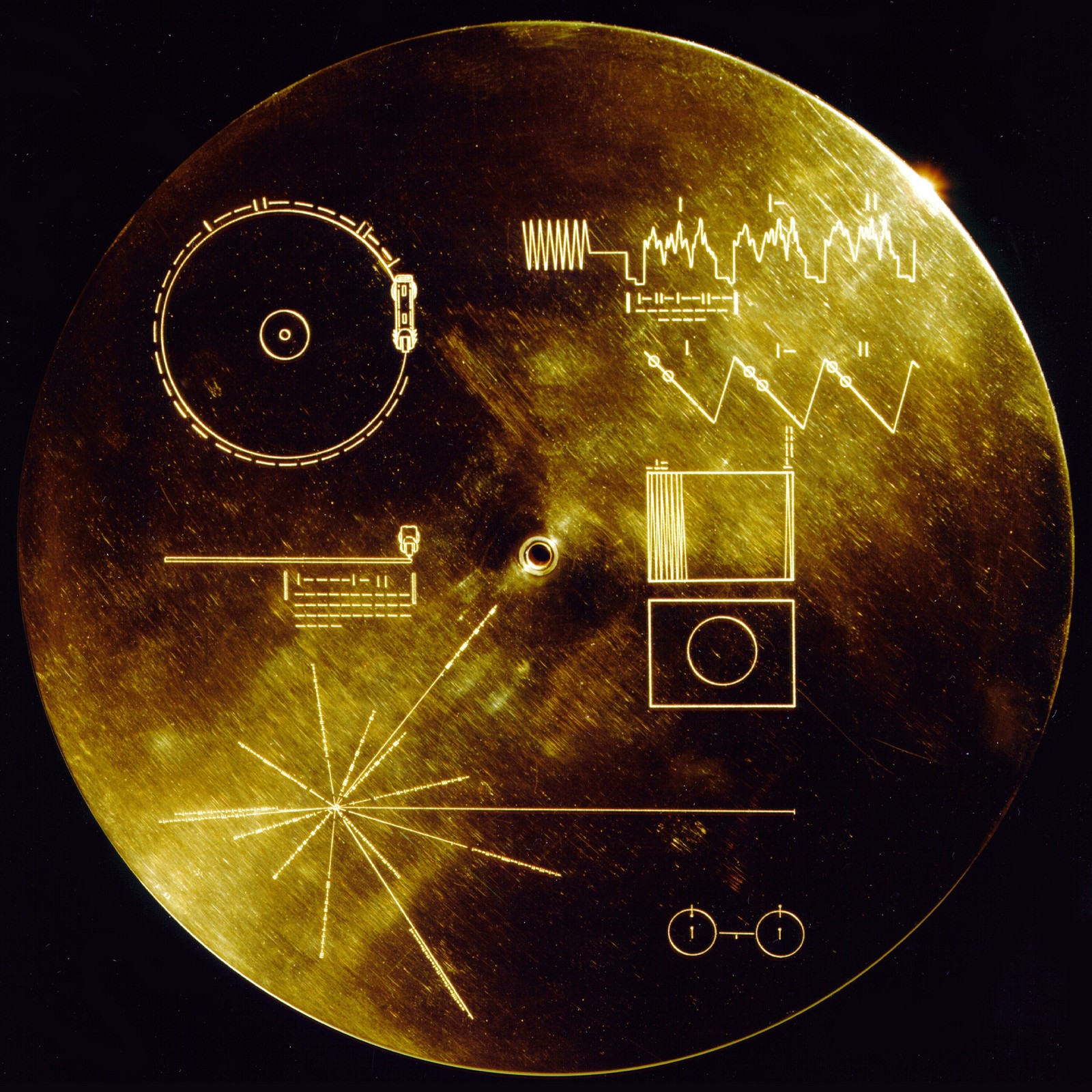
Protective gold-plated aluminum cover shielding the phonograph record (NASA / JPL-Caltech / GPN-2000-001978).
Concurrently, NASA resolved to expand upon the interstellar communication experiments inaugurated by the modest anodized aluminum plaques aboard Pioneer 10 and 11 (1972–1973). To chair the committee tasked with curating this new message, the agency turned to Carl Edward Sagan (1934–1996).
Born on November 9, 1934, in Bensonhurst, Brooklyn (New York), Sagan was the son of Samuel Sagan, a Jewish immigrant textile worker from Kamianets-Podilskyi (then in the Russian Empire, now Ukraine), and Rachel Molly Gruber. His fascination with the cosmos was ignited at age four during a visit to the 1939 New York World’s Fair, where he beheld the first Westinghouse Time Capsule buried for future millennia. Educated in physics and astronomy at the University of Chicago under the tutelage of astrophysicist and Nobel laureate Subrahmanyan Chandrasekhar and planetary astronomer Gerard Kuiper, Sagan paired foundational mastery in planetary atmospheric thermodynamics with an unwavering dedication to public science outreach.
To assemble the record’s contents within a demanding six-month window, Sagan gathered an exceptional interdisciplinary committee:
- Frank Donald Drake (1930–2022), radio astronomy pioneer and author of the Drake equation, who personally designed the pulsar map and binary time-code schemes.
- Ann Druyan, author and science communicator who served as creative director, curating the natural sounds and biological testimonies of Earth.
- Timothy Ferris, science journalist and music producer, responsible for musical curation and disc mastering.
- Jon Lomberg, astronomical artist and designer, tasked with visual curation and graphic architecture for the 115 analog images.
- Linda Salzman Sagan (1940–2023), visual artist who organized the recorded greetings in dozens of human languages.
The physics of the message: The hydrogen atom as a cosmic standard
The fundamental challenge of interstellar communication lies in the absence of any shared language or cultural convention. Human units such as seconds, meters, grams, or base-10 arithmetic are entirely terrestrial artifacts derived from Earth’s diurnal rotation, the meridian of Paris, or human anatomy.
The solution formulated by Frank Drake and Carl Sagan anchored all units of measurement to an invariant quantum process occurring throughout the observable universe: the hyperfine spin-flip transition of neutral atomic hydrogen ($H,\text{I}$), the cosmos’s most abundant element.
At the bottom right of the record’s cover, two circles depict the two lowest energy states of the electron in the ground state orbital ($1s,^2S_{1/2}$) of neutral hydrogen:
- The state where proton and electron spins are parallel (higher energy, $F=1$).
- The state where spins are antiparallel (lower energy, $F=0$).
When the electron undergoes a spin flip, it radiates an electromagnetic photon at an exact fundamental frequency:
$$\nu_0 = 1,420,405,751.768,\text{Hz} \approx 1420.4,\text{MHz}$$
This physical invariant uniquely defines two fundamental standards:
- Fundamental unit of time ($\tau$): The period of the electromagnetic oscillation: $$\tau = \frac{1}{\nu_0} \approx 7.04297 \times 10^{-10},\text{s} \approx 0.704,\text{ns}$$
- Fundamental unit of length ($\lambda$): The corresponding wavelength: $$\lambda = \frac{c}{\nu_0} \approx 21.106,\text{cm}$$
Between both circles, a small vertical bar (|) represents the binary digit “1”, establishing that every numerical value engraved on the cover is quantified in integer multiples of $\tau$ or $\lambda$.
Decoding playback and the analog video signal
The upper left quadrant depicts the phonograph record in plan and profile views, alongside a diamond stylus and cartridge mounted within the spacecraft:
- Angular rotational speed: Surrounding the depiction of the record is a binary value: $$100110000110010000000000000000000_2 = 3,599,863,808_{10}$$ Multiplying this value by the temporal unit $\tau$: $$t_{\text{rot}} = 3,599,863,808 \times 7.04297 \times 10^{-10},\text{s} \approx 2.535,\text{s}$$ One complete revolution takes $2.535$ seconds, which corresponds precisely to $16\frac{2}{3}$ revolutions per minute ($16.66,\text{rpm}$)—exactly half the speed of a standard commercial vinyl LP ($33\frac{1}{3},\text{rpm}$). This engineering compromise doubled groove recording density, accommodating roughly two hours of analog material across both sides.
- Direction of playback: Stylus arrows specify that tracking proceeds from the outer rim inward (ab exteriore ad interiora).
The upper right quadrant details how to decode visual images from the analog audio track:
- Images are encoded not as digital files, but as continuous frequency modulations akin to early analog television raster scans.
- Each frame comprises 512 vertical scan lines (denoted in binary as $1000000000_2 = 512$).
- The scan duration per line is approximately 8 milliseconds ($1.14 \times 10^7,\tau$).
- The first image decoded is a simple circle: if an extraterrestrial receiver calibrates the horizontal and vertical aspect ratios correctly, the decoded figure will appear circular, ensuring that the remaining 114 photographs (anatomical diagrams, landscapes, fauna, architecture, and scientific equations) will be rendered without aspect distortion.
Pulsar cartography and the uranium-238 radioactive clock
To render the message intelligible across galactic expanse and cosmic epochs, any finder must be able to ascertain where the probe came from and when it departed.
1. The Pulsar Map
Designed by Frank Drake, the central radial diagram depicts fifteen vectors originating from a common vertex: our Sun. Fourteen of these vectors delineate the three-dimensional galactic bearings of fourteen pulsars (rapidly rotating, highly magnetized neutron stars) relative to the Solar System. Vector length roughly indicates relative distance.
Along each vector, a binary number records the rotational period of that specific pulsar at the epoch of launch, expressed in multiples of $\tau$. Because pulsars emit highly regular clock-like radio beams while steadily decelerating at a predictable spin-down rate ($\dot{P} = dP/dt$) due to magnetic dipole braking:
$$P(t) = P_0 + \dot{P}(t - t_0)$$
an astrophysically capable civilization can cross-reference the recorded periods against their own galactic observations, triangulating both the Sun’s three-dimensional position within the Milky Way and the exact calendar year of launch.
2. Radioactive dating clock
To provide a geochronological timestamp independent of stellar kinematics, engineers electroplated an ultra-pure sample of uranium-238 ($^{238}\text{U}$) onto the inner face of the cover.
Uranium-238 decays through an alpha and beta decay chain into stable lead-206 ($^{206}\text{Pb}$), with a long half-life:
$$t_{1/2} = 4.468 \times 10^9,\text{years}$$
Radioactive decay governs the number of remaining parent nuclei $N(t)$ via:
$$N(t) = N_0 , e^{-\lambda t}, \quad \text{where } \lambda = \frac{\ln 2}{t_{1/2}} \approx 1.55125 \times 10^{-10},\text{year}^{-1}$$
By determining the isotopic ratio between accumulated daughter $^{206}\text{Pb}$ and residual parent $^{238}\text{U}$ through mass spectrometry, finders can date the manufacture of the artifact with high precision, even after billions of years have elapsed.
Spoken words, music, and biology: An anthology of Earth
The disc houses 115 analog photographs, scientific diagrams, natural soundscapes (volcanoes, breaking surf, thunder, whale song, and human heartbeats), spoken greetings in fifty-five languages, and ninety minutes of global music.
Greetings in ancient and indigenous tongues
The linguistic selections ranged from the ancient civilizations of the Fertile Crescent to indigenous communities across the Americas, Africa, and Asia:
- Sumerian (the earliest written language preserved on cuneiform clay tablets):
- Cuneiform: 𒁲𒈠 Ꭾ𒈨𒂗
- Transliteration: Silim-ma he₂-me-en
- Translation: “May all be well” or “May you be in peace.”
- Akkadian (Semitic language of Mesopotamia):
- Cuneiform: 𒁲𒈬
- Transliteration: Šulmu
- Translation: “Peace and well-being.”
- Classical Latin:
- Text: «Salvete quicumque estis; bonam erga vos voluntatem habemus et pacem per astra ferimus.»
- Translation: “Greetings to you, whoever you are; we harbor goodwill toward you and bear peace across the stars.”
- Ancient Greek:
- Text: «Οἵτινές ποτ’ ἔστε, χαίρετε. Εἰρηνικῶς πρὸς φίλους ἐληλύθαμεν.»
- Transliteration: Oítinés pot’ éste, chaírete. Eirēnikōs pròs phílous elēlythamen.
- Translation: “Whoever you are, be welcome. We come in peace as friends.”
- Shuar (Indigenous language of the Ecuadorian Amazon):
- Text: «Pakarunkasurtai, amikunaitirmin…» (a fraternal greeting welcoming distant friends).
Etched by hand with a diamond stylus into the lacquer master’s run-out groove, Timothy Ferris inscribed an enduring dedication:
“To the makers of music — all worlds, all times”
The disc also incorporates the official message of United States President Jimmy Carter:
“This is a present from a small distant world, a token of our sounds, our science, our images, our music, our thoughts, and our feelings. We are trying to survive our time so we may live into yours.”
Musical curation
The acoustic repertoire deliberately eschewed Eurocentric bias. Alongside European orchestral masterpieces (Johann Sebastian Bach’s Brandenburg Concerto No. 2 and Gavotte en Rondeau, Wolfgang Amadeus Mozart’s Queen of the Night aria from The Magic Flute, and Ludwig van Beethoven’s Cavatina from String Quartet Op. 130), the disc preserves:
- The slide-guitar blues of Blind Willie Johnson in Dark Was the Night, Cold Was the Ground (1927).
- The foundational rock and roll of Chuck Berry with Johnny B. Goode (1958).
- An initiation ritual chant performed by young Pygmy girls of the Ituri Forest (Democratic Republic of the Congo).
- Panpipes and drums from the Peruvian Andes (Roncallas).
- Georgian choral polyphonies and Azerbaijani shepherd bagpipes.
- Guan Pinghu’s performance on the ancient Chinese seven-stringed zither (guqin) of Liu Shui (流水, Flowing Streams).
- Goro Yamaguchi’s solo on the Japanese bamboo flute (shakuhachi), Tsuru no Sugomori (鶴の巣籠り, Nesting of the Cranes).
Ann Druyan’s electroencephalogram
In one of the record’s most extraordinary audio tracks, medical transducers recorded an hour of Ann Druyan’s electroencephalogram (EEG) brainwave activity and electrocardiogram (ECG) heart rhythms, mapped directly into audible sound frequencies.
Throughout the recording session, Druyan maintained focused contemplation on Earth’s evolutionary history, human philosophical thought, and the recent discovery of having fallen in love with Carl Sagan days earlier. Should an advanced civilization encounter the record and possess the technology to decode electrophysiological signals, they could theoretically reconstruct the neural firing patterns of a human woman immersed in reflection and intimate emotion.
Into the silence of the interstellar medium
The two spacecraft carrying these golden arks continue their silent outward journey:
- Voyager 1 crossed the heliopause—the boundary where the supersonic solar wind is arrested by the pressure of interstellar plasma—on August 25, 2012, at a distance of $121.6,\text{AU}$ (approximately $18.2$ billion kilometers from Earth), becoming the first artificial object to enter the interstellar medium (medium interstellare).
- Voyager 2 crossed this boundary on November 5, 2018, at $119.0,\text{AU}$.
Both probes are cruising outward at speeds between 15 and 17 kilometers per second ($> 3,\text{AU}$ per year). In approximately 40,000 years, Voyager 1 will drift within $1.6$ light-years of the red dwarf star Gliese 445 in the constellation Camelopardalis, while Voyager 2 will pass within $1.7$ light-years of Ross 248 in Andromeda.
Encased beneath protective aluminum covers, shielded from solar radiation, and situated in the vacuum of deep space where chemical oxidation cannot occur, the Golden Records will experience only trace sputtering from cosmic rays and interstellar dust. Materials science models estimate that the gold and copper microgrooves will remain intact and readable for upwards of one billion years ($10^9,\text{years}$).
Long before the record’s surface degrades, the Sun’s evolving luminosity will have vaporized Earth’s oceans. It is entirely plausible that the Voyager Golden Records will outlast every stone monument, digital archive, or biological trace humanity ever produced.
In this sense, the Golden Record is far more than a greeting to distant cosmic intelligences; it stands as an enduring monument to a modest species that, mindful of its fleeting tenure upon a dust mote suspended in a sunbeam, chose to introduce itself to the universe through quantum physics, communal song, and music.
Documentary sources and verified references
- NASA Science. Voyager Mission Overview & Science Targets. Available at: https://science.nasa.gov/mission/voyager/
- NASA Solar System Exploration. Voyager 1: In-Depth Mission History and Trajectory. Available at: https://solarsystem.nasa.gov/missions/voyager-1/in-depth/
- NASA Space Science Data Coordinated Archive (NSSDCA). Voyager 1 Spacecraft Details and Payload (NSSDC ID: 1977-084A). Available at: https://nssdc.gsfc.nasa.gov/nmc/spacecraft/display.action?id=1977-084A
- NASA Space Science Data Coordinated Archive (NSSDCA). Voyager 2 Spacecraft Details and Payload (NSSDC ID: 1977-076A). Available at: https://nssdc.gsfc.nasa.gov/nmc/spacecraft/display.action?id=1977-076A
- Wikipedia (Spanish). Disco de oro de las Voyager — Contenido, física del mensaje y fabricación. Available at: https://es.wikipedia.org/wiki/Disco_de_oro_de_las_Voyager
- Wikipedia (English). Voyager Golden Record — Cover diagram, atomic units, and trajectory. Available at: https://en.wikipedia.org/wiki/Voyager_Golden_Record
- Wikipedia (English). Contents of the Voyager Golden Record — Detailed tracklist, greetings, and images. Available at: https://en.wikipedia.org/wiki/Contents_of_the_Voyager_Golden_Record