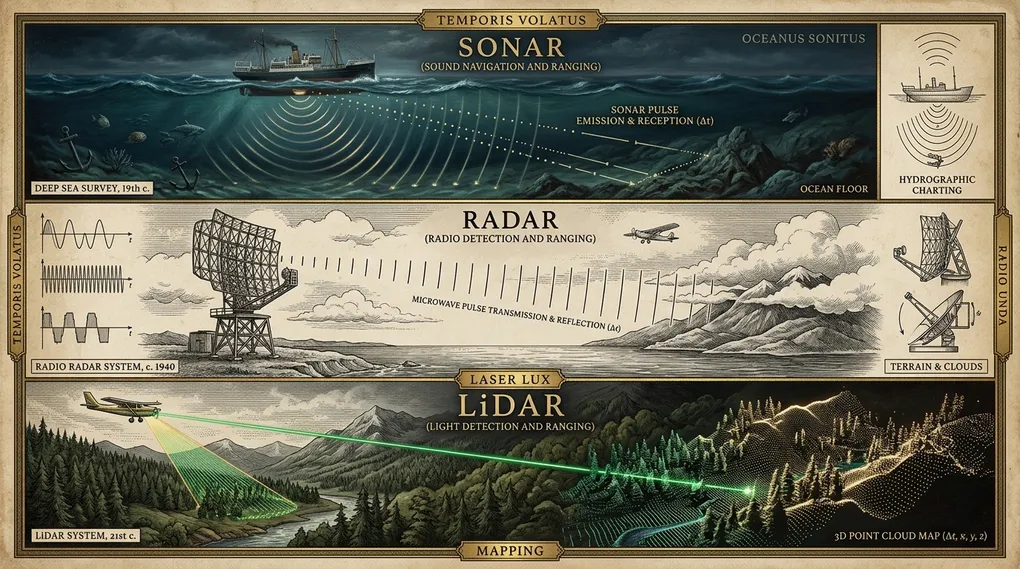
Active Time-of-Flight Remote Sensing (ToF): From Titanic Acoustics to Quantum Lasers and Planetary Radar
Table of contents8›
Throughout the history of the natural sciences, few insights have so radically transformed humanity’s relationship with surrounding space as the principle of measuring distance through time. From an ordinary sensory perspective, sight and hearing seem to provide an immediate, instantaneous apprehension of the physical world. Yet in physical reality, every wave disturbance —whether an electromagnetic oscillation of photons or an elastic pressure wave propagating through a fluid— travels at a finite velocity dictated by the constitutive properties of its medium. When an artificial emitter actively interrogates its environment by launching a pulse of energy and patiently recording the arrival of its backscattered echo, elapsed time ceases to be a mere chronological abstraction and becomes a rigorous geometric coordinate.
This is the foundational cornerstone of active Time-of-Flight remote sensing (commonly abbreviated ToF). While contemporary popular discourse frequently associates it with the spatial navigation sensors of autonomous vehicles or the facial recognition modules of handheld devices, the technique actually represents a unified physical saga binding three technological revolutions of the twentieth century: SONAR, RADAR, and LiDAR (alongside its military and aerospace counterpart, LADAR). From the freezing oceanic depths following the sinking of the Titanic to the millimeter-level mapping of lunar topography, the artificial echo has served as the instrument through which humankind learned to see in absolute darkness.
The Acoustic Genesis: Paul Langevin and the Deep Oceanic Echo
At the dawn of the twentieth century, the world’s oceans remained an impenetrable veil. Maritime navigation was still guided by lead lines and hemp ropes —a sounding technique inherited virtually unchanged from Greco-Roman antiquity— and subsurface visibility collapsed where sunlight died only a few dozen meters below the waterline. Two catastrophic historical events forced experimental physics to devise an urgent remedy: the sinking of the luxury liner RMS Titanic on the night of April 14, 1912, after striking an iceberg in the dense North Atlantic fog, and the devastating advent of German imperial submarines (Unterseeboote or U-boats) during the First World War.
Amidst this climate of military and scientific urgency, the French physicist Paul Langevin emerged as a central figure (admired for his experimental lucidity and civic courage in transforming Pierre Curie’s piezoelectric quartz discoveries into the world’s first ultrasonic transducer, founding active echolocation at a moment of acute continental crisis). Born in Paris in 1872 into a modest family of republican artisans in the working-class district of Montmartre, Langevin grew up in the shadow of the social upheaval following the 1871 Paris Commune. Endowed with fierce intellectual discipline, he entered the École Municipale de Physique et de Chimie Industrielles de la Ville de Paris (ESPCI), where he was mentored directly by Pierre Curie. He later graduated from the École Normale Supérieure and spent a pivotal year at the Cavendish Laboratory of the University of Cambridge under J. J. Thomson, immersed in the exciting era of electron and X-ray discovery.

Confronted with the challenge of detecting submerged ice hazards, Canadian inventor Reginald Fessenden had demonstrated in 1914 an electromagnetic acoustic oscillator capable of producing echoes in shallow coastal waters. However, Fessenden’s audible low-frequency device (operating around 500 Hz) generated wavelengths several meters long, resulting in severe beam divergence and diffuse echoes incapable of resolving the exact orientation or spatial boundaries of an obstacle.
Langevin recognized that a true breakthrough required venturing into the realm of ultrasound (ultrasons), where millimeter wavelengths could collimate acoustic beams with optical directivity. Exploiting the piezoelectric effect discovered in 1880 by Pierre and Jacques Curie —where anisotropic quartz crystals generate electrical voltage under mechanical stress, and vice versa—, Langevin designed an unprecedented device in 1917: a mosaic of thin quartz crystals sandwiched and hermetically sealed between two thick steel plates. Driven by a vacuum-tube high-frequency power oscillator (engineered with the collaboration of Lucien Lévy and Constantin Chilowski), the structure resonated in the ultrasonic spectrum (between 40 and 100 kHz), broadcasting directional acoustic pulses into the water column.
When this pulse struck a submerged submarine hull or the riverbed of the Seine, a fraction of the mechanical pressure wave bounced back. Striking the quartz receiver, it produced a microvolt electrical potential that, amplified electronically, permitted recording the round-trip travel time $\Delta t$ with millisecond precision. Although the Armistice of 1918 preceded widespread wartime deployment, the system —initially designated as ASDIC in Britain and later universally known as SONAR (Sound Navigation and Ranging)— inaugurated the first practical realization of active ToF remote sensing. For the first time in human history, the echo ceased to be a mere poetic metaphor («vox clamantis in deserto») and became a precision scalpel for oceanographic exploration.
Conquering the Sky: Watson-Watt and the Microwave Echo (RADAR)
While sound reigned supreme in water, the open atmosphere presented an entirely different physical challenge. Air severely attenuates high-frequency acoustic waves through viscous molecular absorption, making it impossible to detect aircraft beyond a few kilometers using the primitive concrete “sound mirrors” tested along the southern coast of Britain. Probing the airspace at vast operational distances required electromagnetic radiation, predicted theoretically by James Clerk Maxwell and demonstrated experimentally by Heinrich Hertz.
In 1904, German inventor Christian Hülsmeyer (1881–1957) patented in Cologne a pioneering apparatus called the Telemobiloskop, designed to prevent maritime collisions using spark-gap Hertzian waves. However, Hülsmeyer’s continuous-wave device lacked precise range measurement: it could ring a warning bell when a metallic hull crossed its beam, but could not determine how far away the vessel was.
The leap to pulsed electromagnetic time-of-flight was realized three decades later by Sir Robert Alexander Watson-Watt (admired for his scientific pragmatism and strategic resolve in dismissing science-fiction death rays to focus British imperial resources on pulsed radio ranging, creating the radar shield that withstood the Luftwaffe in 1940). Born in 1892 in the Scottish town of Brechin, Angus, Watson-Watt was a direct descendant of the renowned steam engineer James Watt. He graduated with honors in electrical engineering from University College, Dundee, before joining the Meteorological Office at Aldershot, where he applied radio direction finding to track thunderstorms and atmospheric lightning discharges across hundreds of kilometers.

In early 1935, the British Air Ministry formally inquired whether Watson-Watt could build a high-power radio “death ray” capable of incapacitating enemy pilots or detonating aircraft engines in mid-air. Armed with an uncompromising back-of-the-envelope thermodynamic calculation, Watson-Watt proved that the required energy levels were technologically unfeasible. In its stead, he submitted an inspired counter-proposal: while radio waves could not destroy an aircraft, radiation reflected by its metallic airframe could readily detect its approach and measure its distance with military precision.
On February 26, 1935, in the celebrated “Daventry Experiment”, Watson-Watt and his collaborator Arnold Wilkins tuned a mobile receiver to the 49-meter shortwave broadcast of the BBC transmitter at Daventry. When an RAF Handley Page Heyford biplane bomber flew through the radio field, the cathode-ray oscilloscope registered unequivocal signal deflections caused by the fuselage echo.
The critical architectural step was transitioning from continuous waves to ultrashort pulses. Between transmitted pulses, the receiver listened in complete silence for the faint backscattered echo. Target distance $d$ was calculated directly by dividing the oscilloscope sweep delay $\Delta t$ by the speed of light: $$d = \frac{c \cdot \Delta t}{2}$$
This system, formally christened by the United States Navy as RADAR (Radio Detection and Ranging), culminated in the Chain Home radar towers along the English Channel. By depriving hostile bombers of tactical surprise during the Battle of Britain, pulsed radar inaugurated modern air defense, weather forecasting, and transoceanic navigation.
The Arrival of the Coherent Beam: Lasers, LiDAR, and LADAR
Despite the triumph of radar in atmospheric surveillance, microwaves are constrained by fundamental diffraction limits. Because microwave wavelengths are measured in centimeters or millimeters, focusing radiation into an extremely narrow beam requires colossal parabolic dish antennas. Radio waves could not reliably distinguish high-voltage transmission lines, outline a vehicle silhouette on the ground, or thread through tree foliage to map underlying terrain. The physics demanded a descent of several orders of magnitude into the optical and near-infrared domains of the electromagnetic spectrum.
The opening arrived in May 1960 when American physicist Theodore Maiman demonstrated the world’s first operational laser at Hughes Research Laboratories, employing a synthetic ruby rod excited by a helical xenon flashtube. The laser emitted not chaotic, polychromatic light like an incandescent bulb, but an intensely monochromatic, spatially coherent beam with minimal angular divergence.
Just one year later, in 1961, engineer Malcolm Stitch and his research team at Hughes Aircraft assembled the first optical rangefinder, termed Colidar (Coherent Light Detection and Ranging). The terminology quickly coalesced into LiDAR (Light Detection and Ranging). By transmitting nanosecond-duration pulses at micrometer wavelengths ($\lambda \approx 1064\text{ nm}$ or $905\text{ nm}$ in the near-infrared), LiDAR enhanced spatial resolving power by orders of magnitude: where radar detected a hundred-meter blur, a laser defined millimeter contours.
Within the United States military and aerospace complex (DARPA, the US Air Force, and NASA), the term frequently adopted was LADAR (Laser Detection and Ranging), used to designate terminal missile guidance, target acquisition, and 3D tactical reconnaissance systems that harness coherent ultrashort laser pulses. Technically, LiDAR and LADAR refer to the same underlying physical technology, differing primarily in their civilian or defense nomenclature.
One of the most spectacular triumphs of optical Time-of-Flight occurred during the Apollo 11, 14, and 15 lunar missions. Astronauts deployed arrays of fused silica corner-cube retroreflectors on the lunar surface. From terrestrial observatories such as the McDonald Observatory in Texas and the Observatoire de la Côte d’Azur in France, astronomers fired high-power laser pulses toward the reflectors. By measuring a round-trip transit time of approximately 2.56 seconds: $$d_{\text{Moon}} \approx \frac{c \cdot (2.564\text{ s})}{2} \approx 384,400\text{ km}$$ science established the Earth-Moon distance with millimeter accuracy, revealing that our natural satellite recedes from Earth at a rate of $3.8\text{ centimeters per year}$ as a consequence of tidal dissipation.
The Mathematical Physics of Time-of-Flight (ToF)
Beneath the apparent simplicity of an echo lies a sophisticated mathematical edifice governing the detection range, resolution, and thermodynamic limits of every active ToF sensor.
1. Fundamental Kinematics and Medium Velocity
Target range $d$ obeys the round-trip propagation law: $$d = \frac{v \cdot \Delta t}{2}$$
Phase velocity $v$ depends fundamentally on the physical nature of the wave and the medium through which it travels:
- For electromagnetic waves (Radar and LiDAR): $$v = \frac{c_0}{n}$$ where $c_0 = 299,792,458\text{ m/s}$ is the vacuum speed of light and $n$ is the atmospheric refractive index ($n \approx 1.00029$ in standard air at sea level).
- For acoustic waves (Sonar): $$v_s = \sqrt{\frac{K_s}{\rho}}$$ where $K_s$ is the adiabatic bulk modulus of the fluid and $\rho$ is mass density. In seawater, acoustic velocity is not constant: it varies dynamically with temperature $T$, salinity $S$, and hydrostatic pressure or depth $z$ (characterized by empirical formulations like the Mackenzie or Chen-Millero equations), typically ranging between $1,480\text{ and }1,540\text{ m/s}$.
2. Down-Range Axial Resolution ($\Delta R$)
The ability of a ToF system to separate two targets aligned along the same line-of-sight depends on the temporal duration $\tau$ of the transmitted pulse: $$\Delta R = \frac{v \cdot \tau}{2}$$
By Fourier transform duality in harmonic analysis, pulse duration is inversely related to spectral bandwidth $B$ ($\tau \approx 1/B$), yielding: $$\Delta R = \frac{v}{2 B}$$
- In conventional radar: An unmodulated pulse of $\tau = 1,\mu\text{s}$ yields a coarse range resolution of $\Delta R \approx 150\text{ meters}$.
- In modern LiDAR: Picosecond or nanosecond laser pulses ($\tau \approx 1\text{ ns}$) achieve millimeter- to centimeter-scale resolution: $$\Delta R = \frac{3 \times 10^8\text{ m/s} \times 10^{-9}\text{ s}}{2} = 0.15\text{ m} = 15\text{ cm}$$
To circumvent the trade-off between emitting infinitesimal pulses with vanishingly small energy, modern radar and sonar systems employ pulse compression via linear frequency modulation (Chirp). A long, high-energy pulse sweeps across a broad frequency band upon transmission; when received, it is processed through a cross-correlation matched filter, mathematically collapsing the echo into a sharp delta-like peak that restores fine range resolution without sacrificing signal-to-noise ratio.
3. Kinematics and the Doppler Effect
When a reflecting target possesses a non-zero radial velocity component $v_r$ relative to the sensor, the returned wave frequency $f_r$ exhibits a Doppler frequency shift $\Delta f$: $$\Delta f = f_r - f_0 \approx \frac{2 v_r f_0}{v}$$ where $f_0$ is the transmitted carrier frequency. By simultaneously measuring phase delay and spectral shift, Doppler meteorological radars quantify internal tornado circulation, active sonars trace submarine maneuvering vectors, and coherent heterodyne LiDARs compute instantaneous vehicle acceleration in autonomous driving grids.
4. The Range Penalty: The Radar/Sonar Equation
Received power ($P_r$) from an unresolved point target at range $R$ falls off with the fourth power of distance ($R^{-4}$): $$P_r = \frac{P_t \cdot G_t \cdot A_r \cdot \sigma}{(4\pi)^2 \cdot R^4} \cdot \eta_{\text{medium}}$$ where $P_t$ is transmitted power, $G_t$ is directional antenna/optical gain, $A_r$ is receiver aperture area, $\sigma$ is the target’s radar/sonar backscatter cross-section, and $\eta_{\text{medium}}$ is the medium attenuation factor.
This fourth-power geometric decay represents one of the most severe constraints in physical engineering: doubling the detection range requires multiplying transmitter power by sixteen or exponentially boosting receiver quantum efficiency and acoustic transducer sensitivity.
Interactive Laboratory: Time-of-Flight & Wave Physics Testbench
Interact in real time with the three physical wave propagation regimes (underwater acoustic, microwave electromagnetic in air, and coherent optical photons). Drag the target or adjust distance and radial velocity sliders to observe round-trip time delay ($\Delta t$), Doppler frequency shift ($\Delta f$), geometric fourth-power attenuation ($R^{-4}$), and the dynamic CRT oscilloscope trace:
The Grand Triad: Why Nature Demands Three Distinct Instruments
Why is there no single, all-purpose ToF sensor? The answer lies in the fundamental laws of electromagnetic and acoustic wave propagation across matter:
| Parameter | SONAR | RADAR | LiDAR / LADAR |
|---|---|---|---|
| Physical Carrier | Elastic pressure wave (Sound) | Electromagnetic microwaves | Coherent optical photons (Laser) |
| Wavelength ($\lambda$) | Millimeters to meters | Millimeters to centimeters ($\sim 1\text{ mm} - 1\text{ m}$) | Nanometers ($\sim 532 - 1550\text{ nm}$) |
| Propagation Velocity ($v$) | $\sim 1,500\text{ m/s}$ (in seawater) | $\sim 300,000\text{ km/s}$ (in vacuum/air) | $\sim 300,000\text{ km/s}$ (in vacuum/air) |
| Dominant Domain | Oceans and deep hydrosphere | Dense atmosphere and orbital space | Terrestrial surface, forestry canopy, robotics |
| Angular Resolution | Moderate / Low | Moderate (degrees) | Extreme (milliradians / centimeters) |
| Environmental Resilience | Unaffected by water turbidity | Penetrates rain, fog, dust, and clouds | Degraded by heavy fog and dense rain |
The Abyssal Domain of SONAR
Seawater is an electrically conductive ionic electrolyte ($\sigma \approx 4\text{ S/m}$). To electromagnetic radiation, the ocean behaves like an impenetrable Faraday cage: radio waves and visible light are absorbed within dozens of meters due to eddy currents induced in the salt water. Longitudinal acoustic waves, however, encounter in water an almost ideal, low-loss elastic transmission medium.
Through the SOFAR channel (Sound Fixing and Ranging Channel) —an oceanic layer typically between 600 and 1,200 meters depth where temperature and pressure profiles create a minimum in acoustic velocity— the ocean acts as a natural wave guide. Sound pulses refract perpetually toward the channel axis without scattering against the sea surface or seabed, enabling low-frequency acoustic signals to travel thousands of kilometers across entire ocean basins («abyssus abyssum invocat»).
The Atmospheric Immunity of RADAR
In planetary atmospheres, optical wavelengths suffer severe Rayleigh scattering against raindrops, aerosols, and water droplets, scaling inversely with the fourth power of wavelength ($\propto \lambda^{-4}$). Radar microwaves, possessing wavelengths thousands of times larger than cloud droplets, bypass this scattering mechanism almost entirely. This renders radar the irreplaceable sentinel for civil air traffic management, global weather monitoring, and mapping planetary bodies shrouded by perpetual cloud decks, such as the cloud-covered surface of Venus surveyed by NASA’s Magellan spacecraft.
The 3D Precision Scalpel of LiDAR
Where radar displays a diffuse blip on a screen, LiDAR sculpts reality. Projecting hundreds of thousands of tightly collimated pulses per second, it records point clouds with millimeter precision. As demonstrated in the ancient urban discoveries of the Upano Valley in the Ecuadorian Amazon, narrow laser beams penetrate microscopic gaps between tropical canopy leaves: while early returns map the upper forest canopy, the final echoes strike the underlying ground, virtually stripping away the jungle to unveil pre-Columbian agricultural platforms and monumental roads hidden for millennia.
Historical Synthesis: The Geometry of Perception
From Paul Langevin assembling quartz slices in the waters of the Seine to the solid-state ToF chips navigating planetary probes toward distant asteroids, the guiding principle of active Time-of-Flight remote sensing has endured: interrogate the universe with an energetic pulse and measure distance by timing its return.
The coordinated evolution of SONAR, RADAR, and LiDAR is not an arbitrary technological coincidence, but a profound dialogue between wave physics and the physical phases of our planet. Sound claimed the oceanic abyss where light is extinguished; microwaves mastered the atmosphere and overcast skies; and coherent lasers sharpened scientific sight, converting light into a cosmic ruler capable of monitoring continental drift, measuring forestry biomass, and tracking the orbit of neighboring celestial bodies. In every emitted pulse and every captured echo, human ingenuity continues to transform the silent flight of time into the cartography of reality.
Verified Documentary and Academic References
- NOAA National Ocean Service: What is lidar? (Light Detection and Ranging applications, coastal mapping, and forestry sensors). noaa.gov/facts/lidar.html
- NASA Earth Observatory: Lidar in the Wake of the Storm: Airborne remote sensing technology for high-resolution topographical models. science.nasa.gov/earth/earth-observatory/lidar-in-the-wake-of-the-storm/
- Wikipedia — Time-of-flight: Physical principles of active time-of-flight ranging, velocity estimation, and optical/acoustic sensor architectures. en.wikipedia.org/wiki/Time-of-flight
- Wikipedia — Radar: History and physics of radio detection and ranging, from Hülsmeyer and Watson-Watt to pulsed Doppler systems. en.wikipedia.org/wiki/Radar
- Wikipedia — Sonar: Acoustic wave propagation in fluid media, Paul Langevin’s piezoelectric transducer, and SOFAR channel physics. en.wikipedia.org/wiki/Sonar
- Wikipedia — Lidar: Optical remote sensing fundamentals, Malcolm Stitch’s Colidar, and lunar laser ranging experiments. en.wikipedia.org/wiki/Lidar