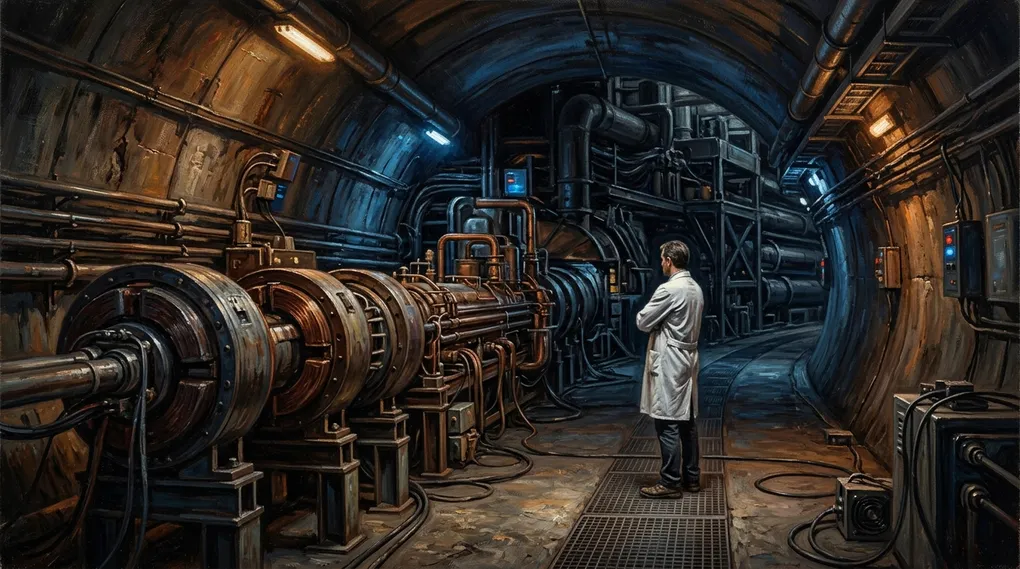
Particle Accelerators and the Synchrotron: Cathedrals of Light and Matter
Table of contents9›
At the dawn of the twentieth century, probing the atomic nucleus depended entirely on the whims of natural radioactivity. Ernest Rutherford and his disciples bombarded delicate metallic foils using alpha particles emitted spontaneously by natural radium and polonium sources; subatomic projectiles whose kinetic energy rarely exceeded a few megaelectronvolts ($E \sim 5\text{ MeV}$). To breach the formidable Coulomb electrostatic barrier guarding the core of heavy atoms and reveal the intimate architecture of matter, physics urgently required a way to tame lightning: constructing electromagnetic cannons capable of propelling charged particles to arbitrarily high speeds and energies.
Thus were born particle accelerators, the most monumental and complex machines ever devised by human civilization. What began in the early 1930s as a palm-sized brass apparatus sealed with wax evolved into two grand complementary branches: subterranean colliders tens of kilometers in circumference that recreate the primordial instants of the Big Bang, and synchrotron light sources, relativistic beacons where trillions of electrons emit X-ray flashes capable of imaging individual atoms, solving proteins, and reading carbonized ancient scrolls. Moreover, among the more than 30,000 accelerators operating on Earth today —from Geneva and Jordan to Brazil and Ecuador—, the overwhelming majority quietly save lives in hospitals or sculpt the nanoscale architecture of our microprocessors.
Formative Origins and Ernest Lawrence’s Spark (1928–1932)
The quest to penetrate the atomic nucleus initially split into two divergent engineering philosophies: brute-force electrostatic voltage and resonant cyclic acceleration. At Cambridge’s Cavendish Laboratory, John Cockcroft and Ernest Walton erected a colossal cascade voltage multiplier with which they split lithium nuclei in 1932 ($p + {^7}\text{Li} \to 2\alpha$), while Robert Van de Graaff perfected charge-carrying dielectric belt generators at Princeton. Yet both electrostatic systems encountered an insurmountable dielectric ceiling: at voltages exceeding a few million volts, surrounding air and insulating columns broke down into violent electrical sparks.
The breakthrough that would permanently transform the discipline emerged from the fertile mind of a young American experimental physicist:
-
Ernest Orlando Lawrence (a visionary who conceived circular resonant acceleration and inaugurated the era of interdisciplinary Big Science): Born on August 8, 1901 in Canton, South Dakota, Lawrence grew up on the Midwestern plains in an environment deeply committed to education. His father, Carl Gustavus Lawrence, the son of Norwegian immigrants, served as superintendent of education; his mother, Gunda Jacobson, fostered fierce intellectual curiosity in the home. Throughout his youth in South Dakota, Ernest shared with his childhood friend Merle Tuve an ardent passion for amateur wireless radio, building homemade spark transmitters and receiving antennas. After studying at the universities of South Dakota and Minnesota, and earning his doctorate in physics from Yale University in 1925 under W. F. G. Swann, Lawrence joined the University of California at Berkeley in 1928.
One evening in early 1929 in the Berkeley library, casually browsing a German paper by Norwegian electrical engineer Rolf Widerøe (Archiv für Elektrotechnik, 1928) on linear drift-tube accelerators, Lawrence experienced a geometric epiphany. Instead of aligning dozens of accelerating tubes across an impractically long building, why not use an electromagnet to bend the ions into a spiral, forcing them to traverse the same oscillating accelerating gap over and over again?
Alongside his gifted doctoral student M. Stanley Livingston, Lawrence built the first operating cyclotron in the spring of 1931: a brass and glass apparatus measuring just 10 centimeters (4 inches) across, sealed with sealing wax, which accelerated protons to $80\text{ keV}$ using an applied potential of only $1.8\text{ kV}$. That elegant invention earned Lawrence the 1939 Nobel Prize in Physics and laid the foundation for the historic Berkeley Radiation Laboratory.
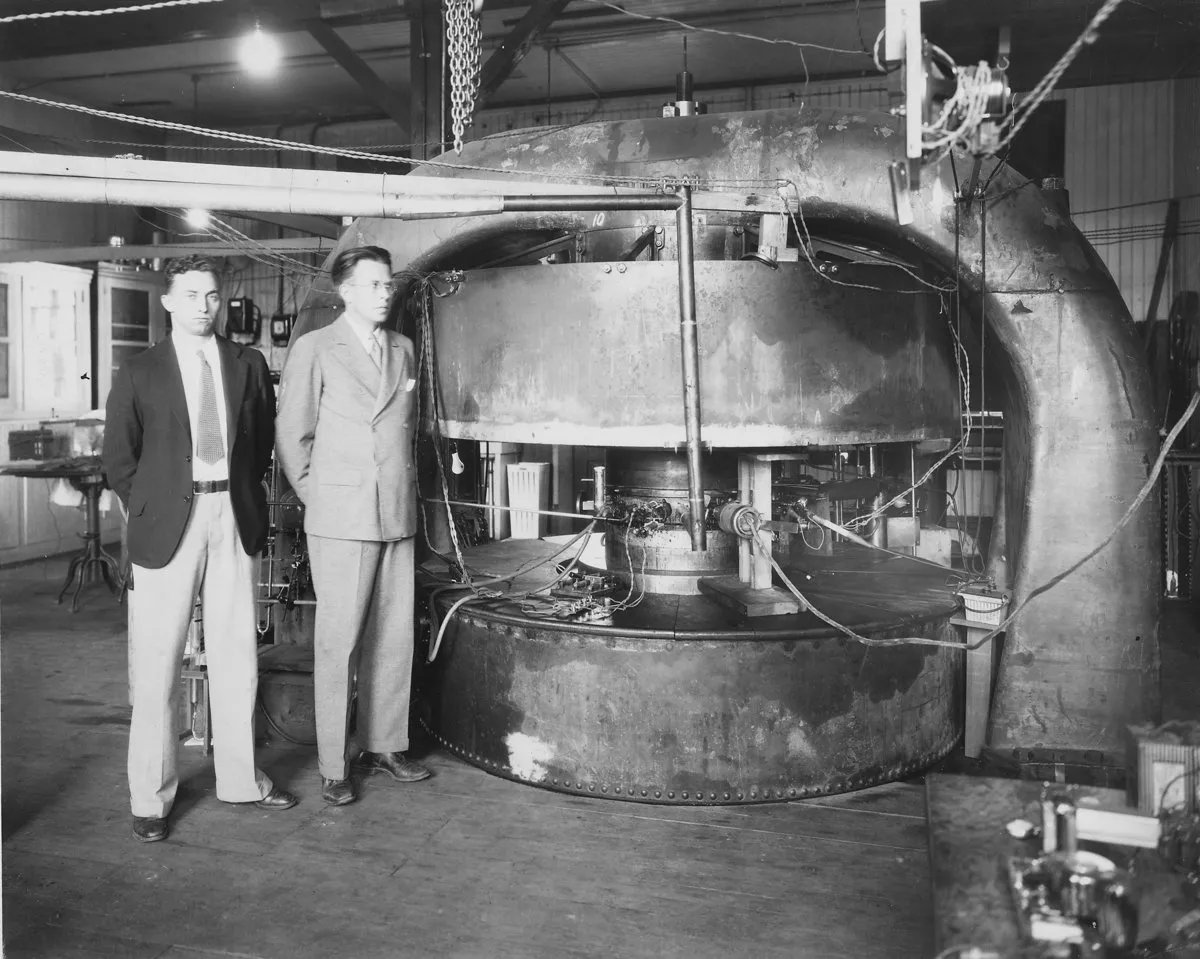
M. Stanley Livingston (left) and Ernest O. Lawrence (right) beside the 27-inch cyclotron at the Berkeley Radiation Laboratory in 1932 (Photo: Lawrence Berkeley National Laboratory / Public Domain).
The Physics of the Cyclotron: Isochronous Resonance and Lorentz Confinement
The operational physics of any circular magnetic accelerator rests upon the unified interplay of electromagnetic fields governed by the Lorentz force:
$$\vec{F} = q \left(\vec{E} + \vec{v} \times \vec{B}\right)$$
In the classic cyclotron, the acceleration chamber is split into two hollow D-shaped metallic electrodes —universally known as «dees»— separated by a narrow central accelerating gap and immersed in a uniform perpendicular static magnetic field $\vec{B}$.
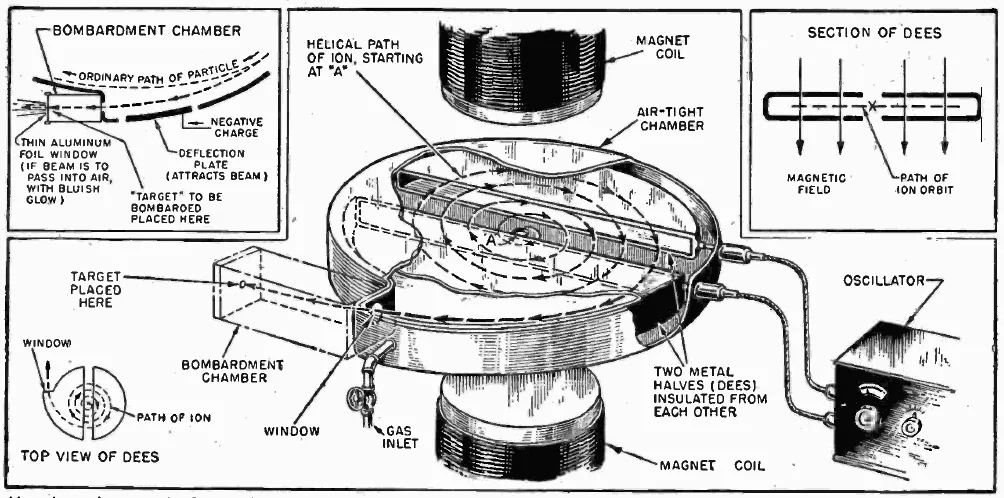
Diagram of the cyclotron: spiral trajectory of charged ions confined by magnetic field B between hollow D-electrodes connected to a radiofrequency oscillator (Diagram: Wikimedia Commons / CC BY-SA 3.0).
When a particle of electric charge $q$ and mass $m$ enters the field-free interior of a dee with velocity $v$, the perpendicular magnetic field performs no work but imparts a pure centripetal acceleration, bending the particle into a circular arc of radius $r$:
$$q v B = \frac{m v^2}{r} \implies r = \frac{m v}{q B} = \frac{p}{q B}$$
where $p$ denotes the particle’s linear momentum. The time required to complete each half-turn within a dee is strictly the ratio between semicircular path length and speed: $t_{1/2} = \frac{\pi r}{v} = \frac{\pi m}{q B}$.
From this simple relationship springs the marvel of classical isochronous resonance: the angular orbital frequency, termed the cyclotron frequency $\omega_c$, is completely independent of both orbital radius and particle kinetic energy:
$$\omega_c = \frac{q B}{m} \quad \implies \quad f_c = \frac{q B}{2\pi m}$$
As the ion accelerates each time it crosses the gap under the alternating electric field $\vec{E}$, its orbit describes ever-widening semicircles, yet it takes precisely the same duration to complete each half-turn. Tuning the radiofrequency oscillator to match $f_c$ guarantees that the particle receives an accelerating impulse in perfect rhythm at every gap crossing.
By the mid-twentieth century, however, this classical harmony hit an insurmountable wall. As particles approach speeds comparable to that of light $c$, the rising Lorentz factor $\gamma = 1/\sqrt{1 - v^2/c^2}$ increases their effective inertial mass ($m = \gamma m_0$), causing the orbital frequency to drop ($\omega_c = qB/\gamma m_0$) and throwing the beam out of phase with the oscillating electric field. Worse still, classical electrodynamics warned that any charged particle undergoing centripetal acceleration would radiate energy away into the vacuum as electromagnetic waves. To surpass the gigaelectronvolt threshold, the physics of beam confinement had to be reinvented.
The Birth of the Synchrotron: Phase Stability and Strong Focusing (1944–1952)
The answer to the relativistic crisis of the cyclotron was the synchrotron, whose name derives from classical Greek σύν (syn, “together” or “in unison”) and χρόνος (chronos, “time”). Instead of spiraling outward between massive solid magnet poles, the synchrotron confines particles within a fixed-radius tubular ring, ramping the guiding magnetic field upward and modulating the radiofrequency in unison with the beam’s rising energy.
For circular confinement of relativistic particles to be viable, a mathematical mechanism of self-correcting synchronism was required, formulated independently in 1944–1945 on both sides of the geopolitical divide by two extraordinary minds:
-
Vladimir Iosifovich Veksler (Владимир Иосифович Векслер) (a pioneer who formulated the phase stability principle to overcome the relativistic ceiling of cyclic accelerators): Born on March 4, 1907 in Zhytomyr, Russian Empire (modern-day Ukraine), Veksler endured an early childhood marked by the loss of his father and the severe hardships of the Russian Civil War. Raised in an educational commune for orphaned children in Moscow, he began his working life as an apprentice electrician in an electrical installation facility. His fierce intellectual drive led him to graduate from the Moscow Power Engineering Institute (MEI) in 1931 and join the prestigious Lebedev Physical Institute of the Academy of Sciences (FIAN). In 1944, Veksler formulated the seminal principle of phase stability (in Russian: принцип автофазировки, printsip avtofazirovki), demonstrating that by modulating the radiofrequency electric field or the guiding magnetic field, lagging particles receive a larger acceleration kick than leading ones, ensuring collective orbital stability.
-
Edwin Mattison McMillan (a Nobel laureate who independently conceived orbital synchronization and formally christened the synchrotron architecture): Born on September 18, 1907 in Redondo Beach, California, McMillan was raised in Pasadena within an educated household: the son of respected physician Edwin Harbaugh McMillan and Anna Marie Mattison. Formed rigorously at Caltech (where he earned his bachelor’s and master’s degrees) and obtaining his doctorate in physics from Princeton University in 1932 under Edward Condon, McMillan joined Ernest Lawrence’s Radiation Laboratory at Berkeley. In 1940, he co-discovered neptunium alongside Philip Abelson —an achievement that earned him the 1951 Nobel Prize in Chemistry shared with Glenn Seaborg—. In September 1945, unaware of Soviet physics papers due to wartime censorship, McMillan independently conceived the principle of phase stability and proposed the canonical name synchrotron.
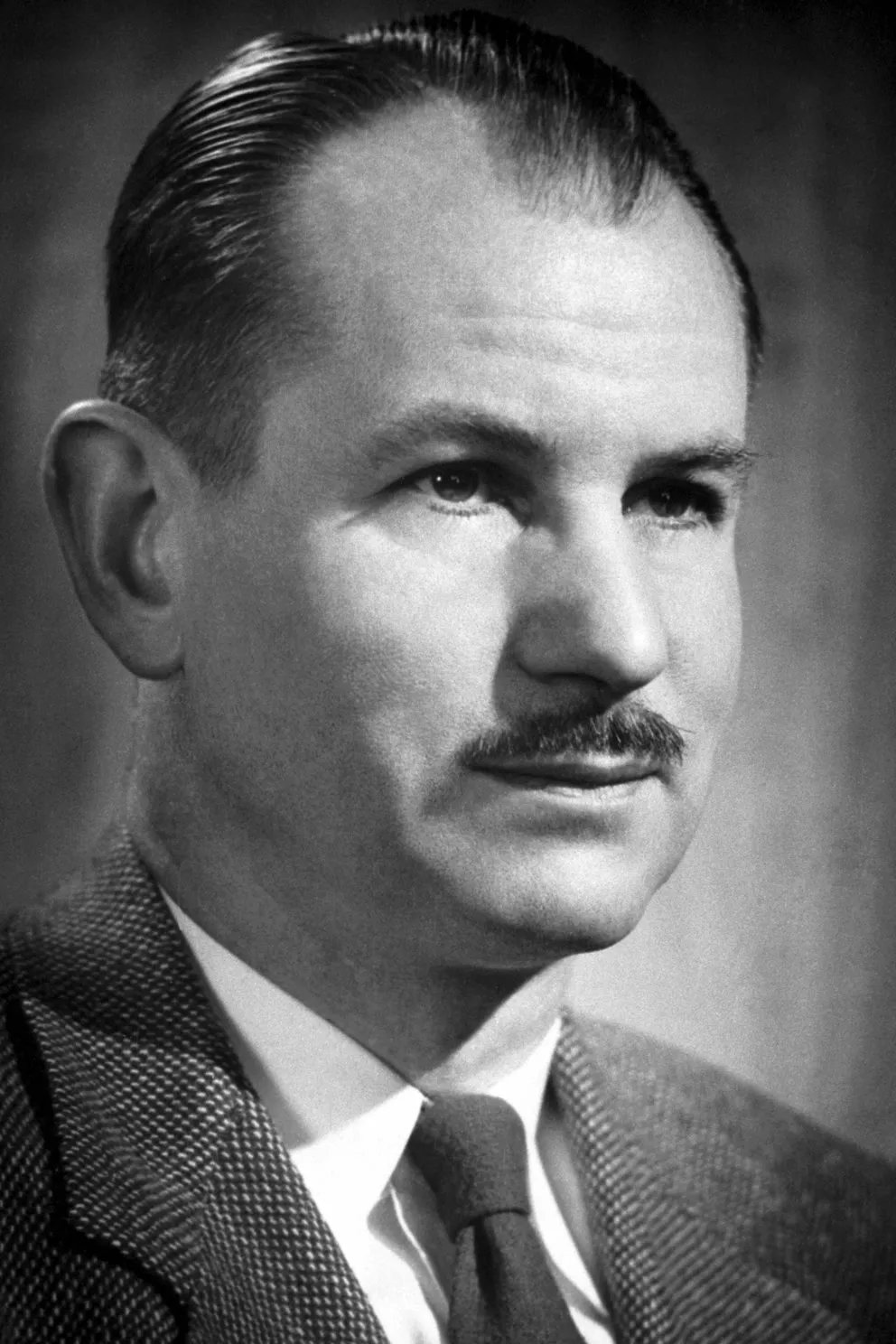
Edwin Mattison McMillan (1907–1991), co-discoverer of the phase stability principle and neptunium, photographed in the 1950s (Photo: Berkeley Lab Archives / Public Domain).
Both scientists, whose intellectual generosity transcended Cold War boundaries by openly acknowledging each other’s priority, jointly shared the Atoms for Peace Award in 1963. Yet early multi-GeV synchrotrons faced impending engineering bankruptcy: dipole magnets had to enclose vacuum chambers over a meter wide to prevent the beam from dispersing through betatron oscillations.
The decisive leap that made kilometer-scale rings feasible was the invention of strong focusing (alternating-gradient focusing), proposed by Greek-American inventor Nicholas Christofilos in 1950 and formalized independently in 1952 by Ernest Courant, M. Stanley Livingston, and Hartland Snyder at Brookhaven National Laboratory. Exploiting the optical principle that an alternating sequence of converging and diverging lenses of equal power produces net positive focusing along both axes ($F-D-F-D$), quadrupole electromagnets with magnetic polarity rotated $90^\circ$ were interleaved along the ring. Transverse beam dispersion shrank from meters to millimeters, slimming down vacuum pipes and opening two grand avenues for modern physics: matter colliders and synchrotron light factories.
First Branch: Subatomic Colliders and CERN’s Subterranean Cathedral
For decades, high-energy experiments relied on firing a beam accelerated inside a synchrotron against a stationary target (fixed-target experiment). In relativistic kinematics, however, striking a stationary target of mass $m$ with a projectile of laboratory energy $E_{\text{lab}}$ incurs a severe penalty imposed by four-momentum conservation (the Mandelstam invariant $s$):
$$E_{\text{cm}} = \sqrt{s} = \sqrt{2 m c^2 E_{\text{lab}} + 2 (m c^2)^2} \approx \sqrt{2 m c^2 E_{\text{lab}}}$$
The energy available in the center of mass to create new particles scales only with the square root of the incident beam energy: a $7\text{ TeV}$ proton beam striking a fixed hydrogen target yields barely $\approx 115\text{ GeV}$ of useful energy, wasting the rest in forward system recoil. In 1961, Austrian physicist Bruno Touschek proposed at Frascati (Italy) colliding two counter-rotating beams head-on. In a symmetric head-on collider, net spatial momentum vanishes and the entire energy of both beams transforms into pure mass following Einstein’s equivalence ($E = mc^2$):
$$E_{\text{cm}} = 2 E_{\text{beam}} = 14\text{ TeV}$$
The zenith of this branch is CERN’s Large Hadron Collider (LHC), a collider synchrotron housed inside a 27-kilometer circular tunnel bored one hundred meters beneath the Franco-Swiss countryside between the Jura mountains and the Alps.
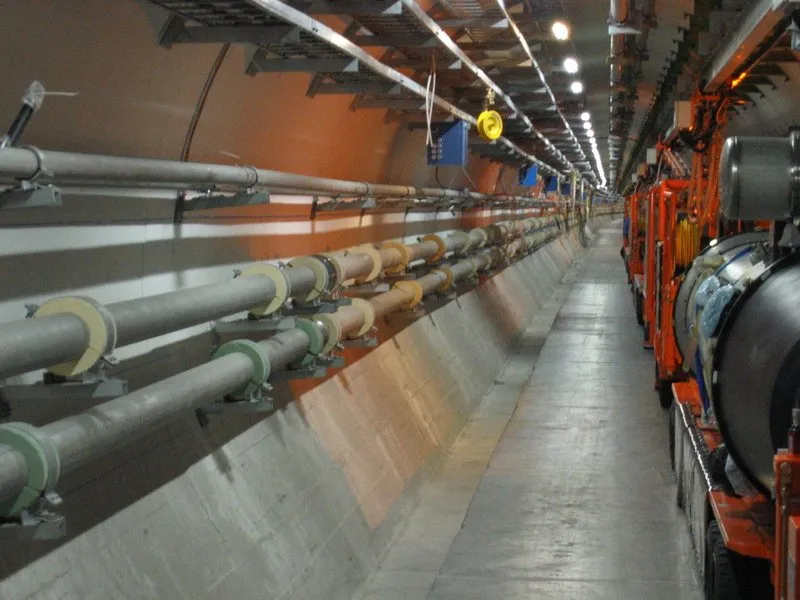
The 27-km circular tunnel of the Large Hadron Collider (LHC) at CERN, showing the distinctive blue superconducting cryostats housing the dipole magnets (Photo: CERN / Julian Herzog / CC BY-SA 3.0).
To steer proton beams at a record collision energy of $13.6\text{ TeV}$, the LHC operates under conditions that challenge the extremes of the universe:
- Extreme Cryogenics: 1,232 superconducting niobium-titanium (Nb-Ti) dipole magnets, each 15 meters long, operate bathed in superfluid helium at $1.9\text{ K}$ ($-271.3^\circ\text{C}$), colder than the cosmic microwave background of deep space ($2.7\text{ K}$).
- Titanic Magnetic Fields: The magnets carry lossless currents of nearly 12,000 amperes, generating $8.33\text{ Tesla}$ magnetic fields to bend protons hurtling at $99.9999991%$ of the speed of light.
- Ultra-High Vacuum and the Higgs Boson: Inside dual pipes kept at $10^{-10}\text{ mbar}$ ($10^{-13}\text{ atm}$), protons collide one billion times per second within the ATLAS, CMS, ALICE, and LHCb detectors, where on July 4, 2012 humanity confirmed the Higgs boson, predicted in 1964 by Peter Higgs and François Englert.
Second Branch: The Schenectady Flash and the Physics of Synchrotron Light
While particle physicists pursued ever-higher collision energies, a radiative energy loss initially viewed as a thermodynamic nuisance gave birth to the second great accelerator revolution. On April 24, 1947, physicists Herbert Pollock, Robert Langmuir, Frank Elder, and Anatole Gurewitsch were testing a $70\text{ MeV}$ electron synchrotron at the General Electric Research Laboratory in Schenectady, New York.
The machine incorporated an evacuated torus crafted from transparent quartz glass instead of opaque ceramic shielding. During a test run, technician Floyd Haber, stationed behind a concrete barrier wall and using a small handheld mirror to check for high-voltage arcing, spotted in amazement a brilliant arc of blue-white light gleaming inside the vacuum chamber.
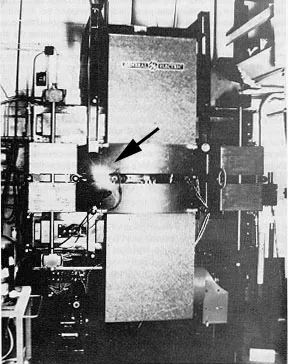
First direct visual observation of synchrotron radiation on April 24, 1947 at General Electric’s 70 MeV synchrotron in Schenectady, viewed through the transparent quartz tube (Photo: General Electric Research Laboratory / LBNL Archives / Public Domain).
What Floyd Haber witnessed was the direct optical signature of synchrotron radiation, analytically predicted by Alfred-Marie Liénard in 1898 and formalized by Julian Schwinger. When an electron of rest mass $m_e$ and charge $e$ circulates inside a modern storage ring at a typical energy of $E = 3\text{ GeV}$ ($\beta = v/c \approx 0.999999985$), its Lorentz factor reaches a massive value:
$$\gamma = \frac{E}{m_e c^2} = \frac{1}{\sqrt{1 - \beta^2}} \approx 5870$$
In the electron’s rest frame, centripetal acceleration from the magnets produces a classic toroidal dipole emission. Yet transforming this emission into the laboratory frame via special relativity triggers relativistic beaming: all radiation compresses into an ultra-narrow forward cone aligned tangentially with the orbit, whose angular half-opening $\theta$ is constrained by the reciprocal of $\gamma$:
$$\theta \approx \frac{1}{\gamma} \approx 0.17\text{ milliradians } (0.01^\circ)$$
The total power $P$ radiated by an electron bent along radius $\rho$ obeys the relativistic Liénard formula, and its energy loss per turn ($\Delta E_{\text{turn}} = P \cdot 2\pi\rho/c$) scales fiercely with the fourth power of energy:
$$P = \frac{e^2 c}{6 \pi \varepsilon_0} \frac{\gamma^4}{\rho^2} \quad \implies \quad \Delta E_{\text{turn}} = \frac{e^2}{3 \varepsilon_0 \rho} \gamma^4 \propto \frac{E^4}{\rho}$$
This steep dependence explains why radiofrequency cavities must continually replenish the radiated energy. In return, the emerging light beam possesses a staggering spectral brilliance $B$ —the photon flux $\Phi$ per unit transverse area $\Sigma_x \Sigma_y$, angular divergence $\Sigma_{x’} \Sigma_{y’}$, and $0.1%$ relative spectral bandwidth—:
$$B = \frac{\Phi}{4\pi^2 \Sigma_x \Sigma_y \Sigma_{x’} \Sigma_{y’} \cdot (0.1% \text{ BW})}$$
Whereas a hospital X-ray tube achieves a brilliance of $10^8$ to $10^9$ photons/(s $\cdot$ mm$^2$ $\cdot$ mrad$^2$ $\cdot$ $0.1%$ BW), modern synchrotrons reach $10^{20}$ to $10^{22}$: light up to twelve orders of magnitude brighter, tunable from the infrared to hard X-rays.
Four Generations of Light Rings and Unveiling the Invisible
The evolution of the synchrotron into the ultimate lantern for materials science and structural biology unfolded across four technological generations:
- First Generation (1960s–1970s): Parasitic operation on particle physics colliders (Tantalus in Wisconsin, SPEAR at Stanford, or DORIS in Hamburg), harvesting radiation discarded by nuclear physicists.
- Second Generation (1980s): Dedicated storage rings engineered exclusively to produce synchrotron light via dipole bending magnets (SRS in the United Kingdom and NSLS in Brookhaven).
- Third Generation (1990s–2010s): Incorporation of insertion devices along straight sections: periodic magnetic arrays termed undulators and wigglers whose emissions interfere constructively, multiplying spatial coherence and brilliance (ESRF in Grenoble, APS in Argonne, SPring-8 in Japan, and ALBA in Barcelona).
- Fourth Generation (from 2016): Diffraction-Limited Storage Rings (DLSR) built on Multi-Bend Achromat (MBA) magnetic lattices, crushing horizontal emittance down to tens of picometers-radian to reach the fundamental X-ray diffraction limit.
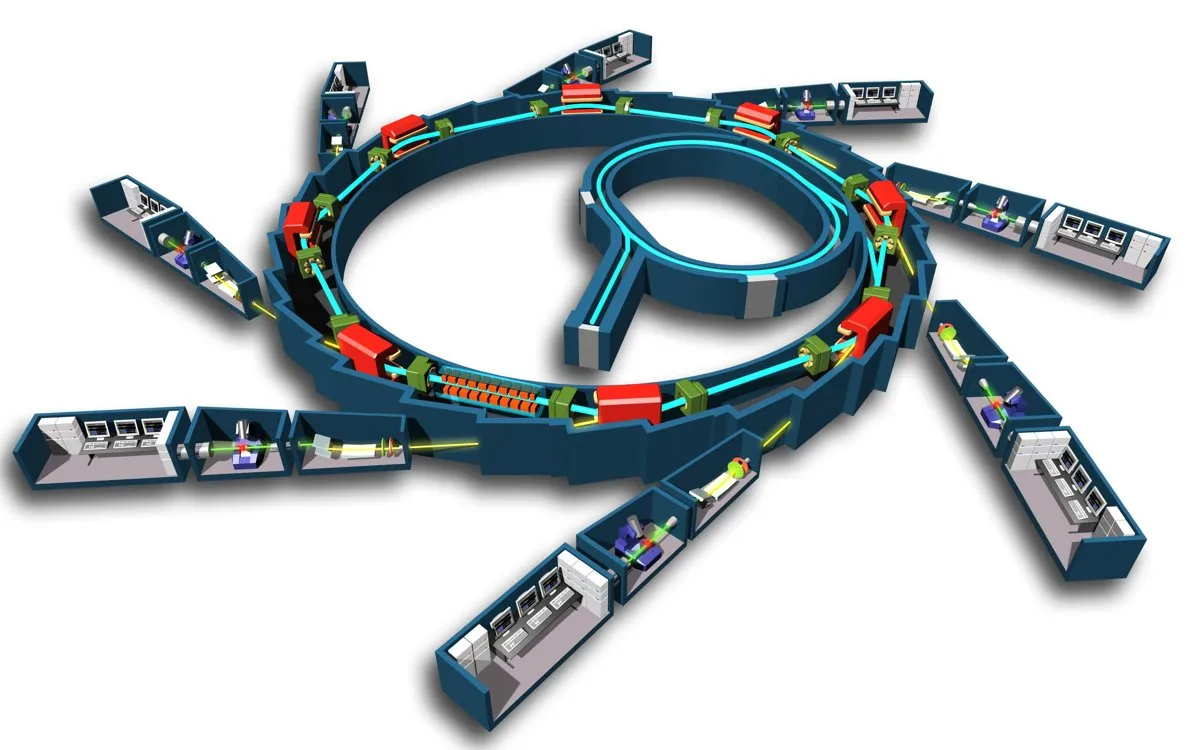
Conceptual diagram of a modern synchrotron light source: electron gun, linear accelerator (linac), booster synchrotron, main storage ring with bending magnets and undulators, and tangential beamlines (Diagram: Wikimedia Commons / CC BY-SA 3.0).
With these sub-micrometer beams, science resolved the atomic structure of the ribosome (2009 Nobel Prize in Chemistry to Ramakrishnan, Steitz, and Yonath), mapped within weeks the main protease ($M^{\text{pro}}$) of the SARS-CoV-2 virus in 2020 to guide the rational design of the antiviral Paxlovid, and read via X-ray phase-contrast tomography the carbonized Herculaneum papyri (buried by Mount Vesuvius in 79 AD) without physically unrolling or destroying them.
Global Geography of the Beam: From the Americas and Ecuador to SESAME
Far from being confined to Western Europe, the contemporary map of particle accelerators traces a vibrant network of technological sovereignty, regional cooperation, and science diplomacy spanning the Americas and the Middle East:
-
North America (From the Tevatron and SLAC to Canada’s TRIUMF): In the United States, three historic complexes shaped the high-energy and photonics frontier: the $3.2\text{ km}$ linear accelerator at Stanford’s SLAC (home to the world’s first hard X-ray free-electron laser, LCLS); Fermilab in Batavia, Illinois (where the Tevatron proton-antiproton collider discovered the top quark in 1995 and which now leads the LBNF/DUNE neutrino program); and Brookhaven National Laboratory in New York (housing the Relativistic Heavy Ion Collider RHIC and the NSLS-II light source). Further north, Canada operates TRIUMF in Vancouver, home to the world’s largest cyclotron (accelerating $\text{H}^-$ ions to $520\text{ MeV}$), and the Canadian Light Source (CLS) synchrotron in Saskatoon.
-
Brazil and the Southern Cone (The Global Milestone of SIRIUS and Argentina’s TANDAR): In Campinas (São Paulo, Brazil), the Brazilian Synchrotron Light Laboratory (LNLS/CNPEM) designed and constructed SIRIUS (successor to the pioneering UVX ring): one of the most advanced fourth-generation synchrotron facilities on the planet. With a 518-meter storage ring, $3\text{ GeV}$ energy, and an ultra-low emittance of $0.25\text{ nm}\cdot\text{rad}$, SIRIUS is the largest and most complex scientific infrastructure in Latin American history, with over $85%$ of its components manufactured by domestic engineering. Meanwhile, Argentina operates the iconic TANDAR electrostatic accelerator (Tándem Argentino, a $20\text{ MV}$ machine of the CNEA housed inside a 73-meter tower in Buenos Aires) for heavy-ion nuclear physics alongside the Argentine Proton Therapy Center (CEARP), while Mexico operates Tandem Van de Graaff and Pelletron accelerators at UNAM.
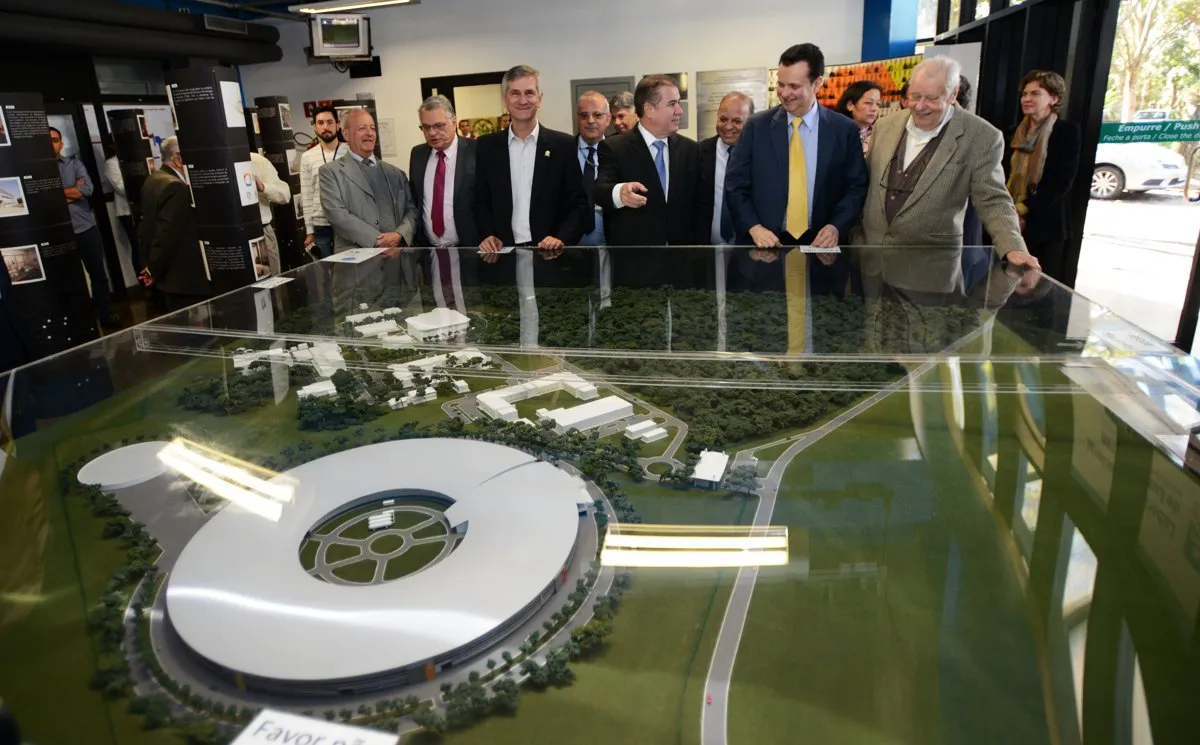
The Sirius particle accelerator and synchrotron light facility at CNPEM in Campinas, Brazil: a triumph of cutting-edge Latin American science (Photo: Carlos Bassan / Wikimedia Commons / Public Domain).
-
Ecuador (Linear Acceleration at EPN, Medical Cyclotrons, and CERN Presence): Ecuador participates actively in accelerator physics and technology across three strategic fronts:
- Research and Industrial Irradiation at EPN: Since April 1990, the Escuela Politécnica Nacional (EPN) has operated in the «Casa Mata» building on its Quito campus (under the Department of Nuclear Sciences with IAEA technical cooperation) a Russian-built ELU-6U linear electron accelerator ($7\text{ MeV}$ nominal energy and $5\text{ kW}$ beam power). Through conveyor-belt irradiation ($2\text{ to } 30\text{ kGy}$), this accelerator has enabled the synthesis of biocompatible hydrogels and artificial skin membranes via radiation-induced polymer cross-linking for burn patients, alongside sterilizing medical supplies, decontaminating agro-industrial products, and treating liquid effluents via radiolysis.
- Medical Cyclotrons and Clinical LINACs (HCAM and SOLCA): In healthcare, the Carlos Andrade Marín Specialty Hospital (HCAM – IESS) in Quito set a milestone in Ecuadorian public health by commissioning its own PET-Cyclotron Unit (complemented by private cyclotrons in Quito and Guayaquil). These cyclotrons accelerate protons to bombard oxygen-18 enriched water via the nuclear reaction $^{18}\text{O}(p,n)^{18}\text{F}$, synthesizing on-site the radiopharmaceutical Fluorine-18 ($^{18}\text{F}$-FDG) essential for Positron Emission Tomography (PET-CT), while dozens of clinical linear accelerators ($6\text{ to } 18\text{ MeV}$ LINACs) treat cancer patients daily across SOLCA centers and public hospitals.
- High-Energy Physics at the LHC: At the fundamental frontier, Ecuadorian physicists and engineers from EPN and the Universidad San Francisco de Quito (USFQ) are official members of the CMS (Compact Muon Solenoid) collaboration at CERN’s LHC.
-
The Middle East (SESAME, the Synchrotron of Peace Under Jordan’s Sun): Thirty kilometers northwest of Amman, in Allan, Jordan, stands one of the most inspiring scientific and humanitarian endeavors of our century: SESAME (Synchrotron-light for Experimental Science and Applications in the Middle East). Established under the auspices of UNESCO following CERN’s post-war reconciliation model and inaugurated in 2017, SESAME is a third-generation $2.5\text{ GeV}$ synchrotron with a $133.2\text{-meter}$ circumference. Around its beamlines, scientists from Cyprus, Egypt, Iran, Israel, Jordan, Pakistan, Palestine, and Türkiye work side by side, proving that the language of photons transcends the planet’s deepest geopolitical divides. Moreover, in 2019 SESAME made history by becoming the world’s first accelerator complex powered $100%$ by renewable solar energy.
The Silent Footprint: Medicine, Industry, and the Plasma Frontiers
Beyond giant international colliders and light rings, beam physics quietly permeates everyday medicine and industry while preparing its next evolutionary leap:
- Hadron Cancer Therapy: While conventional X-ray radiotherapy damages healthy tissue both before and after a tumor, proton and carbon-ion beams exploit the Bragg peak: they deposit nearly all their destructive ionization at a calibrated depth, destroying deep-seated tumors while sparing adjacent vital organs.
- Nuclear Medicine and Radiotracers: Compact hospital cyclotrons operate daily synthesizing ultra-short-lived isotopes, such as Fluorine-18 ($^{18}\text{F}$, $\tau_{1/2} \approx 110\text{ min}$) for Positron Emission Tomography (PET) scans and Technetium-99m for cardiovascular diagnostics.
- Microelectronics and Ion Implantation: The global semiconductor industry relies on low-energy accelerators to dope silicon wafers atom by atom, forging the billions of transistors powering modern computing.
- Plasma Wakefield Frontiers: To surpass the dielectric breakdown limit of metallic radiofrequency cavities ($\sim 50\text{ MV/m}$), plasma wakefield acceleration uses ultra-short laser pulses or particle bunches to excite waves in ionized gas, achieving gradients exceeding $100\text{ GV/m}$ that promise to compress kilometer-long accelerators onto a laboratory tabletop.
A century after Ernest Lawrence sketched the first magnetic spirals at Berkeley and nearly eight decades after Floyd Haber spotted that unexpected blue-white glow in Schenectady, particle accelerators and synchrotrons —from CERN’s Franco-Swiss tunnel and Jordan’s solar-powered plains to Brazil’s SIRIUS ring and the laboratories of Quito— endure as the supreme cathedrals of human ingenuity: instruments where electromagnetism and relativity converge to unveil the cosmos and safeguard human life.
Documentary Sources and Further Reading
- The Nobel Prize: Ernest O. Lawrence – Facts and Nobel Lecture (1939). Royal Swedish Academy of Sciences. nobelprize.org/prizes/physics/1939/summary.
- The Nobel Prize: Edwin M. McMillan – Biographical and Nobel Lecture (1951). Royal Swedish Academy of Sciences. nobelprize.org/prizes/chemistry/1951/mcmillan/biographical.
- Lawrence, E. O. & Livingston, M. S. (1932): The Production of High Speed Light Ions without the Use of High Voltages. Physical Review, 40(1), 19–35. doi.org/10.1103/PhysRev.40.19.
- Elder, F. R., Gurewitsch, A. M., Langmuir, R. V., & Pollock, H. C. (1947): Radiation from Electrons in a Synchrotron. Physical Review, 71(11), 829–830. doi.org/10.1103/PhysRev.71.829.5.
- Courant, E. D., Livingston, M. S., & Snyder, H. S. (1952): The Strong-Focusing Synchrotron — A New High Energy Accelerator. Physical Review, 88(5), 1190–1196. doi.org/10.1103/PhysRev.88.1190.
- CERN: The Large Hadron Collider – Accelerator Complex and Experiments. Official science communication site. home.cern/science/accelerators/large-hadron-collider.
- Lawrence Berkeley National Laboratory (LBNL): Synchrotron Radiation – Characteristics and Capabilities. X-Ray Data Booklet, Section 2.1. xdb.lbl.gov/Section2/Sec_2-1.html.
- The Nobel Prize: The Nobel Prize in Chemistry 2009 – Studies of the Structure and Function of the Ribosome. nobelprize.org/prizes/chemistry/2009/summary.
- Wikipedia (English): Sirius (synchrotron light source). Fourth-generation storage ring in Campinas, Brazil. en.wikipedia.org/wiki/Sirius_(synchrotron_light_source).
- SESAME: Synchrotron-light for Experimental Science and Applications in the Middle East. Allan, Jordan. sesame.org.jo.
- Escuela Politécnica Nacional (EPN): Departamento de Ciencias Nucleares – Electron Accelerator Laboratory. Quito, Ecuador. es.wikipedia.org/wiki/Escuela_Politécnica_Nacional.
- Wikipedia: Acelerador de partículas, Ciclotrón and Sincrotrón. es.wikipedia.org/wiki/Acelerador_de_part%C3%ADculas.
- Wikipedia (English): SESAME (Synchrotron-Light in the Middle East) & Vladimir Veksler. en.wikipedia.org/wiki/Synchrotron-Light_for_Experimental_Science_and_Applications_in_the_Middle_East.