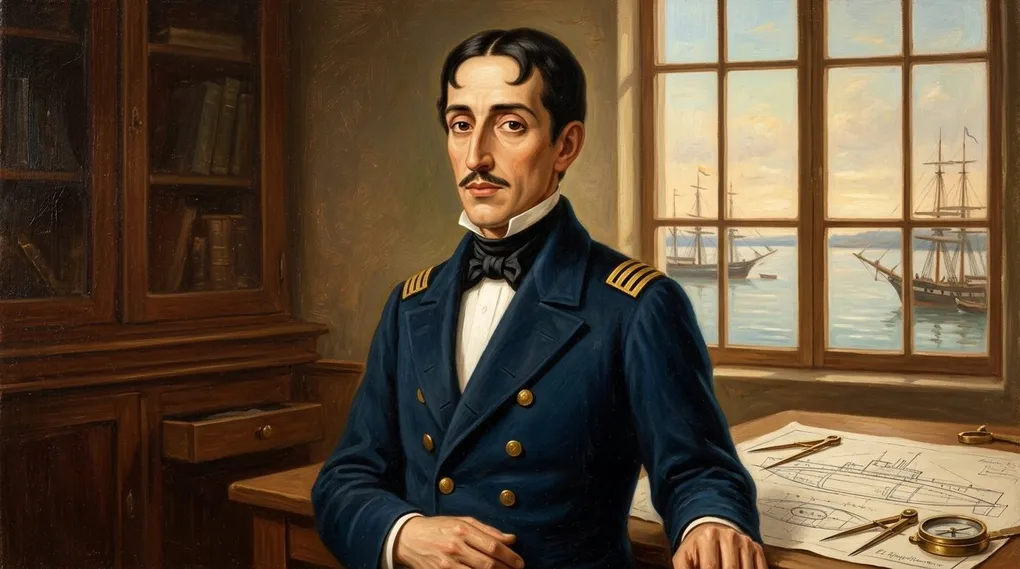
José Rodríguez Labandera: The Inventor of Latin America’s First Submarine
Table of contents9›
In my readings on the history of technology and science in the Americas, I have always been fascinated by how applied ingenuity had to forge its path amid material scarcity and the institutional instability of fledgling nineteenth-century republics. Few biographies capture this perseverance with such eloquence as that of José Raimundo Rodríguez Labandera (admired for his inventive audacity in conceiving, constructing, and successfully piloting the first operational submarine tested in Latin America). Long before undersea navigation was standardized by the navies of major industrial powers, this Guayaquil naval officer and mechanical artisan defied the mighty currents of the Guayas River sealed within a caulked wooden vessel born entirely of his own vision.
Family Origins and Training at the Nautical School of Guayaquil
José Raimundo Rodríguez Labandera was born in Guayaquil between 1805 and 1806, in the twilight years of Spanish colonial rule under the Real Audiencia de Quito. Born into a family of modest economic means without inherited status or fortune, he grew up in the bustling riverine port of the Guayas, where riverside shipwright yards, artisan iron foundries, the scent of pine pitch, and the continuous movement of sailing craft defined urban daily life.
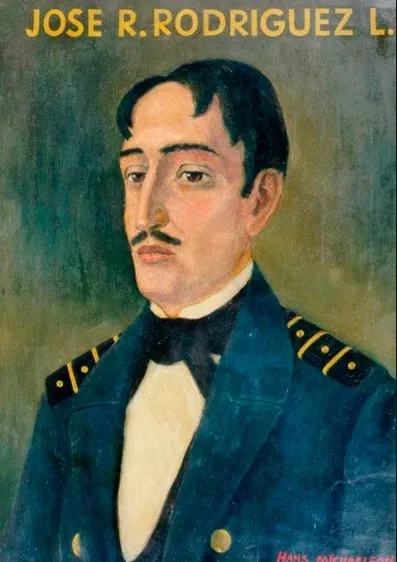 Oil portrait of José Raimundo Rodríguez Labandera (work by painter Hans Michaelson, preserved by the Historical Naval Museum of the Ecuadorian Navy).
Rather than resigning himself to routine empirical trades, Rodríguez Labandera harnessed his aptitude for exact sciences and mechanics by seizing the educational opportunities ushered in by independence:
- Admission to the Nautical School (1823): He was one of the founding cadets at the renowned Nautical School of Guayaquil, established on October 9, 1822, by the British-born naval hero General Juan Illingworth Hunt.
- Rigorous Scientific Instruction: Under the direction of Colonel Domingo Agustín Gómez, he received methodical instruction in advanced arithmetic, descriptive geometry, hydrostatics, nautical kinematics, experimental physics, and cosmography, acquiring the solid theoretical foundations that would underpin his mechanical creations.
- Naval Service in Gran Colombia: In 1827, he entered active naval service as a midshipman in the Gran Colombian navy under officers such as Illingworth and Thomas Charles Wright, rising by 1830 to the rank of Lieutenant of Frigate (Teniente de Fragata).
A Prolific Inventor: Automata, Typography Casting, and El Patriota
Before directing his focus to undersea navigation, Rodríguez Labandera displayed remarkable mechanical versatility across diverse domains:
- Automata and Microkinematics: In his mid-twenties, he constructed mechanical toys and articulated figures capable of reproducing the lifelike gait and natural motions of animal limbs, alongside a crankshaft-driven mechanical piano and self-propelled miniature nautical models.
- Type-Casting Foundry Machine (1831): Confronted with the severe shortage of movable type in the region, he designed and cast a mechanical apparatus to produce lead type for printing presses. Following a technical inspection commissioned by the Guayaquil Cantonal Council, municipal authorities praised his craftsmanship and appointed him Administrator of the Municipal Printing Office on January 2, 1832.
- Independent Publishing: Only ten days later, he resigned after a municipal merger of public printing facilities to establish his own independent periodical, El Patriota, a venture that demonstrated his civic spirit despite its brief run in a limited local readership market.
The Genesis of «El Hipopótamo»: From Lima to the Shores of Durán
Attentive to reports of early attempts at underwater navigation —such as the pioneer trials of the American David Bushnell with the Turtle (1775) and Robert Fulton with the Nautilus (1800)—, Rodríguez Labandera conceived his project not merely as a scientific novelty or laboratory curiosity, but as an offensive naval warship capable of navigating submerged between two waters («buque de guerra que navega entre dos aguas»). Its primary tactical purpose was coastal defense and covertly breaking hostile naval blockades: allowing a small, resolute crew to approach anchored enemy frigates stealthily to bore holes into their hulls or plant explosive charges beneath the waterline.
In 1837, Rodríguez Labandera travelled to Lima during the height of the Peru-Bolivian Confederation presided over by Marshal Andrés de Santa Cruz. On July 7, 1837, he formally presented detailed blueprints and a working scale model of his armed submersible to the Peruvian government. While authorities issued him an official construction license praising the ingenuity of the concept, they refused to disburse any state treasury funds («without granting him a single calé», as period chroniclers noted).
Convinced of the technical viability of his design, Rodríguez Labandera returned to Guayaquil determined to build the vessel with community backing. Through the pages of the independent local newspaper El Ecuatoriano del Guayas, he launched a civic public subscription explaining the strategic and commercial benefits that a functional submarine would bring to the maritime hub. With modest capital gathered from local artisans, merchants, and mariners, he set up his improvised slipway on the river beach of Durán (on the eastern bank of the Guayas River, opposite Isla Santay and the city waterfront), completing the hull in July 1838.
Technical Architecture of «El Hipopótamo»
Rodríguez Labandera christened his submarine «El Hipopótamo» (The Hippopotamus), drawing upon the ancient Greek compound noun ἱπποπόταμος (hippopótamos, from ἵππος, híppos [“horse”] and ποταμός, potamós [“river”]). The metaphor was fitting: like the powerful semi-aquatic mammal that traverses riverbeds submerged while keeping only its breathing orifices and eyes exposed above the waterline, his vessel would travel beneath the current with only its snorkel and mast breaking the surface.
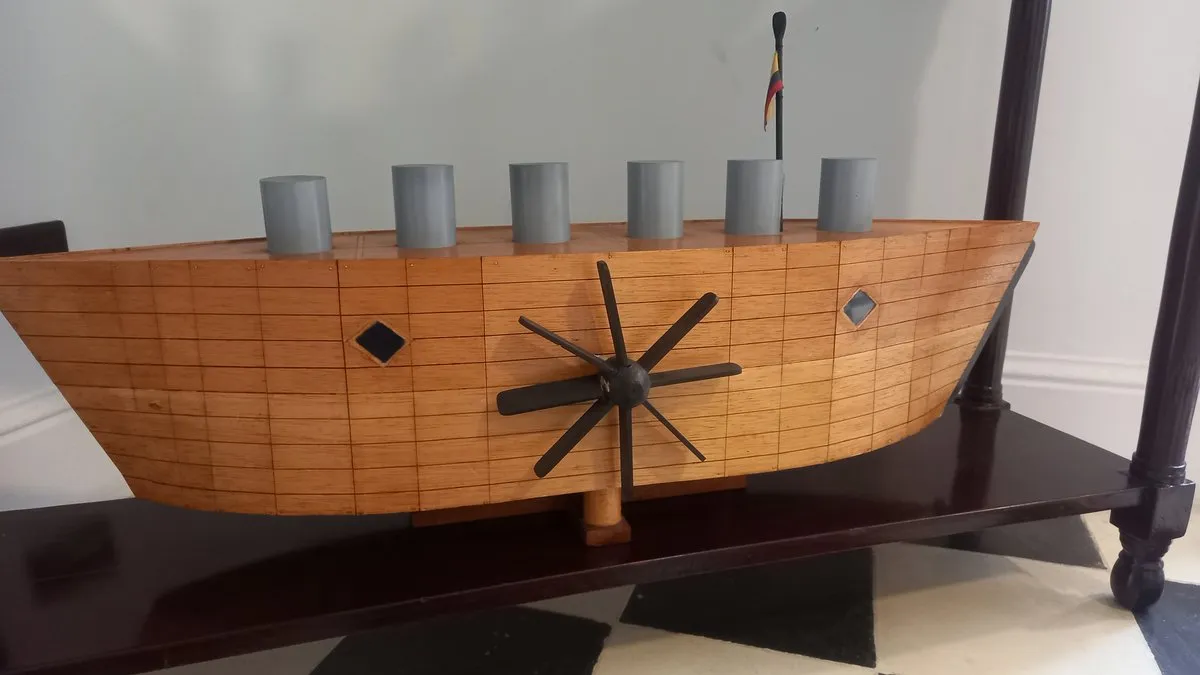 Scale model of «El Hipopótamo», displaying the paddle wheel, breathing snorkel tubes, and mast bearing the national colors (Naval Museum Admiral Juan Illingworth, Guayaquil).
For the technological context of South America in 1838, the submersible represented a masterpiece of empirical naval craftsmanship:
- Timber Selection and Riverside Carpentry: The hull was shaped into a barrel-like fusiform geometry using frames and planking of guachapelí (Pseudosamanea guachapele) and mountain oak (roble de montaña). Celebrated since colonial times in the Royal Dockyards of Guayaquil (Reales Astilleros de Guayaquil), these coastal hardwoods provided outstanding structural elasticity, impact resistance, and natural resins that withstood brackish estuarine conditions.
- Watertight Integrity and Leather Gland Seals: Seams between hull planks underwent double caulking with tarred oakum and a thick sealant of vegetable pine pitch (pix navalis) and natural bitumen. Mobile shaft passages (prensaestopas) for the pedal drivetrain, paddle wheels, and rudder linkages were encased in sleeves of heavy animal hide saturated in tallow and beeswax grease, holding back hydrostatic pressure without seizing mechanical rotation.
- Antifouling Protection: The underbody of the hull was coated with a protective formulation to safeguard the wood from the destructive wood-boring shipworm (Teredo navalis, locally known as la broma), an endemic and aggressive pest in the warm Guayas estuary.
- Hydrostatics and Archimedes’ Principle: Strictly governed by the laws of equilibrium of floating bodies discovered by Archimedes of Syracuse («De corporibus fluitantibus»), immersion was controlled through lower ballast tanks. These were flooded at will by opening sea-cocks and floor valves to equalize total mass with buoyant water displacement ($\rho_{\text{fluid}} V_{\text{sub}} = M_{\text{total}}$). To resurface, the crew operated manual piston force pumps that expelled the confined river water back overboard, restoring positive buoyancy.
- Drivetrain and Hybrid Propulsion: Propulsion power was provided entirely by the two submariners through an articulated arrangement of pedals, connecting rods, and crankshafts. This drivetrain drove a central Archimedean helical screw propeller at the stern alongside two auxiliary paddle wheels/oars mounted on the port and starboard sides, stabilized by flywheels to smooth the cadence of human muscle output.
- The Breathing Snorkel and the «Boca de Fuego»: To ensure an uninterrupted oxygen supply within the sealed cabin without having to surface, Rodríguez Labandera devised a pioneering breathing conduit—decades before the German term Schnorchel became universally adopted in submarine warfare. The vertical tube projected barely above the water surface, protected at its summit by an artillery housing. The original report in El Ecuatoriano del Guayas (Issue No. 237, Friday, September 21, 1838) described it with remarkable fidelity:
«…and following it with fixed gaze upon a small tube, which remained very slightly out of the water and imperceptible to the naked eye at an ordinary distance; said tube was sheltered behind a muzzle/gun-casing [«boca de fuego»] in which was placed the staff of the national flag, fluttering beautifully in the passing breeze».
This «boca de fuego» (ordnance muzzle/housing) not only protected the air intake from river chop and supported the national colors, but also reflected Rodríguez Labandera’s offensive combat design, serving as an armored mounting or embrasure for prospective explosive ordnance.
The Historic Dive of September 18, 1838
On September 17, 1838, Rodríguez Labandera personally distributed printed invitation cards summoning civil authorities, naval officers, and citizens to the Guayas riverfront to witness the maiden operational trial scheduled for the following day.
On September 18, in the afternoon, thousands gathered along the Guayaquil malecón and riverbanks. Expectant spectators crowded into canoes, rowboats, and skiffs to follow the operation from the water. The reviewing party was presided over by the Governor of Guayas Province, General Vicente González, accompanied by senior naval and garrison officers and reporters from the local press.
Joined by helmsman and seaman José Quevedo, Rodríguez Labandera boarded El Hipopótamo on the Durán shore, near Isla Santay. After tightly dogging down the upper access hatch and opening the ballast cocks, the submarine slipped beneath the turbid, silt-laden waters of the Guayas River.
During the submerged crossing, onlookers on the riverbanks and in escort boats tracked the submarine’s course exclusively by following the small Ecuadorian tricolor pennant gliding across the water like an apparition. The vessel navigated submerged for an estimated distance of 12 city blocks (roughly 1.2 kilometers) in a direct line toward the Guayaquil pier.
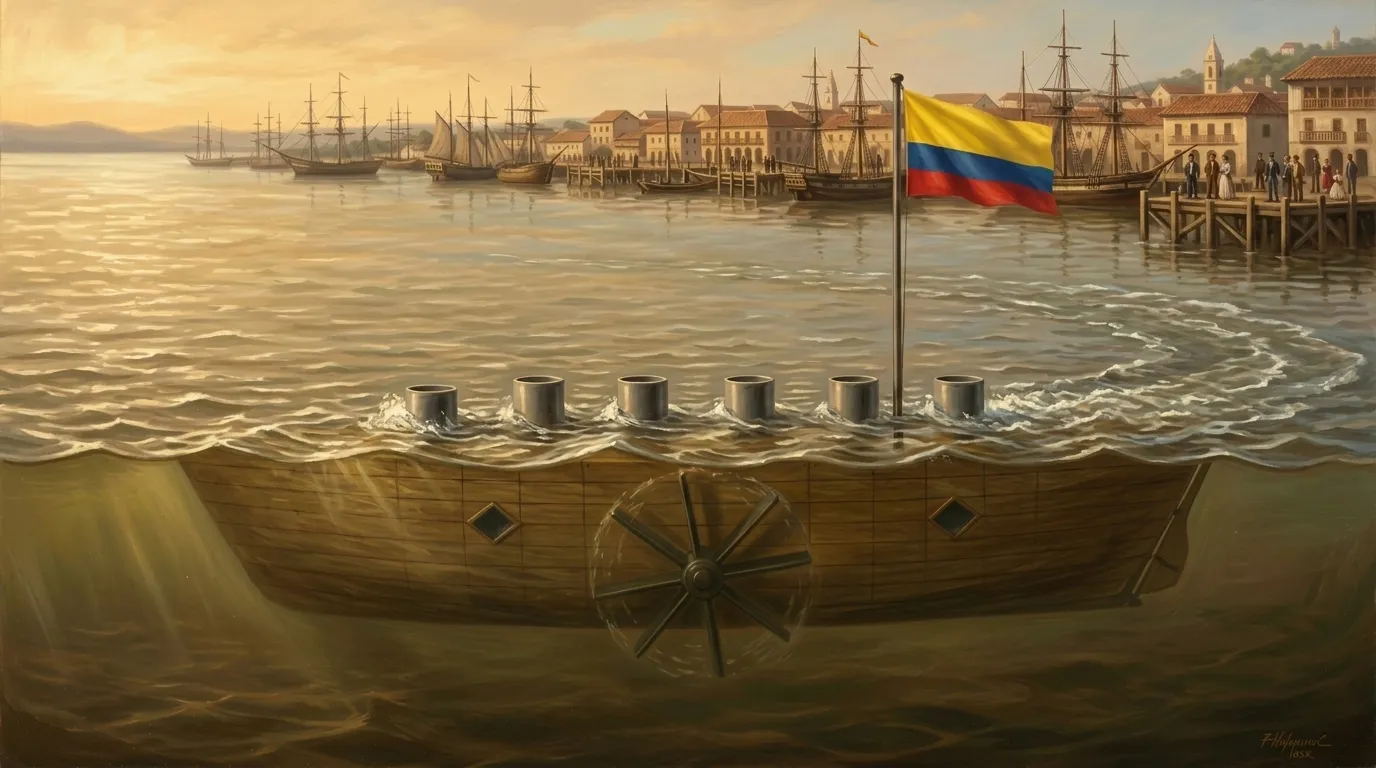 Artistic recreation of «El Hipopótamo» navigating submerged in the waters of the Guayas River (September 18, 1838), with the hull immersed and the snorkel flying the authentic period national tricolor pennant before the Guayaquil waterfront.
However, two formidable challenges emerged during the voyage: the swift estuarine tidal currents of the Guayas—which readily exceed 4 knots (over 7 km/h) during tidal changes—and the extreme mechanical stress placed upon the propulsion train. Under vigorous pedaling, one of the paddle wheels fractured due to material fatigue, halving manual propulsion power just as the outgoing ebb tide threatened to drag the craft downstream toward the gulf. As dusk approached and to ensure the crew’s safety, Governor González dispatched escort boats to secure tow lines to the submarine and guide it the final yards to the pier, arriving safely at quarter past six in the evening (6:15 PM).
General Vicente González documented the milestone in his official gubernatorial report:
«Yesterday, the entire citizenry of Guayaquil was assembled in eager expectation… we witnessed its departure from the coast and its passage of approximately twelve city blocks in an unwavering course toward the city; but its progress was slow due to the violent current, night was drawing near, and we felt apprehensions for those aboard, owing among other reasons to the state of the tide, on the verge of turning, which moved us to tow El Hipopótamo so that this maiden operation would not be compromised and the townsfolk could witness its arrival at the pier. This took place at a quarter past six in the evening… Had the hour and the tide permitted, and had one of the oars not failed due to structural weakness, the inventor would have arrived under his own power, heightening public admiration and the merit of his labors».
From the standpoint of naval engineering, the trial was an undeniable triumph: the caulked timber hull endured hydrostatic depth without a single drop of leakage, the snorkel supplied fresh atmospheric air without asphyxiation, and both submariners disembarked unhurt amid public jubilation.
Second Trial and the Fate of the Prototype
Undeterred by the propulsion mishap, Rodríguez Labandera repaired the paddle mechanism, reinforced the rudder joints, and carried out two subsequent submerged trials in the Guayas River. However, during the final trial in December 1838, treacherous cross-currents caused the vessel to ground upon the mudflats along the Durán shoreline.
Deprived of financial patronage from the national government—whose limited treasury was exhausted by internal factional wars and caudillista uprisings—and lacking commercial partners able to grasp the military potential of submarine warfare, the inventor was forced to abandon further operations. The hull of El Hipopótamo remained beached upon the shores of Durán, where tropical rains, tidal floods, and the equatorial sun gradually dismantled its seasoned guachapelí timbers.
Further Innovations: From Agronomy to Biomechanics
With steadfast resilience, Rodríguez Labandera returned to his private mechanical workshop, directing his inventive problem-solving toward pressing societal and economic needs:
- Mechanized Toquilla Straw Weaving Machine (1844): To boost the regional production of toquilla straw hats (Carludovica palmata, internationally celebrated as Panama hats), he designed and constructed a machine to mechanize the weaving of plant fibers, presenting a machine-woven hat to the national government to demonstrate how industrial efficiency could supersede slow manual handcraft.
- Biomechanical Articulated Prosthetic Leg (1845): At the personal request of General Juan Illingworth Hunt, Rodríguez Labandera engineered an advanced artificial limb crafted from seasoned hardwood and fitted with articulated metal hinges and tension springs for Colonel José María Vallejo Mendoza, an independence war veteran who had lost his lower leg to grapeshot during the Battle of La Elvira in the March Revolution (Revolución Marcista, March 1845). Following a rigorous clinical inspection, the eminent surgeon and chief medical officer, Colonel Dr. Juan Bautista Destruge, publicly lauded the anatomical precision and kinetic mobility of the design. The biomechanical prosthesis enabled Colonel Vallejo to ride horses and resume active frontline military command for two more decades, culminating in the naval Battle of Jambelí in 1865.
Place in Universal Naval History
José Raimundo Rodríguez Labandera died in Guayaquil on November 17, 1869, in modest financial circumstances and without receiving the enduring institutional patronage his vision warranted.
Yet historical analysis of universal naval technology firmly restores El Hipopótamo to its rightful pioneer stature. As documented in studies by the Royal Spanish Naval League and the journal Ingeniería Naval (Madrid, 2012), Rodríguez Labandera’s submersible occupies an undisputed vanguard position in world maritime history:
| Year | Submersible | Inventor | Nation / Theater | Hull Material / Propulsion |
|---|---|---|---|---|
| 1775-1776 | Turtle | David Bushnell | United States | Timber / Hand crank (1 crewman) |
| 1800-1801 | Nautilus | Robert Fulton | France / USA | Copper and iron / Hand crank & surface sail |
| 1838 | «El Hipopótamo» | José Rodríguez Labandera | Ecuador (Guayas River) | Guachapelí timber / Pedals, paddles & screw propeller (2 crewmen) |
| 1850 | Brandtaucher | Wilhelm Bauer | Germany (Kiel) | Iron / Human treadmill |
| 1859 | Ictíneo I | Narciso Monturiol | Spain (Barcelona) | Timber / Manual cranks |
| 1860 | Garcibuzo | Cosme García | Spain (Alicante) | Wrought iron / Manual cranks |
| 1863 | H. L. Hunley | Horace Lawson Hunley | United States (Confederacy) | Iron boiler / Hand-turned crankshaft (8 crewmen) |
| 1866 | Flach | Karl Flach | Chile (Valparaíso) | Iron plates / Pedals and cranks |
In the chronological progression of naval engineering, El Hipopótamo stands as the third functional submarine successfully tested in world history, and the first in the history of Latin America and the entire Southern Hemisphere. Conceived more than twenty years ahead of Monturiol’s and García’s European submersibles, it demonstrated that native Ecuadorian timber, coupled with rigorous mastery of Newtonian physics and hydrostatics, could conquer the mystery of the ocean depths.
Today, the Submarine School of the Ecuadorian Navy (Escuela de Submarinos de la Armada del Ecuador) and the Naval Museum Admiral Juan Illingworth in Guayaquil honor his memory as the founder of the nation’s submarine arm.
References and Historical Documentation
- El Ecuatoriano del Guayas (1838): Issue No. 237, Friday, September 21, 1838. Contemporary news chronicle recording the maiden dive and submerged crossing of the submarine «El Hipopótamo» in the Guayas River, detailing the snorkel tube and gun-casing mounting.
- General Vicente González (1838): Official Report of the Governor of Guayas Province on the Trials of the Submersible El Hipopótamo. Preserved and published by the Maritime History Institute of Ecuador (INHIMA).
- Rodolfo Pérez Pimentel: Biographical Dictionary of Ecuador: José Raimundo Rodríguez Labandera. Biographical record documenting his nautical education, mechanical inventions, and the 1845 biomechanical prosthesis. Article on rodolfoperezpimentel.com.
- Jorge León T. (2017): El submarino, invención ecuatoriana. Revista Mundo Diners. Historical examination of Guayaquil’s shipyard crafts and the 1838 river crossing. Article on revistamundodiners.com.
- Kléver Antonio Bravo (2020): El Hipopótamo. Diario El Telégrafo (Guayaquil Bicentenario). Historical analysis of Rodríguez Labandera’s formation at the 1823 Nautical School and global chronology of early submarines. Article on eltelegrafo.com.ec.
- Jorge Martillo Monserrate (2011): José Rodríguez Labandera y su submarino, El Hipopótamo. Diario El Universo. Historical feature containing the transcription of Governor Vicente González’s official report. Article on eluniverso.com.
- Mariano Sánchez Bravo (2001): Forjadores Navales del Ecuador. Instituto de Historia Marítima de la Armada del Ecuador (INHIMA), Guayaquil.
- Mariano Sánchez Bravo (2009): Escuela Superior Naval Comandante Morán Valverde: sus principales momentos. INHIMA, Guayaquil.
- Wikipedia (Spanish): Hipopótamo (submarino). Technical documentation and operational history of the submarine and its propulsion systems. Article on Wikipedia.
- Wikipedia (Spanish): José Rodríguez Labandera. Biographical monograph on the Guayaquil naval officer and mechanic. Article on Wikipedia.