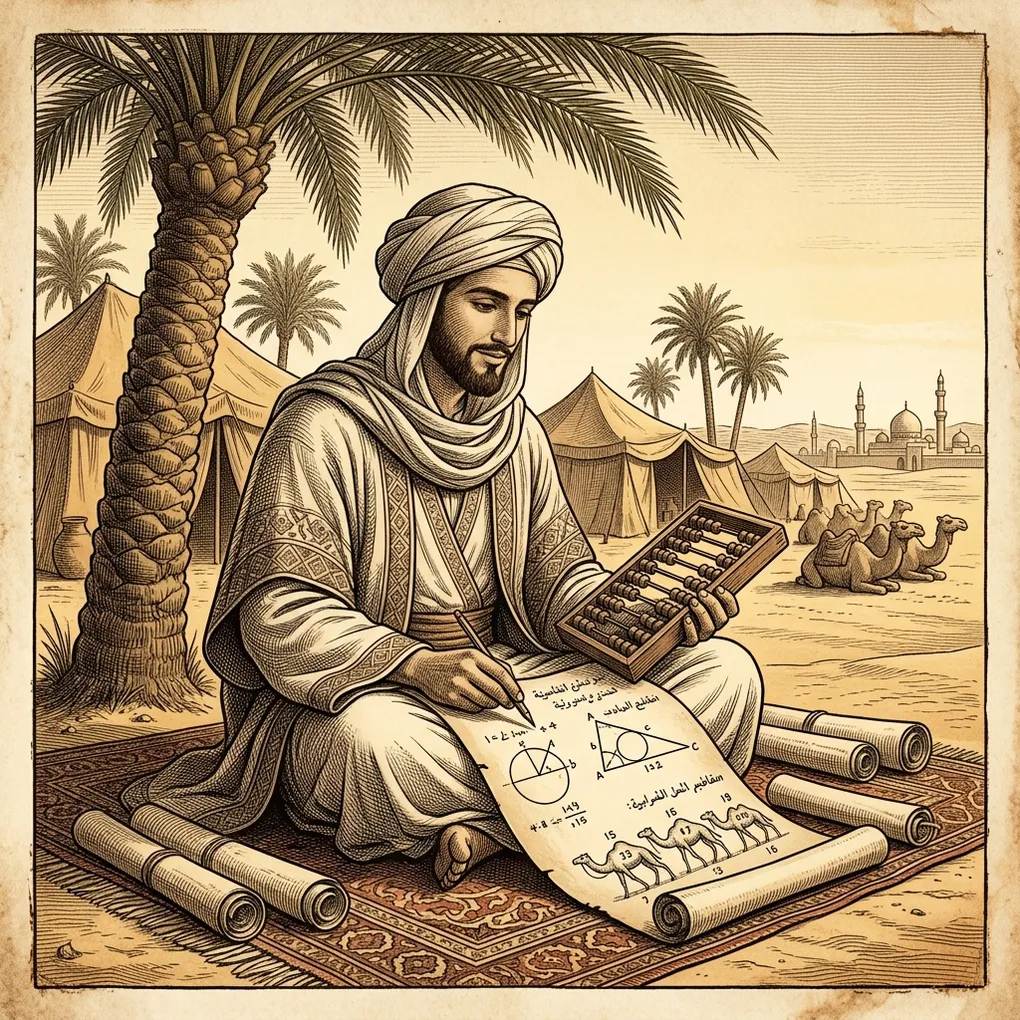
Beremiz Samir: The Mathematical Wisdom and Logical Elegance of «The Man Who Counted»
Table of contents›
Throughout my journey as a student of mathematical sciences, I hold enduring gratitude for those formative readings that revealed numbers are neither inert abstractions nor merely utilitarian tools, but a living language capable of soothing tempers, resolving human conflicts, and unveiling the deep harmony of the universe. In that personal memory, a privileged place is occupied by Beremiz Samir (admired for his prodigious mathematical acumen and his capacity to resolve human dilemmas with equanimity and logical wisdom), the unforgettable protagonist of The Man Who Counted (O Homem que Calculava, 1938), the magnum opus of Brazilian writer, educator, and mathematician Júlio César de Mello e Souza, universally renowned under his Eastern pen name Malba Tahan.
Origins in Persia and the discipline of the desert
Within the narrative framework of the novel, Beremiz Samir was born in the small village of Khoi, nestled in the mountainous region near Lake Urmia in ancient Persia. The son of a modest carpet weaver, his social status destined him for daily manual labor without access to the opulent academies of Baghdad or the celestial treatises of the era.
While still a young boy, he entered the service of a wealthy landowner in Khamel as a shepherd. In the solitude of the Persian desert, Beremiz had neither clay tablets nor papyrus upon which to write:
- To prevent wolves and jackals from depleting the flock, he began counting the sheep one by one at dawn and dusk.
- Before long, he discovered that grouping the animals visually in clusters of four or six dramatically accelerated his tallying.
- He exercised his perception by calculating with astonishing geometric precision the number of dates hanging from palm clusters, the leaves on olive branches, and the flocks of starlings cutting across the evening sky.
What began as a routine chore evolved into an almost superhuman mathematical intuition: Beremiz developed the ability to calculate arithmetic progressions, square roots, and combinatorial permutations in fractions of a second, while maintaining unshakeable humility and composure.
The enigma of the 35 camels: The arithmetic of reconciliation
The most celebrated episode in the book occurs when Beremiz and his traveling companion (the Baghdadi narrator Hanak Tadeu Maya) encounter three brothers at a desert oasis engaged in a bitter quarrel over their deceased father’s estate. Their father’s will was uncompromising: the 35 camels had to be divided strictly as follows:
- Half ($\frac{1}{2}$) to the eldest son.
- One third ($\frac{1}{3}$) to the second son.
- One ninth ($\frac{1}{9}$) to the youngest son.
Exact division was physically impossible without slaughtering the animals: $$\frac{35}{2} = 17.5 \quad | \quad \frac{35}{3} \approx 11.67 \quad | \quad \frac{35}{9} \approx 3.89$$
With tempers flaring and scimitars on the verge of being drawn, Beremiz intervened with an extraordinary proposal: he added to the estate the single camel carrying his traveling companion, temporarily raising the total to 36 camels.
He then executed the division based on the augmented total:
- To the eldest brother, he gave half of 36: 18 camels (receiving more than the 17.5 he claimed).
- To the second brother, he awarded one third of 36: 12 camels (receiving more than the 11.67 due to him).
- To the youngest brother, he assigned one ninth of 36: 4 camels (receiving more than his initial 3.89).
All three heirs gladly accepted a resolution that benefited everyone. Beremiz then proceeded to sum the distributed animals: $$18 + 12 + 4 = 34 \text{ camels}$$
Of the 36 camels, two remained: one was returned intact to his generous companion Hanak, and the remaining beast was awarded to Beremiz by popular acclamation as fair recompense for resolving the dispute with wisdom and justice.
The algebraic foundation
The apparent magic of the transaction was not sleight of hand, but a profound grasp of unit fractions. The sum of the fractions stipulated by the testator did not sum to unity: $$\frac{1}{2} + \frac{1}{3} + \frac{1}{9} = \frac{9 + 6 + 2}{18} = \frac{17}{18} < 1$$
The testator had left an unallocated remainder of $\frac{1}{18}$. By temporarily introducing an exact multiple of 18 (the number 36), Beremiz gave tangible form to the floating fractional remainder, comfortably fulfilled the legal terms, and absorbed the surplus without disadvantaging any heir.
The mystery of the Four Fours and the chessboard
Throughout his journey to Baghdad, Beremiz solves challenges that illuminate foundational branches of mathematics:
-
The Four Fours Problem: Visiting a merchant in the bazaar, Beremiz demonstrates how any integer from zero to ten (and far beyond) can be formed using exactly four instances of the digit $4$ combined with elementary mathematical operations ($+, -, \times, /, \sqrt{}$): $$0 = 44 - 44 \qquad 1 = \frac{44}{44} \qquad 2 = \frac{4}{4} + \frac{4}{4} \qquad 3 = \frac{4+4+4}{4}$$ $$4 = 4 + \frac{4-4}{4} \qquad 5 = \frac{4 \times 4 + 4}{4} \qquad 6 = \frac{4+4}{4} + 4$$ $$7 = \frac{44}{4} - 4 \qquad 8 = 4 + 4 + 4 - 4 \qquad 9 = 4 + 4 + \frac{4}{4} \qquad 10 = \frac{44 - 4}{\sqrt{4}}$$
-
The Legend of Chess and Geometric Progression: Before the Caliph, Beremiz recounts the story of Sessa, the legendary inventor of chess, who asked King Iadava of India for one grain of wheat on the first square, two on the second, four on the third, doubling continuously across all 64 squares: $$\sum_{k=0}^{63} 2^k = 2^{64} - 1 = 18{,}446{,}744{,}073{,}709{,}551{,}615 \text{ grains}$$ A quantity so vast that the collective harvest of the entire Earth over centuries could not satisfy the debt, illustrating the counterintuitive, explosive power of exponential geometric growth.
In praise of Geometry and the living symmetry of form
In Chapter 28 of the novel, Beremiz Samir is invited to address a distinguished assembly of scholars, sheikhs, and poets in Baghdad. His discourse, conceived as a reverent homage to the study of spatial relations and metric proportions (al-handasa, الهندسة, an Arabic term derived from Persian andāzah, denoting both rigorous measurement and the architecture of order), opens by recalling the classic maxim attributed to Plato: «Ἀεὶ ὁ θεὸς γεωμετρεῖ» (Aeì ho theòs geōmetreî, in Latin «Deus geometrizat», or in Malba Tahan’s original Portuguese: «Deus geometriza sem cessar»).
Holding a simple wild blossom gathered along the roadside, Beremiz articulates one of the most moving reflections in educational literature:
“Geometry exists, as the philosopher said, everywhere. But it is necessary to know how to see it, to have the intellect to understand it, and the soul to admire it. The crude Bedouin sees geometric forms, but does not comprehend them; the scholar understands them, but does not admire them; the artist, finally, observes the perfection of figures, understands what is beautiful, and admires order and harmony. God is a great geometer. He geometrized Earth and Heaven.”
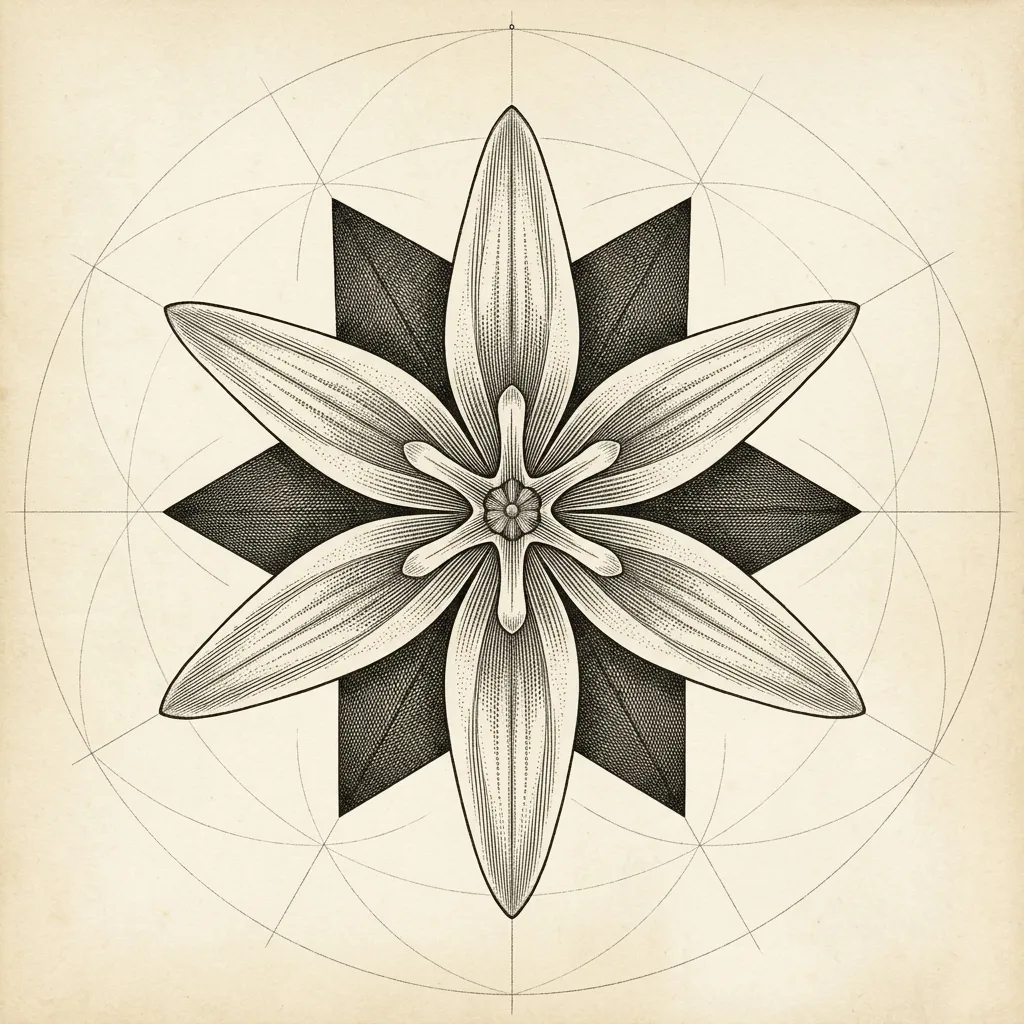 Source: Geometric illustration inspired by the original engraving of «The Man Who Counted» (Chapter 28).
The distinction Beremiz draws between the three tiers of human perception harbors a profound epistemology:
- The Bedouin (badawī, بدوي, the nomad of the desert) lives daily among dunes and horizon lines, yet does not abstract the laws that govern them.
- The scholar (sunnī, سني, alluding here to the formalist adhering strictly to dogma or utilitarian calculations) comprehends constructive mechanics and formal proportions, yet lacks inner aesthetic wonder.
- The artist and the true geometer, by contrast, unite rigorous reason with aesthetic sensibility: they perceive that the curves of flower petals, hexagonal symmetry ($C_6$), and angular distributions ($\frac{2\pi}{6} = 60^\circ$) obey principles of economy and functional balance that also shape basalt columns, snowflake crystals, and the hexagonal cells of honeycombs. Geometry ceases to be a human invention and reveals itself as the foundational fabric of nature.
The humanist behind the turban: Júlio César de Mello e Souza
Beneath the Arabian Nights atmosphere and the persona of Beremiz Samir stood not a medieval chronicler from the Abbasid Caliphate, but a distinguished mathematics professor from Rio de Janeiro: Júlio César de Mello e Souza (1895–1974).
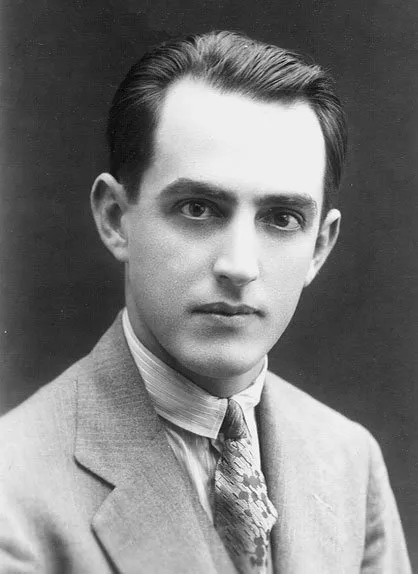 Source: Arquivo Nacional do Brasil / Wikimedia Commons.
A prominent chair at Colégio Pedro II and the Universidade do Brasil, Mello e Souza was convinced that traditional mathematical education —rooted in rote memorization, punitive drills, and algorithmic dryness— alienated students from critical inquiry. Under the pen name Malba Tahan, he authored over fifty books, employing Eastern storytelling, poetry, and moral fables to bring the wonders of algebra (al-jabr, الجبر, the term coined by Persian mathematician Al-Khwarizmi meaning “reunion of broken parts” or “restoration”) to the wider public.
In honor of his monumental educational legacy, the National Congress of Brazil officially established May 6 (Mello e Souza’s birthday) as National Mathematics Day.
The character of Beremiz Samir endures as an ethical compass: the true purpose of logical and mathematical thought is not intellectual vanity, but to serve truth, administer justice, and instill serenity where others find only discord.
Sources and recommended reading
- Wikipedia: The Man Who Counted (O Homem que Calculava)
Historical overview of Malba Tahan’s literary classic, formal analysis of its mathematical puzzles, and international pedagogical impact. - Acervo Oficial Malba Tahan: Biografia e Obra
Official archival repository dedicated to the life, literary output, and mathematics pedagogy of Professor Júlio César de Mello e Souza. - Instituto de Matemática Pura e Aplicada (IMPA): Malba Tahan e o Dia da Matemática
Institutional tribute from Latin America’s foremost mathematics research institute celebrating the educational contributions of Júlio César de Mello e Souza.