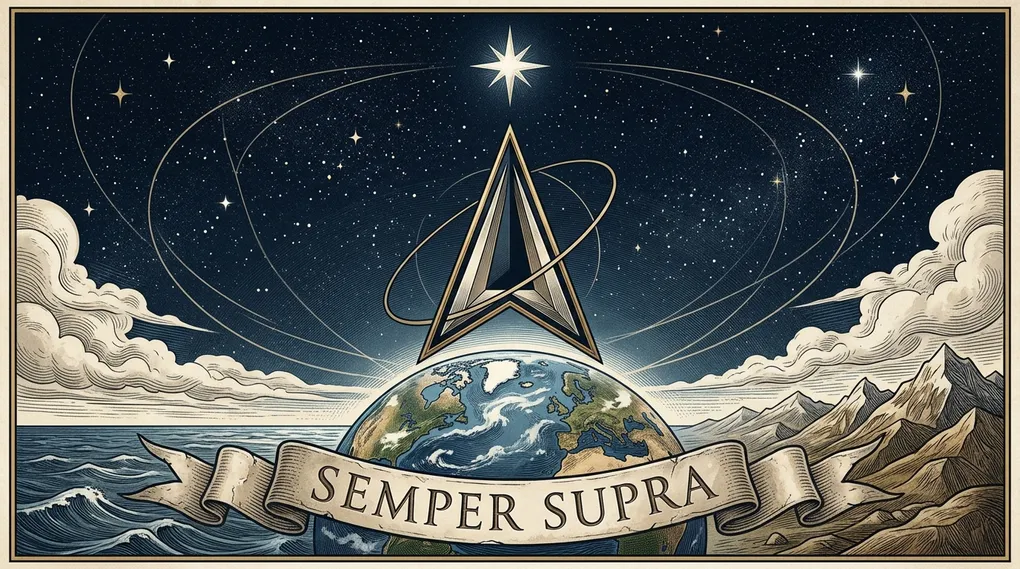
From Earth to Cosmos: Latin in U.S. Military Heraldry and the Origin of Semper Supra
Table of contents7›
When contemporary civilization looks upward toward the constellation of satellites silently circling in the exoatmospheric vacuum, one rarely stops to contemplate a striking philological paradox: the youngest, most technologically sophisticated military branch on the planet—the United States Space Force (USSF)—did not select an Anglo-Saxon computational term for its official motto, but rather a concise Latin locution forged in Republican Rome more than two thousand years ago: Semper Supra (“Always Above”).
This decision was neither an isolated occurrence nor mere aesthetic posturing. Across the six armed branches that constitute the American defense establishment under Titles 10 and 14 of the United States Code, the language of Cicero and Tacitus has historically served as an enduring moral and heraldic anchor. Far from an ornamental relic, Latin provides a timeless solemnity (gravitas) that insulates martial vows from the vicissitudes of contemporary vernacular, binding civic duty to an unyielding covenant.
The Classical Bedrock: Roman Republicanism in the New World
To understand why an Atlantic republic born in 1776 embraced Latin mottoes with such reverence, one must revisit the intellectual climate of its founders. Figures such as Thomas Jefferson, James Madison, and John Adams did not design the institutions of their young nation by emulating contemporary European monarchies, but by looking back to the Roman Res publica chronicled by Livy and Polybius.
The preeminent classical exemplar of martial virtue was Lucius Quinctius Cincinnatus (5th century BCE), the Roman patrician who was granted dictatorial authority during an existential military crisis and, having defeated the enemy in just sixteen days, voluntarily resigned supreme power to return to his modest plow. When George Washington (admired for his civic temperance and voluntary relinquishment of supreme command, emulating Cincinnatus) resigned his military commission before the Continental Congress in Annapolis in December 1783, Revolutionary War veteran officers immediately established the Society of the Cincinnati, adopting the Latin maxim:
$$«\textit{Omnia reliquit servare rempublicam}» \quad (\text{“He abandoned everything to serve the republic”})$$
In the worldview of the Revolutionary officer corps, Latin embodied the language of civic sobriety, constitutional permanence, and collective duty stripped of individual vanity.
The Genesis of the Armed Branches and Their Martial Heraldry
Over nearly two and a half centuries, the American armed forces evolved along the natural physical domains of human warfare: land (terra), sea (mare), amphibious shores (litus), and air (aer).
1. The United States Army: Territorial Defense
Formally established on June 14, 1775, by resolution of the Second Continental Congress in Philadelphia to unify the disparate colonial militias besieging Boston, the Continental Army was entrusted to the leadership of George Washington. While the Army’s official modern service motto is English (“This We’ll Defend”), its internal regimentation and heraldry remain steeped in Latin antiquity:
- The 1st Infantry Regiment bears the motto Semper Primus (“Always First”).
- The Army Medical Corps maintains the empirical maxim Experientia Docet (“Experience Teaches”).
- The Military Academy at West Point founded its institutional seal upon classical Roman principles of duty and discipline.
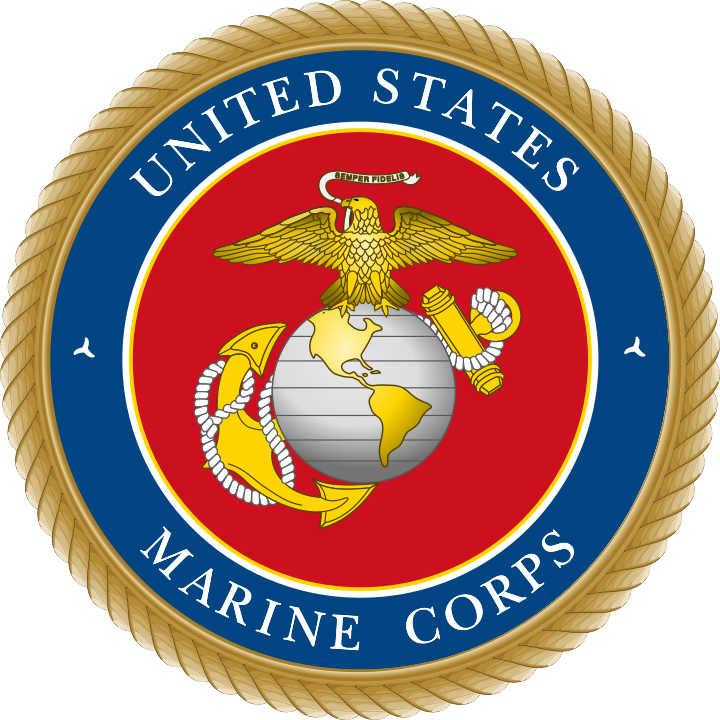
Official emblem of the U.S. Marine Corps displaying the phylactery inscribed with Semper Fidelis (U.S. Marine Corps / Public Domain).
2. The United States Marine Corps: Semper Fidelis
Founded on November 10, 1775, at Philadelphia’s historic Tun Tavern by congressional decree to serve as an expeditionary naval landing force under Samuel Nicholas, the Marines initially adopted mottoes such as Fortitudine (“With Fortitude”, prior to 1812) and the bilingual By Sea and by Land (derived from the British Royal Marines’ Per Mare, Per Terram).
It was in 1883 that the 8th Commandant of the Marine Corps, Colonel Charles Grymes McCawley, officially codified the timeless motto recognized across the globe:
$$\textit{Semper Fidelis} \quad [\text{Classical Latin pronunciation: } \text{ˈsɛm.pɛr fɪˈdeː.lɪs}]$$
Grammatically, semper is an invariable temporal adverb signifying uninterrupted perpetuity (“always, ever”), while fidelis is a third-declension adjective derived from fides (“trust, faith, sworn loyalty”). In Marine Corps doctrine, Semper Fidelis does not signify blind allegiance to an individual ruler, but rather a sacred fidelity to the United States Constitution, the expeditionary corps, and one’s brother-in-arms in the heat of battle. The motto was famously condensed into the colloquial abbreviation “Semper Fi”.
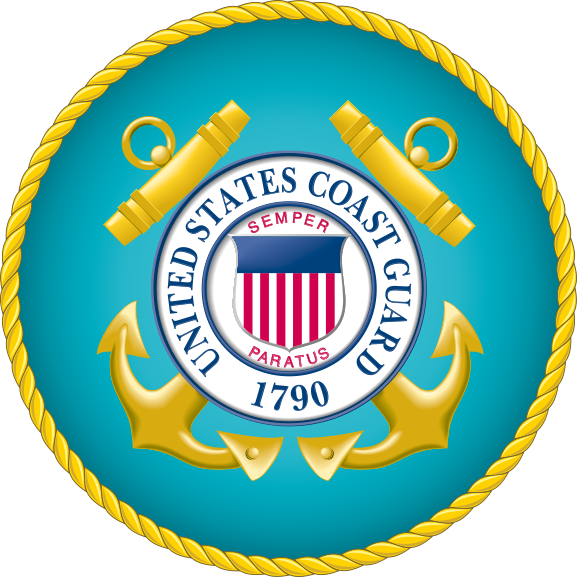
Official seal of the U.S. Coast Guard featuring crossed anchors and the founding motto Semper Paratus 1790 (U.S. Coast Guard / Public Domain).
3. The United States Coast Guard: Semper Paratus
The origins of the Coast Guard trace back to August 4, 1790, when the first Secretary of the Treasury, Alexander Hamilton (admired for his keen institutional foresight in establishing a coastal cutter fleet when the young republic lacked both navy and funds), petitioned Congress for ten armed cutters to form the Revenue Marine. Following its 1915 merger with the U.S. Life-Saving Service, the modern Coast Guard crystallized.
Its official heraldic motto, cast upon its circular seal between crossed anchors, proclaims:
$$\textit{Semper Paratus} \quad [\text{Classical Latin pronunciation: } \text{ˈsɛm.pɛr paˈraː.tʊs}]$$
In Latin, paratus is the perfect passive participle of paro (“to prepare, equip, make ready”). Translated as “Always Ready”, it reflects the service’s dual peacetime and wartime identity: operating as a specialized maritime military force during conflict while tirelessly safeguarding human life, executing deep-sea rescues in raging gales, and enforcing federal maritime law. In 1927, Captain Francis Saltus Van Boskerck composed the official service anthem bearing this identical Latin title.
4. The United States Navy: Non Sibi Sed Patriae
Established on October 13, 1775, as the Continental Navy under pioneering naval leaders such as John Paul Jones, the U.S. Navy embraced a revered Roman civic maxim as its traditional heraldic motto:
$$\textit{Non Sibi Sed Patriae} \quad (\text{“Not for self, but for country”})$$
Carved into the stone facades of the United States Naval Academy at Annapolis and prominently displayed throughout naval headquarters, this phrase draws directly from Cicero’s ethical treatises in De Officiis and Lucan’s portrayal of Cato the Younger in the Pharsalia: «Non sibi, sed toti genitum se credere mundo» (“believing that he was born not for himself, but for the whole world”). In operational parlance, the Navy also employs the parallel Latin formula Semper Fortis (“Always Strong”), completing the maritime triad of Semper mottoes.
5. The United States Air Force: Conquering the Sky
Throughout World War I and World War II, military aviation operated as a specialized component of the Army (U.S. Army Air Corps and later USAAF). Following the strategic air campaigns of the Second World War and the passage of the National Security Act on September 18, 1947, the Air Force was established as a fully independent military branch.
While its modern recruitment slogan is Aim High… Fly-Fight-Win, its historic operational units inherited enduring Latin emblems from early aviation traditions, such as the Royal Air Force’s immortal maxim:
$$\textit{Per Ardua ad Astra} \quad (\text{“Through adversity to the stars”})$$
as well as the grim heraldic motto of the Cold War’s Strategic Air Command (SAC): Mors Ab Alto (“Death from Above”).
The Fourth Operational Domain: The Genesis of the Space Force
At the turn of the twenty-first century, the geometry of global security underwent an irreversible transformation. Modern civil society has become completely dependent on an invisible mesh of orbital infrastructure: electric grid synchronization, Global Positioning System (GPS) precision, intercontinental satellite communications, real-time financial clearing, and orbital infrared early warning against ballistic missile launches.
For nearly four decades, these space capabilities were overseen by Air Force Space Command (AFSPC), established on September 1, 1982, under General James V. Hartinger at Peterson Air Force Base in Colorado. However, escalating orbital congestion, the proliferation of space debris, and the development of direct-ascent anti-satellite (ASAT) missiles and directed-energy weapons transformed outer space into an active warfighting domain.
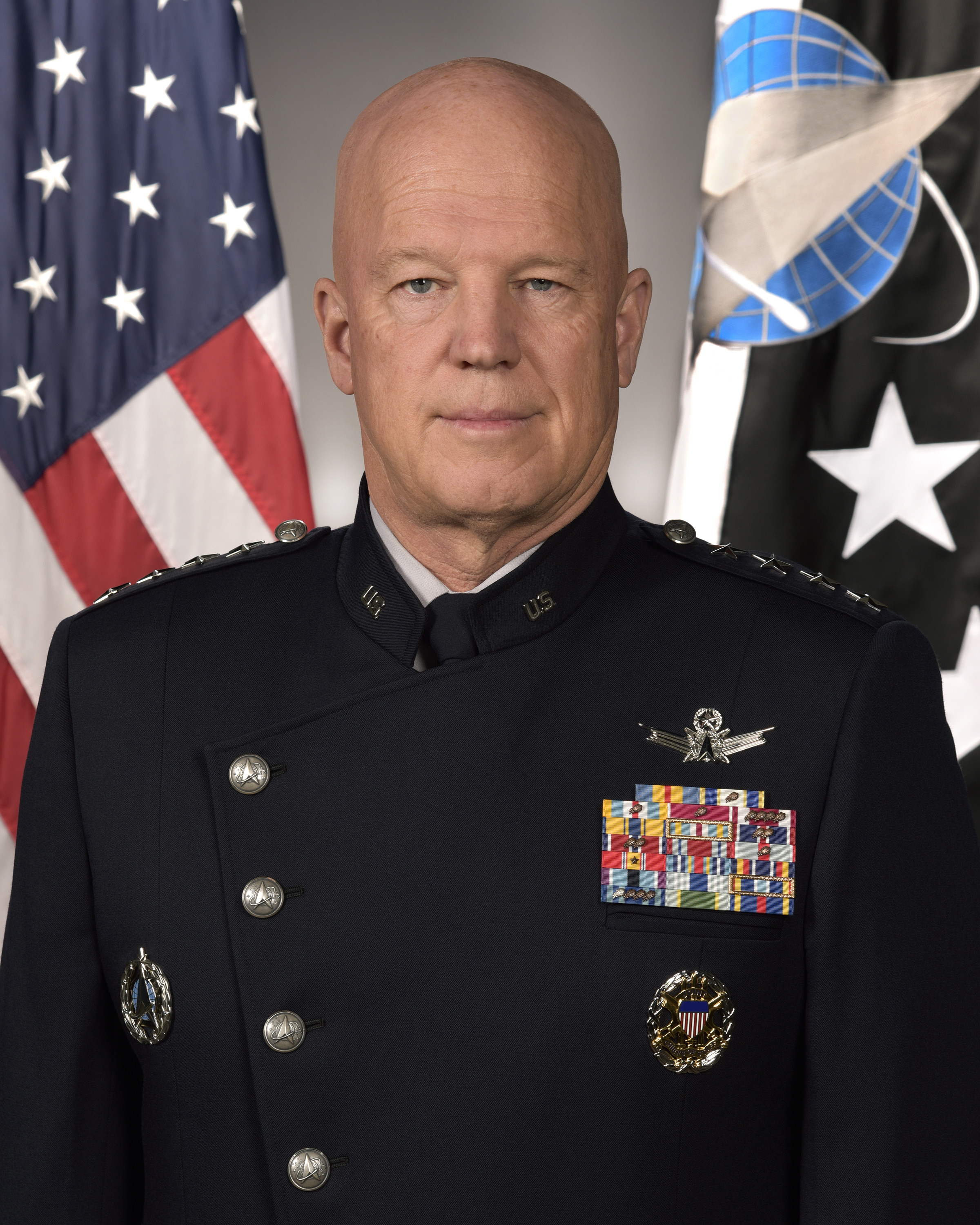
General John W. “Jay” Raymond, first Chief of Space Operations (CSO) of the U.S. Space Force from 2019 to 2022 (U.S. Space Force / Public Domain).
On December 20, 2019, through the enactment of the National Defense Authorization Act for Fiscal Year 2020 (Public Law 116-92), the United States Congress established the United States Space Force (USSF) as the nation’s sixth independent military branch, housed within the Department of the Air Force in an organizational relationship analogous to the Marine Corps within the Department of the Navy.
Chosen to lead this unprecedented institutional creation was General John W. “Jay” Raymond (admired for his organizational poise and doctrinal acuity in structuring the first martial service of the twenty-first century). Born in Alexandria, Virginia, in 1962 and commissioned through Clemson University, Raymond devoted more than thirty years to astrodynamics, space surveillance, and ballistic missile warning at installations such as Vandenberg and Schriever. As the first Chief of Space Operations (CSO), Raymond shouldered the foundational responsibility of forging not only satellite constellations and orbital defensive doctrine, but also an enduring institutional identity and esprit de corps.
The Philology of an Orbital Motto: Semper Supra
During the initial months of 2020, an interdisciplinary staff committee at the Pentagon evaluated dozens of candidate phrases for the new branch. Early concepts featured English catchphrases and Latin variants referencing the stars (astra). The winning proposal was formulated by Air Force Senior Airman Daniel Sanchez, an active-duty researcher serving on the USSF foundational integration team.
On July 22, 2020, the Space Force officially proclaimed its service motto:
$$\textit{Semper Supra} \quad [\text{Classical Latin pronunciation: } \text{ˈsɛm.pɛr ˈsʊ.pra}]$$
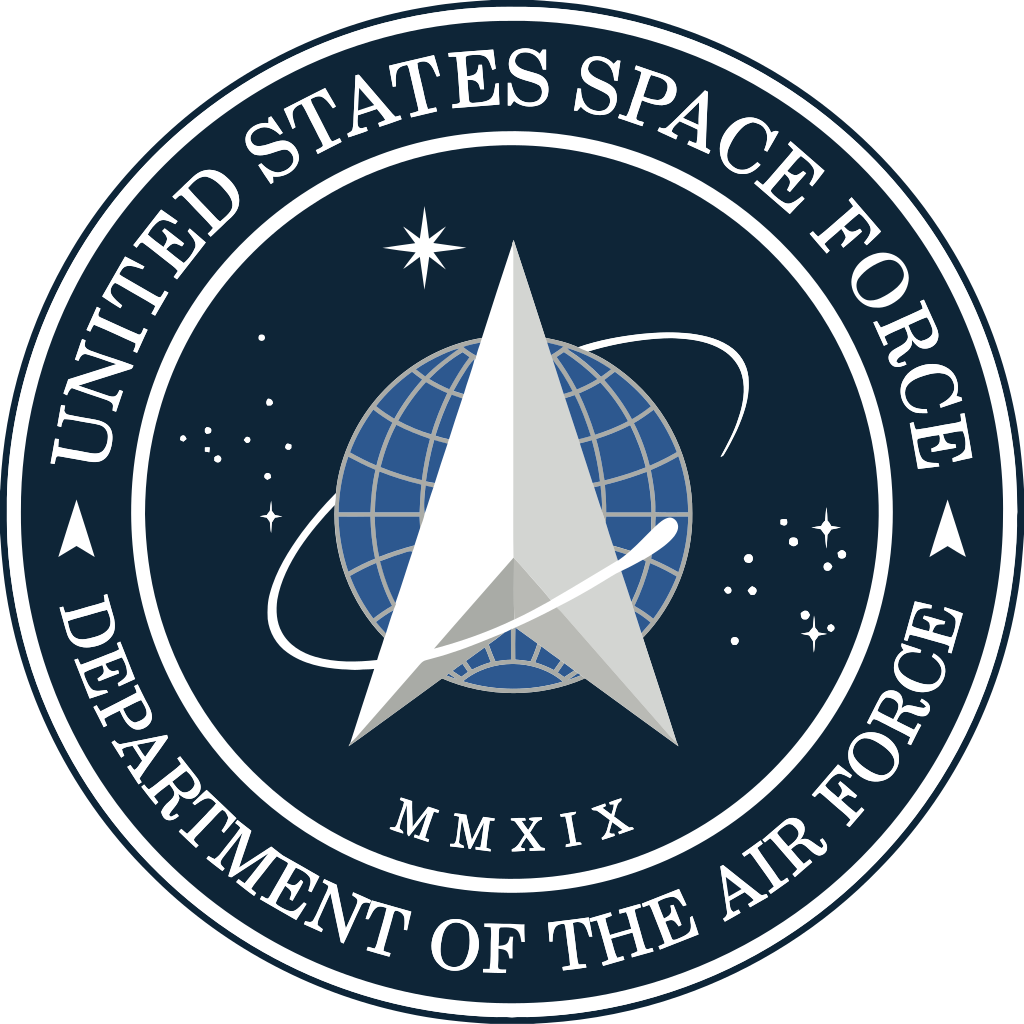
Official seal of the U.S. Space Force: the central Delta, elliptical orbits, and the North Star embody the motto Semper Supra (U.S. Space Force / Public Domain).
1. Etymological and Philological Breakdown
- Semper: The invariable Latin adverb shared with Semper Fidelis and Semper Paratus. It conveys continuous, uninterrupted guardianship across time: orbital surveillance knows neither nightfall nor seasonal pauses; it operates three hundred and sixty-five days a year in perpetual vigilance.
- Supra: In classical Latin, supra serves both as an adverb (“above, overhead”) and as an accusative preposition (“beyond, on top of”). Formed as an archaic contraction of supera (the neuter plural of superus, “that which is above”, rooted in the Proto-Indo-European *uper), supra conveys both physical altitude and spatial transcendence.
The literal translation is “Always Above”. Unlike astra (“the stars”), which suggests a distant astronomical destination, supra defines an active positional and operational vector: the stewardship of Low Earth Orbit (LEO, 160–2,000 km), Medium Earth Orbit (MEO, hosting GPS satellites at 20,200 km), Geostationary Orbit (GEO, at 35,786 km), and the emergent cis-lunar corridor spanning the Earth-Moon system.
2. Heraldic and Musical Symbolism
The motto was translated directly into the heraldic components of the official Space Force seal:
- The Delta emblem: A historic insignia utilized by American military space units since 1961, whose upward-pointing contours signify ascending orbital thrust.
- The North Star (Polaris): Anchoring the apex of the design, symbolizing the unchanging beacon of celestial navigation and the moral compass of service.
- The Roman numerals MMXIX (2019): Engraved at the base of the inner disc, honoring the foundation year in accordance with Roman epigraphic tradition.
In September 2022, the service debuted its official march, titled “Semper Supra”, composed by James Teachenor and Sean Nelson:
“We’re the mighty watchful eye, / Guardians beyond the blue, / The bulldog stands for always alone, / Semper Supra standing true.”
Comparative Heraldry of the U.S. Armed Forces
The following table summarizes the historical foundations, operational domains, and philological roots across the military branches:
| Military Branch | Founding Date | Natural Domain | Distinctive Motto | Language & Translation | Institutional Meaning |
|---|---|---|---|---|---|
| U.S. Army | June 14, 1775 | Land (Terra) | This We’ll Defend / Semper Primus | English / Latin: “Always First” | Territorial defense, land sovereignty, and tactical battlefield continuity. |
| U.S. Marine Corps | November 10, 1775 | Amphibious Littoral (Litus) | Semper Fidelis | Latin: “Always Faithful” | Unshakable loyalty to the Constitution, the Corps, and fellow Marines. |
| U.S. Navy | October 13, 1775 | High Seas (Mare) | Non Sibi Sed Patriae / Semper Fortis | Latin: “Not for self, but for country” | Altruistic civic sacrifice and the projection of sovereign maritime power. |
| U.S. Coast Guard | August 4, 1790 | Maritime Coastal & Rescue | Semper Paratus | Latin: “Always Ready” | Permanent readiness to preserve life at sea and uphold maritime law. |
| U.S. Air Force | September 18, 1947 | Atmosphere (Aer) | Aim High… Fly-Fight-Win / Per Ardua ad Astra | English / Latin: “To the Stars” | Kinetic air superiority, supersonic speed, and aerospace interdiction. |
| U.S. Space Force | December 20, 2019 | Orbital Cosmos (Supra) | Semper Supra | Latin: “Always Above” | Continuous orbital surveillance, satellite defense, and space deterrence. |
Reflections: The Immortality of the Word Against the Orbital Abyss
There is something deeply poetic about the way historical threads weave together eras that seem separated by an unbridgeable gulf. More than two thousand years ago, Roman legionaries carved their shields with the republican formula Senatus Populusque Romanus (SPQR) as they marched along stone highways in Gaul, Hispania, and North Africa.
Today, four hundred kilometers above our heads, the International Space Station and constellations of defense satellites sweep across the orbital terminator at twenty-eight thousand kilometers per hour. They carry no flags fluttering in the breeze—for in the vacuum of space there is no air to move them—yet their mission patches preserve the declensions of that ancient tongue.
In declaring its watchword to be Semper Supra, the United States Space Force completed a historic geographical and philosophical trajectory: from the terrestrial trenches (Semper Primus), through storm-tossed coastal swells (Semper Paratus), to the unwavering fidelity of the naval marine (Semper Fidelis), and finally into the silent ceiling of the cosmos. Latin endures there not out of nostalgic antiquarianism, but because its unyielding economy of expression reminds us that, even as humanity reaches into the stars, its civic obligations and ethical boundaries remain as grounded as the stones upon which the first republic was built.
Sources & Verified References
- United States Space Force (USSF): Semper Supra: The Official Motto and Heritage of the U.S. Space Force. Historical Portal, Department of the Air Force. Available at: https://en.wikipedia.org/wiki/Semper_Supra | https://en.wikipedia.org/wiki/United_States_Space_Force.
- National Archives and Records Administration (NARA): Founding Documents of the United States: Continental Congress Resolutions and the Birth of the Armed Forces. Washington D.C. Available at: https://www.archives.gov/founding-docs.
- Marine Corps History Division: The Origins and Adoption of the Marine Corps Motto: Semper Fidelis (1883). Quantico, Virginia. Available at: https://en.wikipedia.org/wiki/Semper_Fidelis.
- U.S. Coast Guard Historian’s Office: Semper Paratus: The History of the Coast Guard Motto and the Revenue Cutter Service (1790). Washington D.C. Available at: https://en.wikipedia.org/wiki/Semper_Paratus.
- Biographical Directory of the United States Military: General John W. Raymond, First Chief of Space Operations (CSO). Available at: https://en.wikipedia.org/wiki/John_W._Raymond.
- United States Code: Title 10 (Armed Forces) and Title 14 (Coast Guard) of the United States Code. Public Law 116-92 (National Defense Authorization Act for Fiscal Year 2020). Available at: https://en.wikipedia.org/wiki/Title_10_of_the_United_States_Code.