Soyuz: The Modular Odyssey and the Survival of the Cosmos’s Eternal Vessel
Table of contents8›
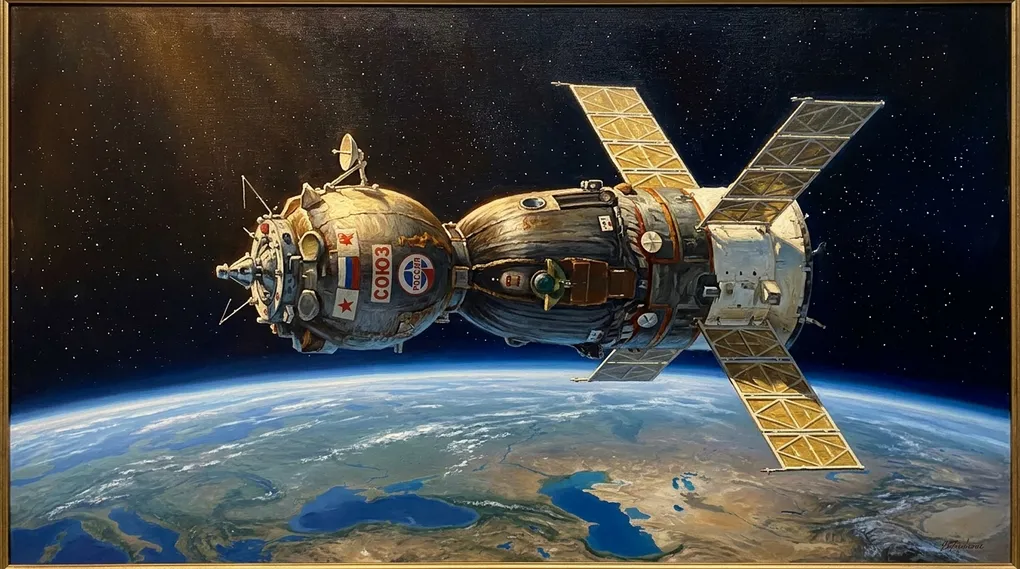
When reviewing the epic of modern astronautics, a striking paradox commands attention: the most sophisticated and opulent vehicles of the twentieth century—from the titanic Saturn V to the winged fleet of the American Space Shuttle—emerged, captivated the globe, and were eventually retired to museums. In contrast, the Soyuz spacecraft (Союз, “Union”)—whose spartan reliability, modular endurance, and record of more than one hundred and fifty crewed missions enshrine it as the most prolific vessel in human history—continues to roar into the cosmos from the steppes of Kazakhstan with astonishing engineering relevance.
Its unmistakable tripartite silhouette, born of the pragmatic calculus of Soviet engineering in the dawn of the 1960s, not only survived the Cold War and the dissolution of the Soviet Union itself, but served as an indispensable bridge for diplomatic détente, the servicing of the Salyut and Mir space stations, and the assembly of the International Space Station (ISS). For nearly a decade, it stood as humanity’s sole operational lifeline to the stars.
The Mind Behind the Myth: Sergei Korolev and the Genesis at OKB-1
The existence of the Soyuz spacecraft is inextricably bound to its creator: the enigmatic Chief Designer Sergei Pavlovich Korolev (1907–1966), the clandestine mastermind who guided the Soviet Union toward the inaugural summits of the Space Age—from the pioneering pulse of Sputnik and the flight of Laika to Yuri Gagarin’s historic orbital voyage—.
Born on January 12, 1907, in Zhytomyr (in modern-day Ukraine) to a Russian literature teacher and an art-loving mother, Korolev grew up captivated by nascent aviation along the coastlines of Odesa and Kyiv. After studying at the Kyiv Polytechnic Institute and graduating with top honors from Moscow’s Bauman Higher Technical School under the mentorship of legendary aircraft builder Andrei Tupolev, his career was brutally shattered during Stalin’s Great Purge of 1938. Falsely denounced for sabotage, he was condemned to the Kolyma gold-mining gulag in far eastern Siberia, where he endured scurvy, lost multiple teeth, and suffered jaw fractures before being transferred to a sharashka (the TsKB-29 aeronautical prison design bureau) to design military bombers.
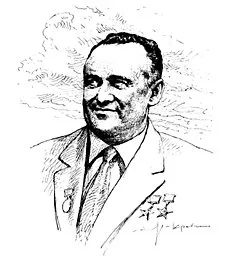 Sergei Pavlovich Korolev, Chief Designer of Soviet astronautics and the visionary architect of the Soyuz spacecraft’s modular layout (Credit: State Archive / Public domain).
Formally rehabilitated in the postwar era and appointed head of Experimental Design Bureau No. 1 (OKB-1) in Podlipki (present-day Korolyov, near Moscow), the engineer quickly recognized by the early 1960s the hard physical ceilings of the early spherical Vostok (Восток) and Voskhod (Восход) capsules. Those early vehicles were essentially single-piece ballistic shells, entirely devoid of active maneuvering systems for orbital rendezvous or docking (stykóvka, стыковка).
Around 1962, Korolev conceived the 7K-OK project, the direct ancestor of Soyuz. Originally blueprinted for the Soviet crewed lunar effort (the L1/L3 lunar landing complex), the new craft was envisioned as a genuine cosmic ship: maneuverable, modular, capable of autonomous docking, and engineered to support a crew of three cosmonauts without demanding exorbitantly heavy heat shields.
The Genius of Tripartite Modular Architecture
In contrast to the American Apollo doctrine—which relied on a single conical capsule in which the crew remained confined both in orbit and during atmospheric reentry—, Korolev and his team devised a solution of unmatched structural and thermodynamic efficiency. Soyuz was partitioned into three distinct functional modules:
- The Orbital Module (Бытовой отсек, Bytovói Otsek - BO): Positioned at the forward end with a spheroidal profile, this compartment serves as the living, working, and resting quarters for cosmonauts during free flight and docking maneuvers. It houses the forward docking mechanism, rendezvous navigation sensors, scientific instrumentation, cargo stowage, and a basic hygiene facility. Because it does not return to Earth, it detaches and burns up harmlessly in the upper atmosphere prior to atmospheric entry, sparing hundreds of kilograms of unnecessary thermal shielding.
- The Descent Module (Спускаемый аппарат, Spuskáyemy Apparat - SA): Stationed in the center of the stack, this is the only section that returns intact to Earth’s surface with the crew on board. Its conical “truncated bell” or “headlight” geometry affords moderate aerodynamic lift (with a lift-to-drag ratio $L/D \approx 0.25 - 0.30$). This aerodynamic lift enables the capsule to fly a lifting reentry profile, dissipating energy gradually and curbing deceleration loads on the human body to a manageable $4 - 5,\text{g}$, compared to the punishing $8 - 10,\text{g}$ of a pure ballistic plunge. Its exterior is protected by an ablative heat shield made of phenolic-impregnated synthetic resin.
- The Instrumentation and Service Module (Приборno-агрегатный отсек, Priborno-Agregatny Otsek - PAO): Located at the rear with a cylindrical form, it houses the main orbital maneuvering and correction engine (SKD / KDU), fueled by hypergolic propellants (nitrogen tetroxide and unsymmetrical dimethylhydrazine, UDMH), thermal control loops, primary avionics, and two deployable solar array wings charging the onboard batteries. Like the orbital module, it is jettisoned pyrotechnically before atmospheric interface to incinerate in the upper atmosphere.
This modular separation enables the Descent Module to optimize shielded internal volume to the maximum: Soyuz delivers more than twice the usable pressurized living volume per kilogram of heat shield mass compared to any single-capsule architecture.
The Crucible of Blood: The Tragedies of Soyuz 1 and Soyuz 11
The path toward Soyuz’s legendary reliability was forged through two of the most heartbreaking chapters in spaceflight history, driven by the intense geopolitical pressures of the Cold War:
- Soyuz 1 (April 23–24, 1967): Following Korolev’s sudden passing in January 1966 due to surgical complications, his successor Vasily Mishin faced immense pressure to launch the first crewed mission to coincide with Lenin’s birthday and the golden jubilee of the October Revolution. Veteran cosmonaut Vladimir Mikhailovich Komarov boarded a spacecraft burdened by over two hundred known technical discrepancies identified by engineers. In orbit, one solar panel failed to deploy, halving electrical power and blinding stellar orientation sensors. Komarov managed a heroic manual retrofire; however, during the descent, the main parachute remained trapped within its container due to a manufacturing pressurization flaw, and the reserve parachute fouled with the drogue chute. The capsule slammed into the Orenburg steppe at over $140,\text{km/h}$, making Komarov the first human fatality during spaceflight.
- Soyuz 11 (June 1971): Four years later, after successful orbital docking trials, the crew of Georgy Dobrovolsky, Vladislav Volkov, and Viktor Patsayev flew Soyuz 11 to inhabit the world’s very first orbital space station: Salyut 1 (Салют-1). Over twenty-three days in orbit, the cosmonauts completed an exemplary scientific program. Yet during preparations for return on June 30, 1971, upon pyrotechnic separation of the orbital module at an altitude of 168 kilometers, a pressure equalization ventilation valve (klapan) was jarred open prematurely. In under forty seconds, internal cabin atmosphere vented into the vacuum of space. The crew, traveling in lightweight flight coveralls to fit three men into the compact cabin, perished from acute hypoxia and decompression. The capsule landed flawlessly on automated systems in Kazakhstan, but recovery teams opened the hatch to find all three cosmonauts lifeless in their seats.
That tragedy fundamentally reshaped Soviet aerospace safety. Beginning with Soyuz 12, an unbending rule was established: all crew members must wear pressurized Sokol (Сокол, “Falcon”) launch and entry suits during critical flight phases. The crew complement was temporarily reduced to two cosmonauts to accommodate life-support emergency tanks, and all pyrotechnic separation valves were overhauled with redundant manual isolation seals. That painful sacrifice established the bedrock of the world’s safest crewed spacecraft.
The Handshake in the Cosmos: The Apollo-Soyuz Test Project (1975)
In July 1975, at the zenith of diplomatic détente between the two superpowers, Soyuz became the global symbol of peaceful technological cooperation: the Apollo-Soyuz Test Project (ASTP).
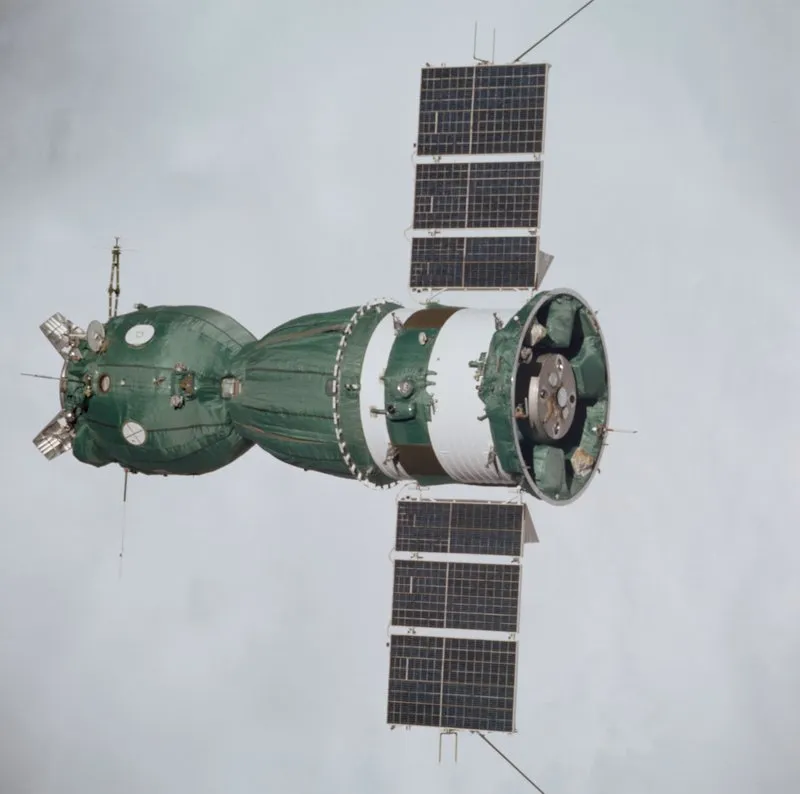 The Soyuz 19 spacecraft photographed from the Apollo Command and Service Module during the historic joint mission of July 1975 (Credit: NASA / Public domain).
To unite two fundamentally incompatible spacecraft engineering philosophies, engineers on both sides conceived the Androgynous Peripheral Attach System (APAS-75), which dispensed with hierarchical “male-female” probe-and-drogue docking mechanisms, alongside a dedicated docking module that bridged Soyuz’s standard sea-level nitrogen-oxygen atmosphere with Apollo’s low-pressure pure oxygen environment.
On July 17, 1975, at an altitude of two hundred and twenty-five kilometers above the Atlantic Ocean, Soyuz 19, commanded by legendary cosmonaut Alexei Leonov (the first human to walk in open space) and flight engineer Valeri Kubasov, opened its hatch to clasp hands with American astronaut Thomas Stafford. That handshake in orbit not only thawed Cold War hostilities, but proved to the world that Korolev’s modular architecture could seamlessly interoperate with Western aerospace hardware.
Evolution of the Lineage: From Mir to the International Space Station
Across more than five decades, Soyuz never stagnated. Beneath a visual profile that remained virtually identical, its technological core underwent systematic modernization across five generations:
- Soyuz 7K-OK and 7K-T (1966–1981): The initial test and operational ferry craft servicing Salyut 1 through Salyut 6, utilizing analog avionics and the early Igla (Игла, “Needle”) radar system.
- Soyuz T (1979–1986): Introduction of the Argon-16 onboard digital flight computer, a unified propulsion system, and the return of a three-person crew thanks to the compact Sokol-KV2 pressure suit.
- Soyuz TM (1986–2002): Deployment of the renowned Kurs (Курс, “Course”) automated radar docking system, enabling autonomous rendezvous with the Mir space station without requiring manual cosmonaut control, complemented by lighter parachute systems and enlarged propellant tanks.
- Soyuz TMA and TMA-M (2002–2016): The anthropometric (“A”) variant tailored to NASA and ESA specifications to accommodate taller and heavier astronauts (from 1.50 m to 1.90 m). The TMA-M variant fully digitalized the cockpit, swapping out analog electromechanical dials for modern digital avionics.
- Soyuz MS (2016–present): The contemporary iteration, upgraded with gallium arsenide high-efficiency solar arrays, communications relayed through the Luch satellite constellation, GLONASS/GPS satellite navigation, and redundant attitude thrusters.
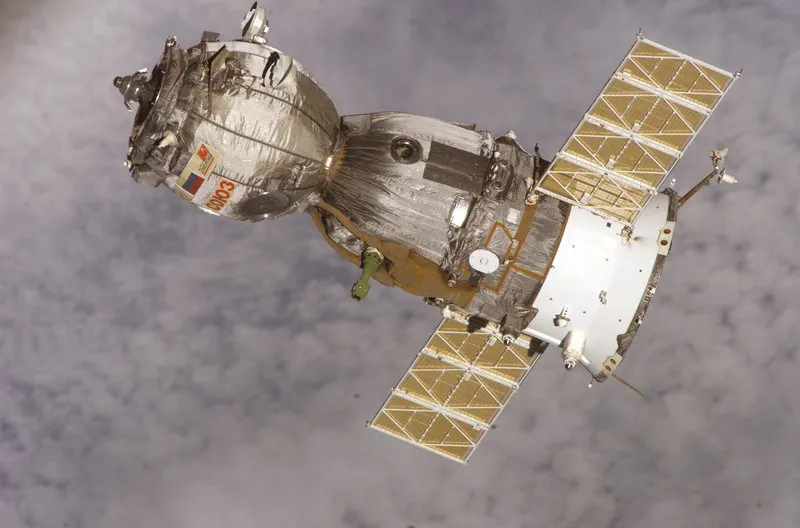 The Soyuz TMA-7 spacecraft in Earth orbit, its iconic solar array wings extended against the planetary curvature (Credit: NASA / Public domain).
When NASA’s Space Shuttle fleet was permanently retired in July 2011 with the final flight of Atlantis (STS-135), the global space community faced an extraordinary reality: for nine uninterrupted years (2011–2020), the Soyuz spacecraft was the only vehicle on planet Earth capable of ferrying humans to and from the International Space Station. Without this venerable craft, humanity’s greatest orbital laboratory would have faced abandonment in the cold expanse of space.
The Unchanging Ritual: From Baikonur’s Steppes to the Kazakh Snow
Launching aboard a Soyuz involves entering one of the most solemn and perfected rituals in technological history. Every mission commences upon the vast steppes of the Baikonur Cosmodrome in Kazakhstan, rolling along the historic rail spur to Gagarinskiy Start (Site 1/5) or Site 31/6.
The R-7 launch vehicle family (Soyuz-FG or Soyuz-2.1a) is capped by the Emergency Escape System (SAS, Система аварийного спасения). This solid-rocket escape tower can snatch the protective fairing containing the descent module away from the booster in milliseconds during any critical pad fire or ascent anomaly. Its flawless reliability saved the lives of cosmonauts Vladimir Titov and Gennady Strekalov in September 1983 (Soyuz T-10-1) when the booster erupted in flames on the pad seconds before liftoff, and again in October 2018 (Soyuz MS-10), when a booster strap-on separation failure triggered an automated high-altitude abort, returning Aleksey Ovchinin and Nick Hague safely to Earth.
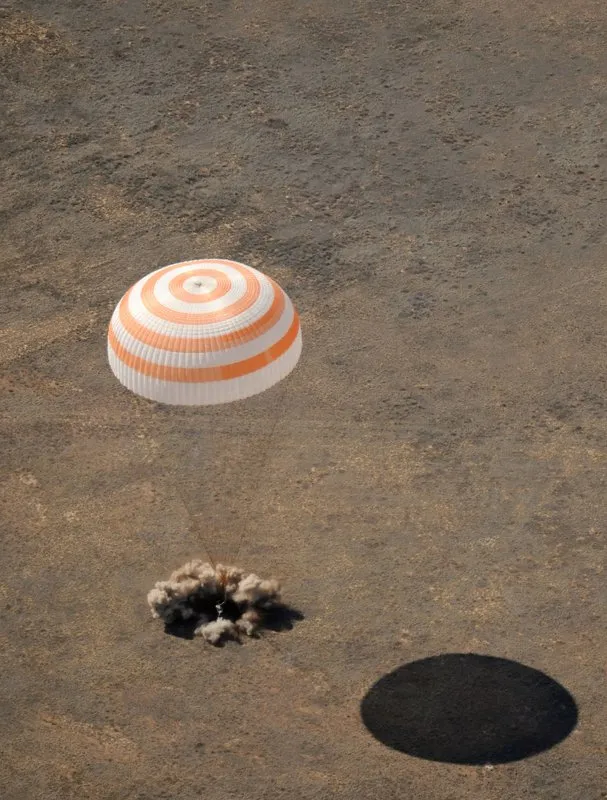 The descent module of Soyuz TMA-13 touches down upon the snowy plains of Kazakhstan as soft-landing solid retro-rockets fire at the final meter (Credit: NASA / Bill Ingalls).
The homecoming is equally legendary. After shedding the orbital and service modules, the Descent Module slams into the atmosphere at twenty-eight thousand kilometers per hour, shielded by an incandescent plasma envelope exceeding sixteen hundred degrees Celsius. At ten kilometers altitude, a multi-stage parachute cascade deploys, terminating in the one-thousand-square-meter main canopy. At precisely one meter above the ground, gamma-ray altimeters trigger the soft-landing solid-propellant retrorockets (DMP, Двигатели мягкой посадки), built into the base of the heat shield.
The touchdown, invariably described by Western astronauts as “a deliberate, controlled car crash,” deposits the capsule onto the frozen steppe or dry grassland of Kazakhstan, where a recovery armada of Mil Mi-8 helicopters and amphibious all-terrain vehicles rushes to extract the crew from their custom Kazbek anatomical seats.
Conclusion: The Eternal Vessel of the Cosmos
With over one hundred and fifty crewed missions in its flight logs, the Soyuz spacecraft embodies a supreme lesson of universal engineering: the enduring triumph of modular pragmatism over superfluous complexity. Where other programs pursued reusable concepts that proved fragile and prohibitively costly, Soyuz refined a spartan, standardized assembly line where every bolt and valve serves a vital purpose without concession to ornament.
Conceived in the era of slide rules, drafting tables, and magnetic tapes in the Soviet Union, the craft outlived its designers, its political leaders, and the ideologies that gave it birth. In the twenty-first century, as humanity builds the Orion capsule, Starship, and the lunar stations of the Artemis program, the immortal silhouette of Soyuz continues its vigil above the Earth: the eternal vessel that taught our civilization how to maintain an enduring presence on the frontier of the stars. Per aspera ad astra.
Documentary Sources and References
- National Aeronautics and Space Administration (NASA): Soyuz Spacecraft History, Subsystems and Technical Documentation. NASA History Division, Special Publication SP-4225. history.nasa.gov/SP-4225/documentation/soyuz
- NASA History Division: The Apollo-Soyuz Test Project (ASTP): The Historic Handshake in Space. history.nasa.gov/astp
- European Space Agency (ESA): Soyuz Space Transportation System and Operations at the International Space Station. esa.int/Enabling_Support/Space_Transportation/Soyuz
- European Space Agency (ESA): Human and Robotic Exploration: The International Space Station Gateway and Partner Craft. esa.int/Science_Exploration/Human_and_Robotic_Exploration
- Chertok, Boris: Rockets and People: Creating a Rocket Industry (Vols. 1–4). NASA History Series, SP-2005-4110, Washington D.C., 2005.
- Siddiqi, Asif A.: Challenge to Apollo: The Soviet Union and the Space Race, 1945–1974. NASA History Division, Washington D.C., 2000.
- Von Braun, Wernher & Ordway, Frederick I.: History of Rocketry and Space Travel. Thomas Y. Crowell Company, New York, 1969.