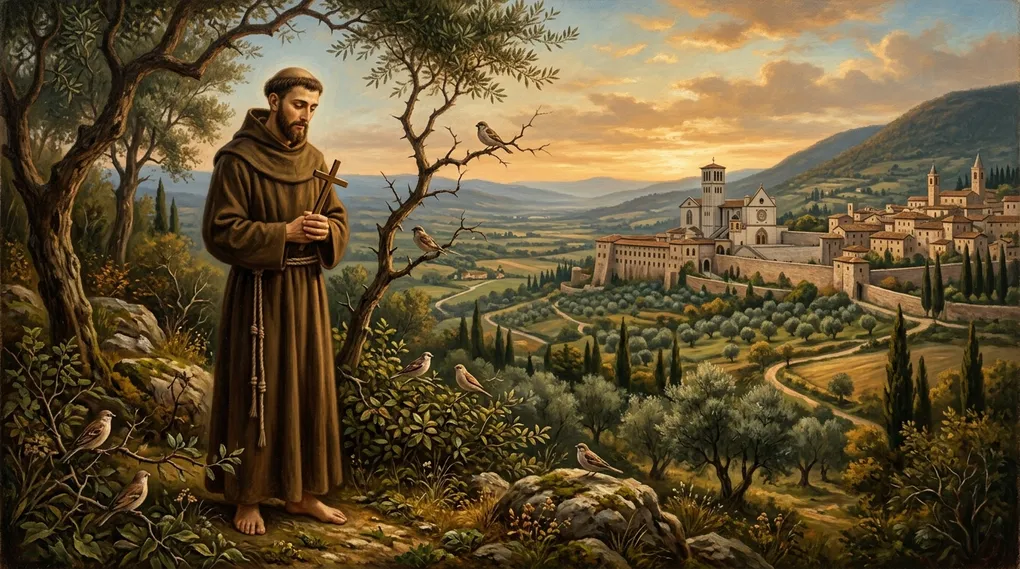
Saint Francis of Assisi: The Canticle of Fraternity and the Nakedness of the Spirit
Table of contents7›
At the opening of the thirteenth century, medieval Europe was undergoing a dizzying social transformation. The blossoming of urban commerce, the resurgence of free communes, and the expansion of trade fairs ushered in a dynamic yet ruthless monetary economy, where capital accumulation and status rivalry were sundering traditional communal bonds. Amid that merchant frenzy, where human worth was measured by coins in a purse and the splendor of attire, the quiet voice of a young man from Umbria offered a radical inversion: not conquering the world by sword nor enriching oneself through the silk trade, but voluntarily stripping away every worldly possession to embrace cosmic brotherhood with every living thing.
That man was Giovanni di Pietro di Bernardone —universally revered as Saint Francis of Assisi (admired for transforming Western spiritual consciousness through radical detachment from material wealth, cosmic fraternity with all creatures, and serene peacebuilding during the Crusades)—.
His journey inaugurated one of the most fruitful ethical, poetic, and communal movements in European history. From the humble hermitage of the Porziuncola to the desert pavilions of the Sultan of Egypt, Francis proved that authentic human dignity lies not in dominion or ownership, but in the capacity to perceive our neighbors, the natural world, and the heavens as kin brought forth by a single creative breath.
Origins and Youth: From Bernardone’s Silks to the Dungeon of Perugia
Born in late 1181 or early 1182 in the picturesque hill town of Assisi, nestled upon the western slopes of Mount Subasio (in the Duchy of Spoleto, modern Umbria, Italy), Francis emerged neither from feudal nobility nor impoverished serfdom, but from the rising, affluent merchant bourgeoisie:
- Father: Pietro di Bernardone dei Moriconi, a prosperous, ambitious cloth merchant who regularly crossed the Alps to the trade fairs of Champagne and Provence to purchase precious textiles, Flemish wools, and fine silks.
- Mother: Pica de Bourlemont, a lady of noble lineage and Provençal heritage, who nurtured religious piety and the lyrical musicality of the langue d’oc within their household.
Initially baptized by his mother as Giovanni at the Cathedral of San Rufino while his father was away trading in France, upon his return Pietro nicknamed the child Francesco (“the Frenchman”) in honor of the land that underwrote his wealth. Throughout his youth, Francis enjoyed every privilege afforded to Assisi’s commercial aristocracy: educated in basic Latin, French, and merchant accounting, he led the nocturnal revels of the town’s patrician youth, enamored by troubadour ballads and chivalric lore of the Round Table.
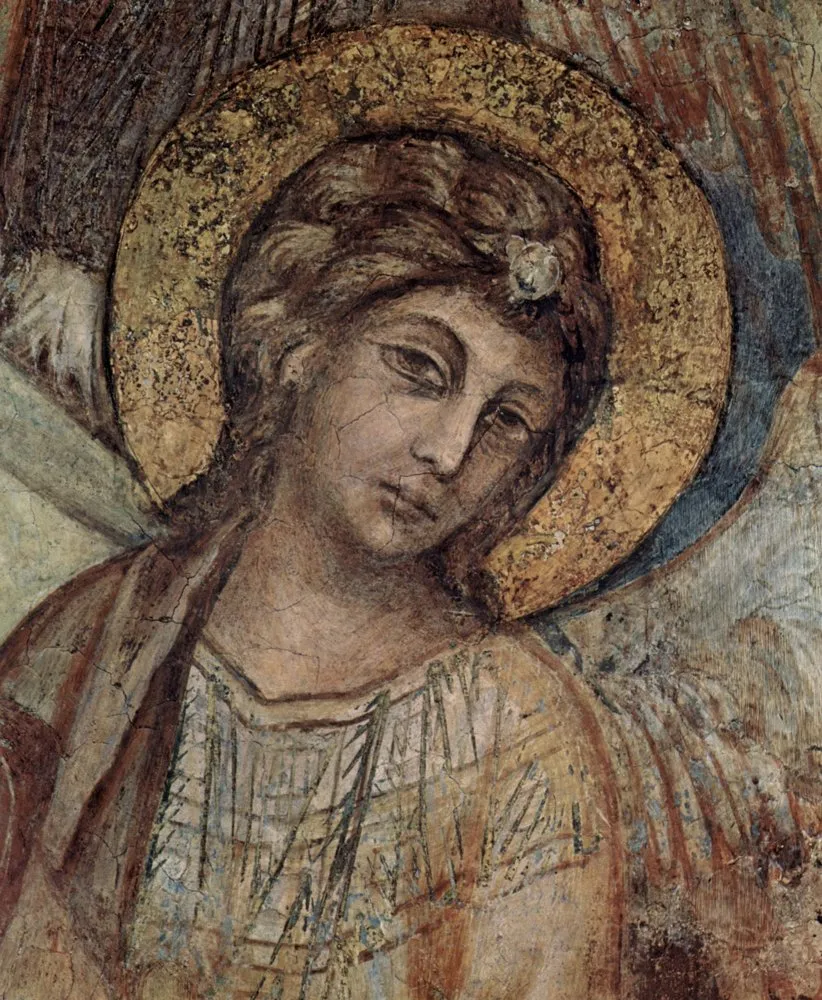
Portrait of Saint Francis of Assisi painted by Cimabue circa 1280 in the Lower Basilica of Assisi, widely considered the earliest and most authentic likeness of the saint (Photo: Historical Archive / Wikimedia Commons / Public Domain).
However, the martial brutality of communal warfare shattered his romantic dreams. In November 1202, Francis rode into armed conflict between Assisi and the neighboring city of Perugia. In the bloody clash of Collestrada, Assisi’s forces were routed; Francis, recognizable by his fine armor and mount, was captured for ransom and imprisoned for over a year in the damp, subterranean vaults of Perugia. That harsh captivity, compounded by debilitating fevers and psychological isolation, planted the first seeds of an enduring existential turning point.
The Great Rupture: Renunciation Before the Bishop of Assisi (1206)
Upon returning home to Assisi, the young man who once squandered his father’s fortune found no solace in worldly pageantry. Two pivotal encounters redefined his path: the first occurred on the plain of Spoleto, where, meeting a leper whose sight had previously filled him with overwhelming disgust, Francis was moved by an irresistible grace, dismounted his horse, pressed a coin into the man’s hand, and kissed his ulcerated flesh, finding that what once tasted bitter turned into sweet solace.
The second transpired at the crumbling country chapel of San Damiano, where, kneeling in prayer before an ancient Byzantine painted crucifix, he heard an interior voice calling to him: «Francis, go and repair my house, which, as you see, is falling into ruin». Interpreting the commission literally, he seized and sold bolts of luxurious dyed cloth from his father’s storehouses to fund the restoration of the shrine.
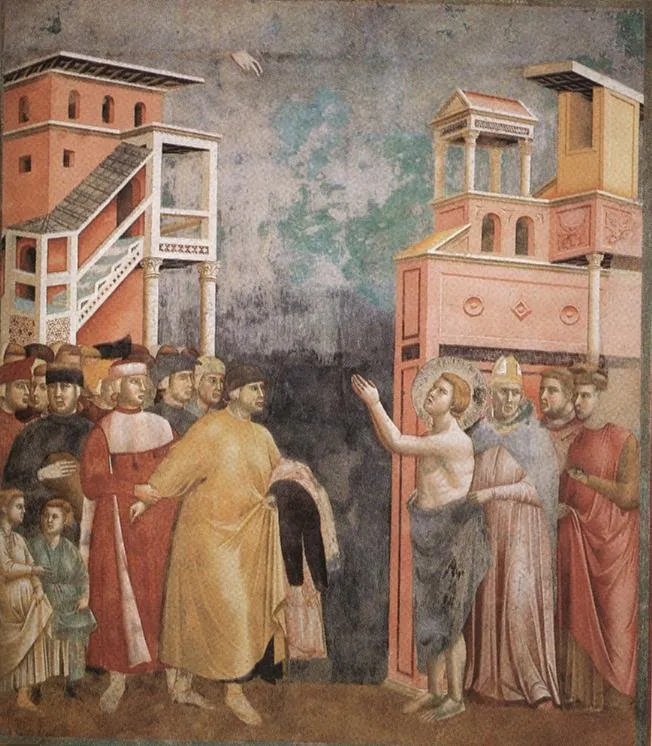
The Renunciation of Worldly Goods depicted by Giotto di Bondone circa 1297–1300 in the Upper Basilica of Assisi: Francis stands stripped bare under Bishop Guido’s mantle while his father clutches his garments (Photo: Wikimedia Commons / Public Domain).
Pietro di Bernardone’s fury over what he perceived as reckless squandering culminated in the spring of 1206 before the municipal tribunal of Bishop Guido II of Assisi. In the open bishop’s square, before townspeople and civil magistrates, Francis returned not only every dispute coin, but stripped off his very clothing, laying them at his father’s feet in absolute destitution, and proclaimed:
«Until now I have called you my father on earth; from now on I can say with unburdened freedom: Our Father who art in heaven, in whose hands I place my wealth and all my hopes».
The bishop, moved to tears by the young man’s earnest resolve, sheltered his nakedness beneath his own episcopal mantle. Francis walked through the town gates clothed in a coarse peasant tunic tied with a hempen rope, entering into a life of voluntary mendicancy, manual church rebuilding, and ministry to the outcast.
The Revolution of Holy Poverty and the Friars Minor
Rather than establishing a cloistered monastic order shielded behind the wealthy walls of a feudal abbey with land rents and tithes, Francis conceived an itinerant brotherhood. To his first companions —penitent nobles, learned jurists, and simple laborers— he gave a deliberately humble designation: Friars Minor (in Latin: Fratres Minores), placing them deliberately on the lowest tier of medieval society.
The center of their life stood Holy Poverty (Sancta Paupertas): conceived not as a bitter curse of destitution, but as radical liberation from greed, institutional power, and warfare. Francis recognized with striking social clarity that whoever amasses private wealth inevitably requires weapons to protect it from others:
«If we possessed property, we should need weapons to defend it. From that spring quarrels, lawsuits, and wars that hinder the love of God and neighbour. For this reason we desire no earthly possessions in this world».
In 1209, Francis and eleven companions journeyed to Rome to seek oral sanction from Pope Innocent III, who, moved by their devotion, granted approval for their evangelical rule. Shortly thereafter, in 1212, the young noblewoman Clare of Assisi (Chiara Scifi) abandoned her palace to embrace the same calling, founding the Second Order of Poor Ladies (subsequently known as the Poor Clares).
The Encounter at Damietta (1219): Unarmed Diplomacy in the Heart of the Crusade
In 1219, during the heights of the Fifth Crusade, Francis sailed across the Mediterranean toward Egypt. Before the fortress city of Damietta in the Nile Delta, crusader armies were laying protracted siege to Muslim garrisons amid brutal carnage and religious hatred.
Defying the warnings of Christian military commanders, Francis crossed enemy lines entirely unarmed accompanied only by Brother Illuminato, carrying no banner save his universal greeting: «Pax et Bonum» (“Peace and All Good”). Captured by Saracen sentries and brought before the Ayyubid Sultan of Egypt, al-Malik al-Kamil (in Arabic: الملك الكامل, nephew of Saladin), Francis brandished no insults nor holy-war ultimatums.
For several days, the destitute Italian friar and the cultured Muslim ruler engaged in respectful dialogue on faith, prayer, and divine mercy. Al-Kamil was so moved by Francis’s gentle courage and spiritual authenticity that he granted him leave to preach, offered precious gifts —which Francis humbly declined—, and provided a safe conduct to return unharmed to the Christian encampment. It was an unprecedented milestone: peace through dialogue without bloodshed amidst medieval religious war.
The Canticle of the Creatures: Wellspring of Italian Literature and Cosmic Ecology
During the winter of 1224 to 1225, confined to a rudimentary wattle hut beside the convent of San Damiano, Francis endured the most agonizing chapter of his life. Afflicted by an Egyptian eye disease that left him nearly blind and intensely photophobic to sun and firelight, his frail body bore the bleeding marks of the stigmata received atop Mount La Verna.
In the heart of this physical darkness, Francis composed the immortal Canticle of the Creatures (in medieval vernacular Umbrian: Càntico de le Creatúre or Càntico del Frate Sole). Universally recognized by scholars as the founding masterpiece of vernacular Italian literature, the hymn is a radiant cosmic symphony in which all creation is addressed as an intimate family:
«Altissimu, onnipotente, bon Signore, / tue so’ le laude, la gloria e l’honore et onne benedictione… / Laudato si’, mi’ Signore, cum tucte le tue creature, / spetialmente messor lo frate sole, / lo qual’è iorno, et allumini noi per lui… / Laudato si’, mi’ Signore, per sora luna e le stelle… / per frate vento et per aere et nubilo et sereno… / per sor’aqua, la quale è multo utile et humile et pretiosa et casta… / per frate focu… / per nostra matre terra… / Laudato si’, mi’ Signore, per sora nostra morte corporale, / da la quale nullo homo vivente pò skappare…»
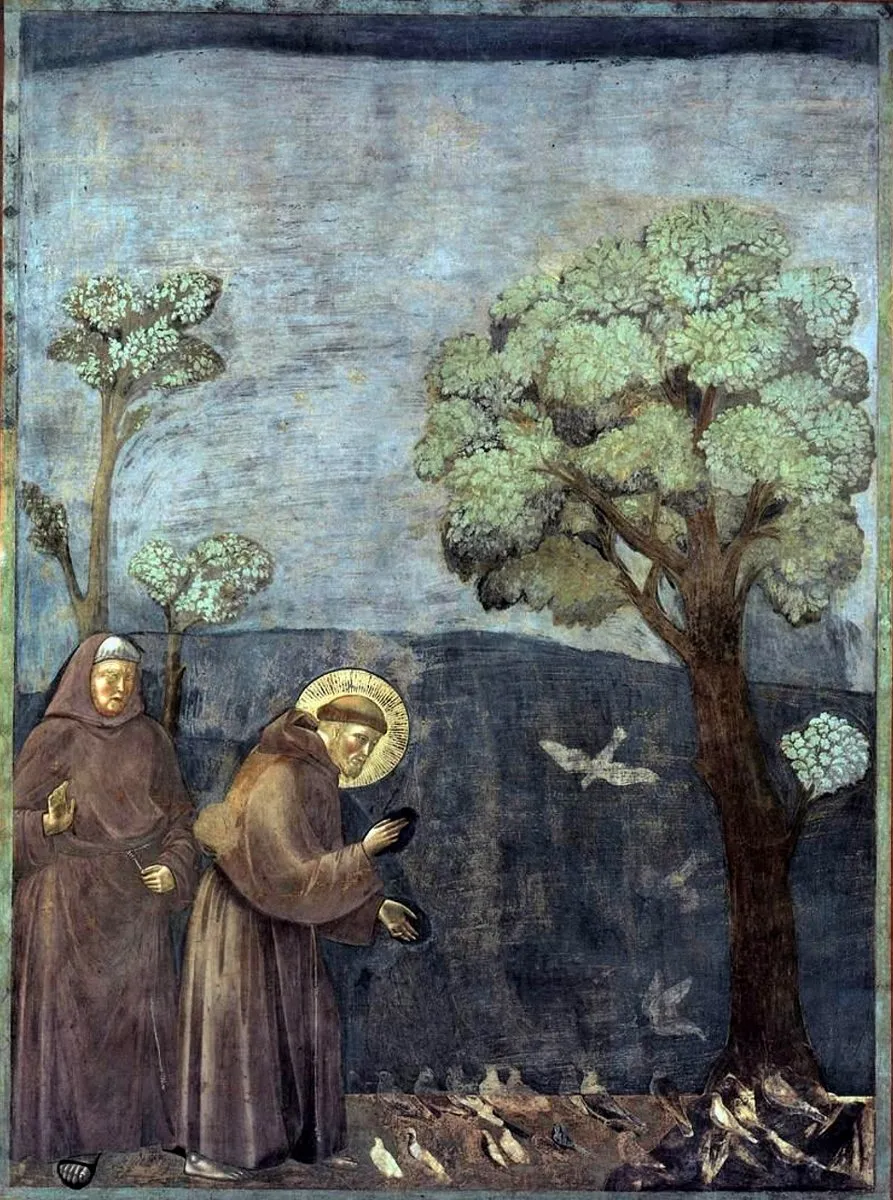
The Sermon to the Birds at Bevagna, painted by Giotto circa 1297–1300 in the Upper Basilica of Assisi: the brotherly dialogue between Francis and living nature (Photo: Wikimedia Commons / Public Domain).
For Francis, the sun is not an inert orb, water a mere resource, or wolves pests to slaughter: they are Brother Sun, Sister Moon, Sister Water, and Mother Earth. In 1979, Pope John Paul II proclaimed Saint Francis the patron saint of ecologists through the bull Inter Sanctos, honoring his timeless insight that humanity shares an indissoluble bond with the living biosphere.
Twilight at the Porziuncola and an Enduring Legacy
Sensing death drawing near, Francis asked to be carried to his beloved hermitage of the Porziuncola in the woods of Santa Maria degli Angeli. On the twilight of October 3, 1226, at the age of forty-four, he asked to be laid bare upon the naked earth, expiring stripped of all worldly vestments in complete harmony with creation. Pious legend recounts that at the moment of his passing, a flock of larks wheeled singing above the thatched roof.
Barely two years later, on July 16, 1228, Pope Gregory IX inscribed his name into the canon of saints. Upon the hill outside Assisi once known as the Hill of Hell, the monumental Basilica of Saint Francis arose, renamed forever as the Hill of Paradise, where Giotto, Cimabue, and Pietro Lorenzetti enshrined his memory in fresco.
Eight centuries later, Francis of Assisi speaks with undiminished resonance. In a twenty-first century beset by ecological crises, warfare, and rampant materialism, his quiet path remains an enduring beacon: that only those who unburden themselves of selfish grasping and embrace the fragility of our world can find abiding peace and the radiant joy of existence.
Documentary Sources and Further Reading
- Catholic Encyclopedia (New Advent): St. Francis of Assisi. Canonical biography, Franciscan early sources, and development of the mendicant order. newadvent.org/cathen/06221a.htm.
- The Holy See (Vatican): Encyclical Letter Laudato si’ of the Holy Father Francis on Care for Our Common Home (2015). vatican.va/content/francesco/es/encyclicals/documents/papa-francesco_20150524_enciclica-laudato-si.html.
- Wikipedia: Francisco de Asís. Biografía, conversión religiosa, viaje a Egipto y canonización. es.wikipedia.org/wiki/Francisco_de_As%C3%ADs.
- Wikipedia (English): Francis of Assisi. Life, ministry, Canticle of the Creatures and patron saint of ecology. en.wikipedia.org/wiki/Francis_of_Assisi.
- Wikipedia: Cántico de las criaturas. Texto original en umbro medieval y trascendencia poética. es.wikipedia.org/wiki/C%C3%A1ntico_de_las_criaturas.
- Wikipedia (English): Canticle of the Sun. Literary analysis of Saint Francis’ hymn. en.wikipedia.org/wiki/Canticle_of_the_Sun.
- Wikipedia: Basílica de San Francisco de Asís. Historia arquitectónica y frescos de Giotto y Cimabue. es.wikipedia.org/wiki/Bas%C3%ADlica_de_San_Francisco_de_As%C3%ADs.
- Wikipedia (English): Al-Kamil. The Ayyubid Sultan of Egypt and his historic meeting with Francis in Damietta (1219). en.wikipedia.org/wiki/Al-Kamil.