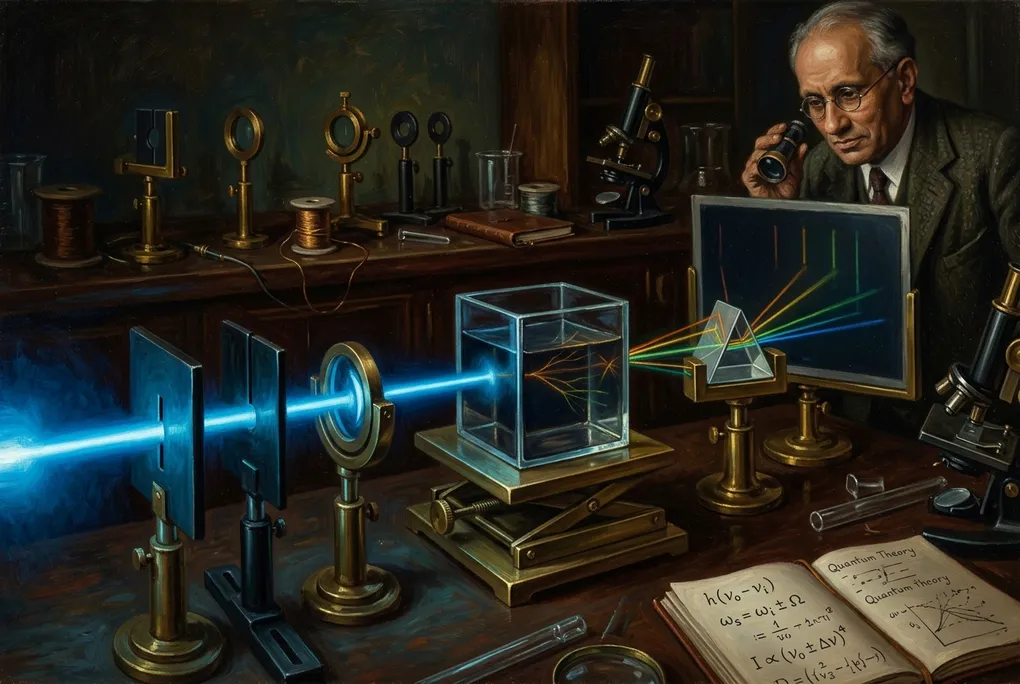
Raman Spectroscopy: The Inelastic Fingerprint of Light and Matter
Table of contents6›
In the summer of 1921, leaning against the deck railing of the passenger steamship SS Narkunda as it cleaved through the open waters of the Mediterranean Sea en route to India, a young physicist stared intently into the unfathomable indigo depths of the water. The prevailing scientific orthodoxy of the era —formulated by the eminent British physicist Lord Rayleigh— asserted that the deep color of the ocean was merely a passive specular reflection of the blue sky above. Doubting that dogma with the calm conviction of an experimentalist, the traveler reached into his coat pocket for a handheld Nicol polarizing prism and a compact spectrograph: by extinguishing the sky’s surface reflections with the prism, he observed with astonishment that the sea’s azure hue did not diminish, but shone with an even richer, opalescent purity. The phenomenon was intrinsic to the molecular body of the liquid itself.
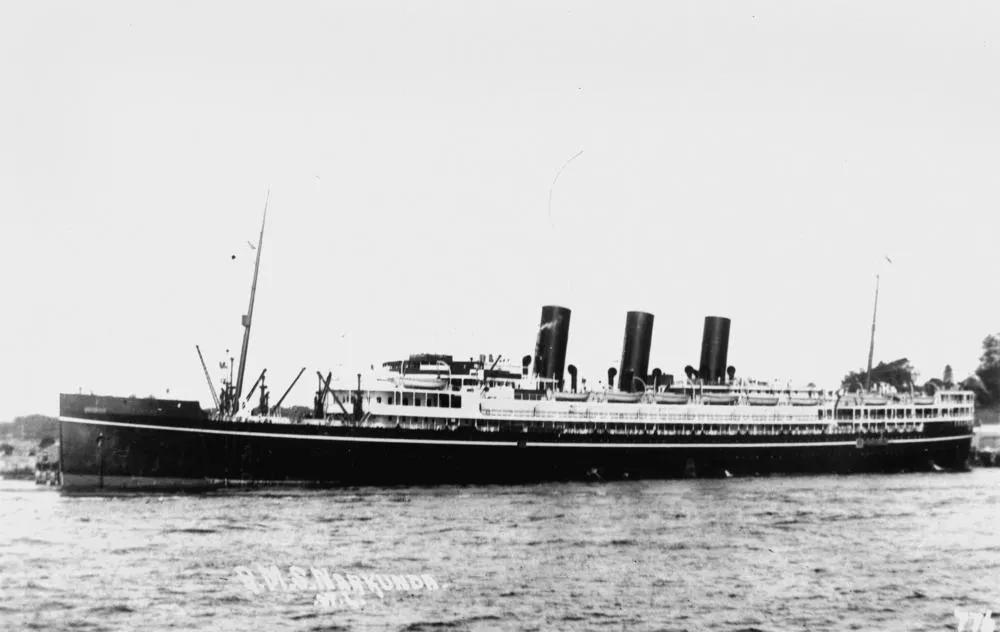
The passenger steamship SS Narkunda aboard which C. V. Raman sailed across the Mediterranean Sea in 1921, questioning the physical origin of the ocean’s azure color (Photo: State Library of Queensland / Public Domain).
That inquisitive traveler was Chandrasekhara Venkata Raman —known universally to history as C. V. Raman (admired for having discovered with modest optical instrumentation and extraordinary physical intuition the inelastic scattering of photons, proving that light can unveil the intimate molecular architecture of matter without disturbing it)—.
In his native Tamil, his name is written as சந்திரசேகர வெங்கட ராமன் (Cantiracēkara Veṅkaṭa Rāmaṉ) and in Sanskrit as चन्द्रशेखर वेङ्कट रामन् (Candraśēkhara Vēṅkaṭa Rāman). His intellectual quest inaugurated one of the most versatile non-destructive analytical techniques in modern science: Raman spectroscopy.
Origins and Early Life: Formative Roots in Tamil Nadu and Calcutta
C. V. Raman was born on November 7, 1888, in Tiruchirappalli, within the Madras Presidency (modern-day Tamil Nadu, India), into a family of Tamil Brahmin scholars:
- Father: R. Chandrasekhara Iyer, a lecturer in mathematics and physics at AVN College in Visakhapatnam, whose rich personal library allowed young Raman to devour early treatises on optics and acoustics by Hermann von Helmholtz and Lord Rayleigh.
- Mother: Parvathi Ammal, a woman of deep musical refinement who introduced traditional South Indian Carnatic music into the household.
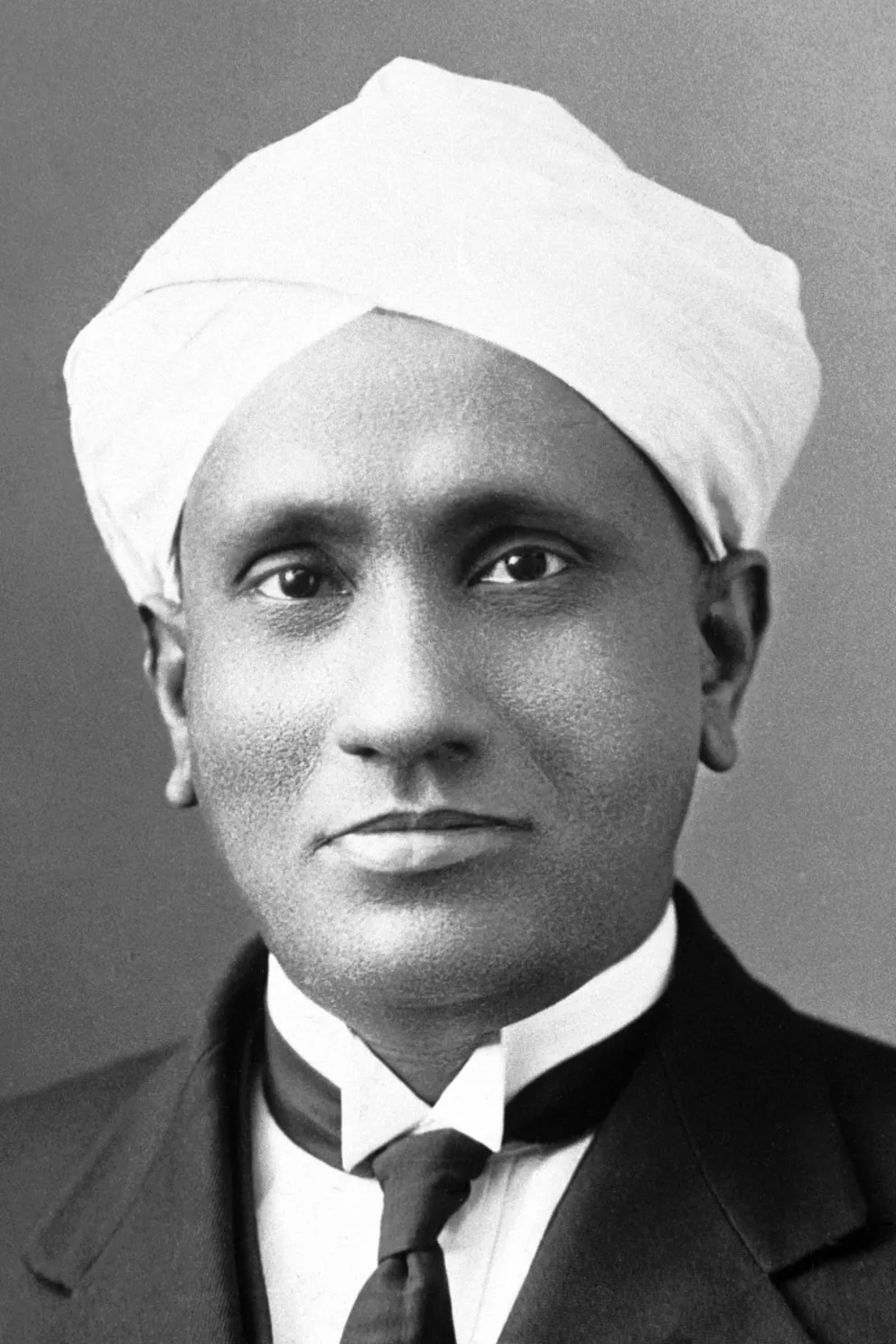
Sir Chandrasekhara Venkata Raman (1888–1970), the first Asian laureate to receive the Nobel Prize in Physics in 1930 (Photo: Historical Archive / Wikimedia Commons / Public Domain).
Displaying prodigious intellect, Raman enrolled at the age of thirteen in the prestigious Presidency College in Madras, graduating with top honors and gold medals in Physics and English at fifteen. In early 20th-century colonial India, however, opportunities for professional scientific research were virtually non-existent for native scholars.
In 1907, having secured first place in the demanding competitive examinations of the Indian Audit and Accounts Service, Raman was posted to Calcutta as an Assistant Accountant General in the Imperial Finance Department. Far from abandoning his calling, he maintained an extraordinary dual discipline for an entire decade: from ten in the morning until five in the afternoon, he audited imperial balance sheets; at dawn and late into the night, he walked to the Indian Association for the Cultivation of Science (IACS), a modest private laboratory founded by the philanthropist Mahendralal Sircar on Bowbazar Street. There, funding optical lenses, prisms, and mercury arc lamps out of his own salary, Raman investigated the acoustics of stringed instruments and optical diffraction.
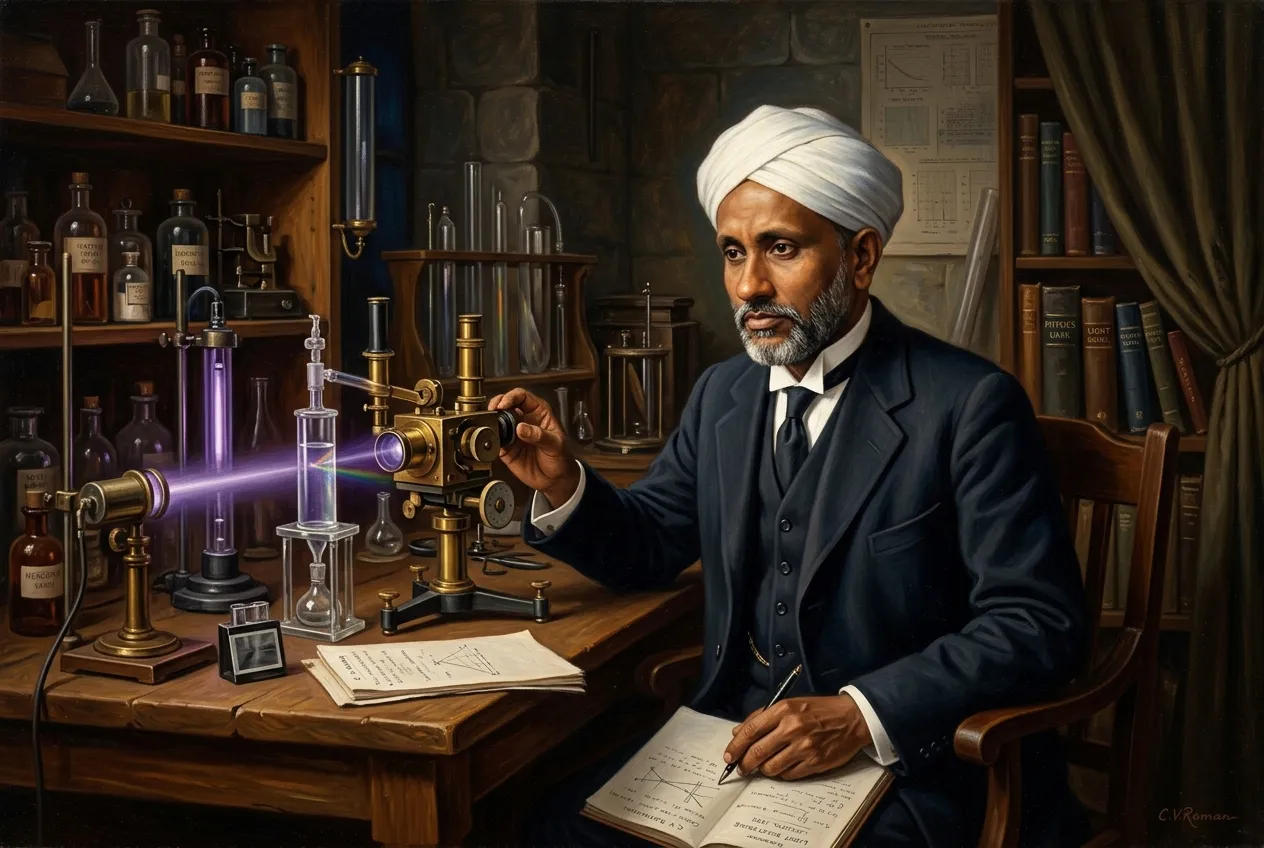
Artistic depiction of C. V. Raman in his Bowbazar Street laboratory in Calcutta, aligning prisms and optical light paths to investigate inelastic scattering.
The Physics of the Raman Effect: The Inelastic Collision of Light
When monochromatic light of frequency $\nu_0$ impinges upon a transparent medium —whether a gas, a liquid, or a crystal— the overwhelming majority of photons undergo an elastic collision with molecular electron clouds: they are scattered without exchanging energy. This elastic phenomenon is Rayleigh scattering, where scattered photons preserve their incident energy and wavelength precisely ($h\nu_{\text{scat}} = h\nu_0$).
On February 28, 1928, after seven years of systematic experimentation alongside his brilliant student K. S. Krishnan, Raman demonstrated that an infinitesimal fraction of the scattered radiation —approximately one photon in every ten million ($10^{-7}$)— underwent an inelastic collision. By coupling with the quantized vibrational normal modes of the molecules, the emerging photons shifted in wavelength.
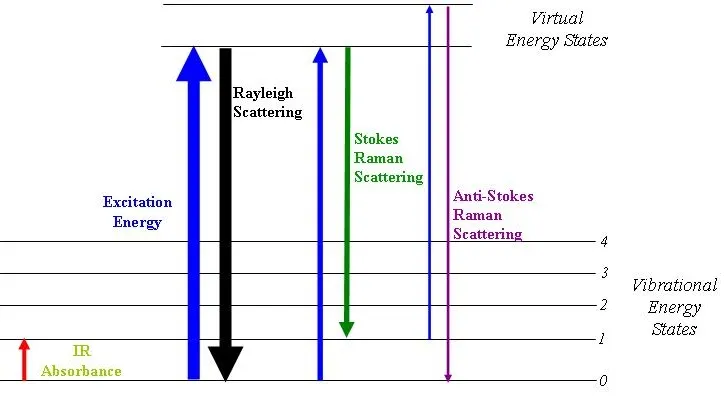
Quantum mechanism of light scattering: elastic Rayleigh collisions contrasted with inelastic Stokes and Anti-Stokes transitions involving molecular vibrational states (Diagram: Wikimedia Commons / CC BY-SA 2.5).
The quantum energy balance of the interaction resolves into two symmetric regimes:
-
Stokes Scattering: The molecule resides initially in its ground vibrational state ($v = 0$). When struck by an incident photon of energy $h\nu_0$, it is momentarily elevated to a short-lived, non-resonant virtual state, decaying almost instantly into an excited vibrational state ($v = 1$). The scattered photon relinquishes part of its kinetic energy and emerges at a lower frequency (longer wavelength): $$h\nu_{\text{Stokes}} = h\nu_0 - h\nu_{\text{vib}}$$
-
Anti-Stokes Scattering: A tiny proportion of molecules already occupy an excited vibrational state ($v = 1$) owing to ambient thermal equilibrium. When the incident photon collides with such a molecule, it relaxes to the ground state ($v = 0$), imparting its vibrational energy to the outgoing photon. The scattered photon gains energy, emerging at a higher frequency (shorter wavelength): $$h\nu_{\text{Anti-Stokes}} = h\nu_0 + h\nu_{\text{vib}}$$
Because the thermal population of molecules across energy states is governed by the canonical Boltzmann distribution, the intensity of Anti-Stokes lines is substantially fainter than that of Stokes lines at room temperature: $$\frac{I_{\text{Anti-Stokes}}}{I_{\text{Stokes}}} = \left(\frac{\nu_0 + \nu_{\text{vib}}}{\nu_0 - \nu_{\text{vib}}}\right)^4 \exp\left(-\frac{h\nu_{\text{vib}}}{k_B T}\right)$$ where $k_B$ represents Boltzmann’s constant and $T$ is absolute temperature in Kelvin. This direct thermal dependence enables Raman spectroscopy to function as an exceptionally precise non-contact optical thermometer at the microscopic scale.
Selection Rules: Polarizability versus Dipole Moment
A fundamental physical principle distinguishing Raman spectroscopy from Infrared (IR) absorption lies in their contrasting quantum mechanical selection rules:
- Infrared Absorption: For a molecular vibration to absorb an IR photon, the atomic displacement must produce a net change in the permanent electric dipole moment $\vec{\mu}$ of the molecule: $$\left(\frac{\partial \vec{\mu}}{\partial Q}\right)_0 \neq 0$$
- Raman Scattering: For a vibrational mode to be Raman-active, the periodic vibration must modulate the molecular polarizability tensor $\alpha$ (the deformability of the electronic cloud in response to an applied electric field $\vec{E}$): $$\left(\frac{\partial \alpha}{\partial Q}\right)_0 \neq 0$$
In centrosymmetric molecules possessing a center of inversion (such as carbon dioxide $\text{CO}_2$ or benzene $\text{C}_6\text{H}_6$), the Rule of Mutual Exclusion dictates that no vibrational normal mode can be simultaneously active in both Raman and infrared spectroscopy. Rather than competing, the two optical techniques act as complementary probes examining orthogonal facets of the same molecular structure.
Universal Recognition and National Science Day
On March 31, 1928, Raman and Krishnan reported their discovery in the journal Nature under the concise title: «A New Type of Secondary Radiation». The finding provided decisive experimental verification for the emerging quantum wave mechanics of Heisenberg, Schrödinger, and Kramers.
In December 1930, the Royal Swedish Academy of Sciences awarded C. V. Raman the Nobel Prize in Physics, making him the first Asian and non-white laureate in any scientific discipline. In his honor, the Government of India designated February 28 —the anniversary of the laboratory breakthrough on Bowbazar Street— as National Science Day (in Hindi: राष्ट्रीय विज्ञान दिवस, Rāṣṭrīya Vijñāna Divasa).
Cutting-Edge Frontiers: From Graphene to the Sands of Mars
With the introduction of monochromatic laser sources in the 1960s and ultra-sensitive charge-coupled device (CCD) spectrometers, Raman spectroscopy underwent a spectacular renaissance:
- Nanomaterials and Graphene Characterization: In condensed matter physics, Raman scattering is the gold standard for determining monolayer thickness, stacking order, and lattice defects in two-dimensional carbon allotropes, resolving with surgical clarity the signature $D$ ($\sim 1350\text{ cm}^{-1}$), $G$ ($\sim 1580\text{ cm}^{-1}$), and $2D$ ($\sim 2700\text{ cm}^{-1}$) bands.
- Space Exploration and Astrobiology: Aboard NASA’s Perseverance rover in Jezero Crater on Mars, the SHERLOC instrument (Scanning Habitable Environments with Raman & Luminescence for Organics and Chemicals) uses a deep-ultraviolet laser ($\lambda = 248.6\text{ nm}$) to search for organic compounds, aromatic ring systems, and biosignatures locked in Martian rock targets.
- Surface-Enhanced Raman Spectroscopy (SERS): By coupling analyte molecules to plasmonic gold or silver nanostructures, SERS amplifies Raman scattering cross-sections by colossal factors of $10^{10}\text{ to }10^{14}$, achieving single-molecule detection of pathogens, chemical toxins, and oncological biomarkers in clinical diagnostics.
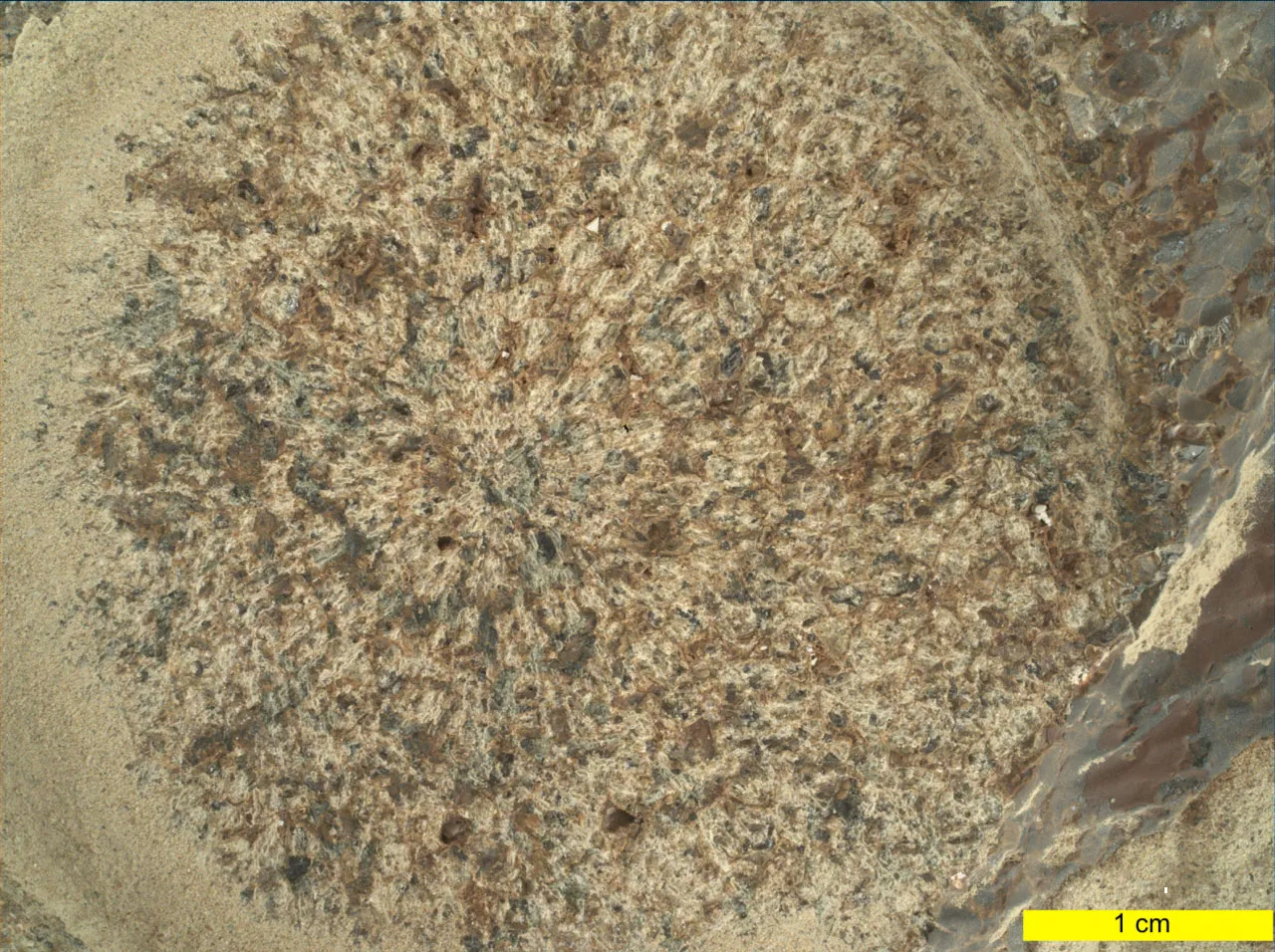
The «Bellegarde» abrasion patch in Jezero Crater, Mars, scrutinized with the deep-UV Raman and fluorescence spectrometer SHERLOC aboard the Perseverance rover (Photo: NASA / JPL-Caltech).
C. V. Raman demonstrated that transformative scientific breakthroughs do not require opulent budgets when accompanied by the intellectual fortitude to interrogate nature with clarity and humility. As he memorably reflected before students in Madras:
«The true spirit of science does not reside in lavish laboratories, but in the capacity to marvel at the sunlight, in the water we drink, and in that incorruptible curiosity that refuses to believe everything has already been discovered».
Documentary Sources and Further Reading
- The Nobel Prize: Sir Chandrasekhara Venkata Raman – Facts and Nobel Lecture (1930). Official archive of the Royal Swedish Academy of Sciences. nobelprize.org/prizes/physics/1930/summary.
- C. V. Raman & K. S. Krishnan (1928): A New Type of Secondary Radiation. Original paper published in the journal Nature. Nature 121, 501–502.
- Wikipedia: Raman Scattering. Quantum mechanical foundations, Stokes/Anti-Stokes transitions, and molecular polarizability. en.wikipedia.org/wiki/Raman_scattering.
- Wikipedia (Spanish): C. V. Raman. Biographical synthesis, optics research in Calcutta, and the founding of the Raman Research Institute. es.wikipedia.org/wiki/C._V._Raman.