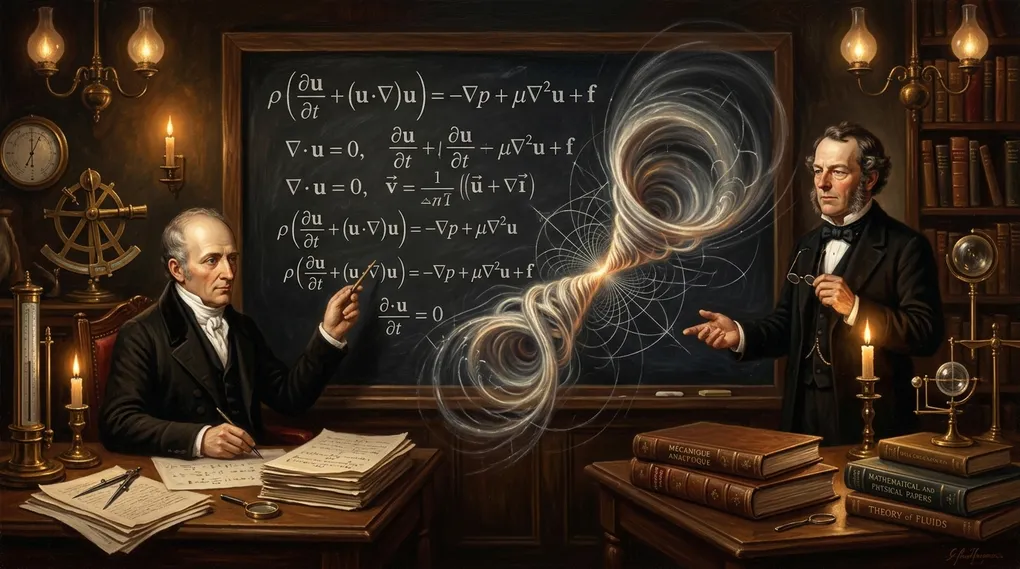
OpenAI and the Navier–Stokes Problem: Finite-Time Singularity and the New Mathematical Frontier
Table of contents›
Throughout my training dedicated to numerical analysis, applied mathematics, and machine learning for the physical sciences (Scientific Machine Learning), few mathematical formulations inspire a reverence as profound as the Navier–Stokes equations. These differential systems stand as the summit of continuum modeling: they encapsulate the swirling rise of smoke, atmospheric turbulence, arterial blood circulation, and the cresting wake of ocean waves.
Yet behind their ubiquity in modern engineering and computational physics, the Navier–Stokes equations have guarded one of the most enigmatic questions in theoretical science: can these equations, starting from smooth or resting initial data, develop a finite-time singularity —where fluid velocity explodes to infinity— or does viscous dissipation forever guarantee smooth, well-behaved solutions?
On September 8, 2026, mathematical research and computational science crossed an unprecedented frontier: OpenAI made public a monumental 166-page analytical manuscript entitled «Finite Time Blowup for Navier–Stokes», accompanied by an open-source formalization repository openai/NavierStokesAndEuler fully certified in the Lean 4 interactive theorem prover. Far from being a heuristic numerical approximation powered by neural networks, the work provides a rigorous constructive proof that resolves both Alternative (C) and Alternative (D) of the Millennium Prize Problem formulated by the Clay Mathematics Institute, alongside a companion theorem establishing finite-time blowup for the classical unforced Euler equations.
In what follows, we examine the historical genesis of these hydrodynamic laws, the analytical mechanisms governing the counterexample, and the immediate implications rippling across the global mathematical community.
Historical Origins: From the Seine to the Cam
The theoretical framework of viscous fluid dynamics was built upon the insights of two pioneers of nineteenth-century science:
Born in Dijon in February 1785, Claude-Louis Navier (admired for his bold physical intuition in introducing intermolecular cohesive forces into fluid dynamics and founding the modern theory of structural elasticity; 1785–1836) was orphaned in early childhood amidst the upheaval of the French Revolution. Raised under the strict tutelage of his uncle, the distinguished public works engineer Émiland Gauthey, Navier entered the École Polytechnique in 1802 and subsequently the École des Ponts et Chaussées, where he would later become a celebrated professor.
In 1822, Navier presented his groundbreaking memoir «Mémoire sur les lois du mouvement des fluides» before the Académie des Sciences in Paris. Until then, fluid mechanics relied solely on Leonhard Euler’s ideal fluid equations (1757), which neglected internal friction (frottement intérieur). Drawing upon a Newtonian molecular hypothesis, Navier deduced that microscopic attractions and repulsions between adjacent fluid layers generate a term proportional to the spatial Laplacian of velocity.
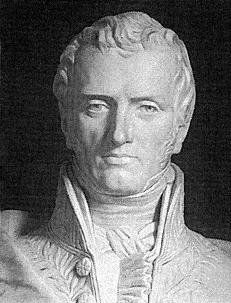 Claude-Louis Navier (1785–1836), French engineer and mathematician who pioneered continuum mechanics. Source: Wikimedia Commons / Public domain.
Two decades later, at the University of Cambridge, Anglo-Irish mathematical physicist Sir George Gabriel Stokes (admired for his unsurpassed mathematical rigor in deriving fluid viscosity from kinematic first principles and bridging harmonic analysis with mathematical physics; 1819–1903) brought the theory to its definitive mathematical formulation.
The son of a rector from Skreen in County Sligo, Ireland, Stokes entered Pembroke College, Cambridge, where he graduated as Senior Wrangler and First Smith’s Prizeman in 1841, ascending to the prestigious Lucasian Chair of Mathematics in 1849. In his seminal 1845 paper «On the Theories of the Internal Friction of Fluids in Motion», Stokes discarded Navier’s speculative molecular assumptions, deriving the equations directly from continuum kinematic principles: he proved that in an isotropic, Newtonian fluid, the viscous stress tensor depends linearly upon the symmetrized velocity gradient.
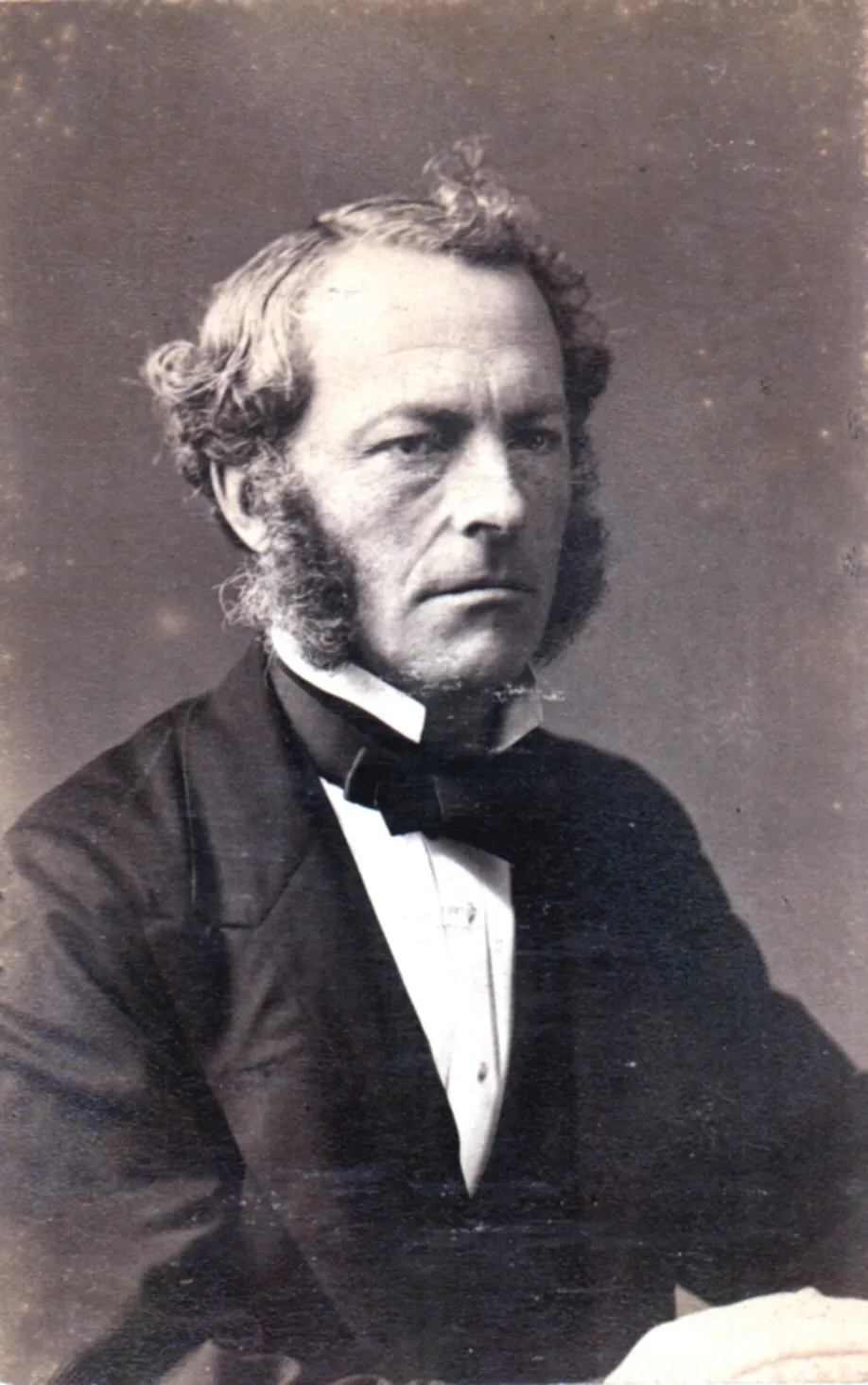 Sir George Gabriel Stokes (1819–1903), Lucasian Professor of Mathematics at Cambridge. Source: Wikimedia Commons / Public domain.
Mathematical Anatomy: Convection versus Dissipation
In three spatial dimensions, for an incompressible, homogeneous fluid with kinematic viscosity $\nu > 0$, the Navier–Stokes equations take the classical vector form:
$$\partial_t u + (u \cdot \nabla)u - \nu \Delta u + \nabla p = f, \quad \nabla \cdot u = 0$$
subject to initial data:
$$u(x, 0) = u_0(x)$$
where:
- $u(x, t) = (u_1, u_2, u_3) \in \mathbb{R}^3$ denotes the fluid velocity field at coordinate $x$ and time $t$.
- $p(x, t) \in \mathbb{R}$ is the scalar pressure field, acting kinematically as a Lagrange multiplier enforcing the divergence-free incompressibility constraint ($\nabla \cdot u = 0$, incompressibilitas).
- $\nu > 0$ represents the kinematic viscosity (denoted by Greek letter $\nu$, nu), quantifying the fluid’s internal resistance to shear stress.
- $f(x, t) \in \mathbb{R}^3$ is an external body force applied to the fluid parcel.
The fundamental drama of these equations lies in the competition between two opposing forces:
- Nonlinear advection $(u \cdot \nabla)u$: Captures the transport of fluid momentum by its own velocity field. This quadratic term is destabilizing: it drives three-dimensional vortex stretching, cascades kinetic energy toward arbitrarily fine spatial scales, and accelerates local velocity gradients toward potential blowup.
- Viscous diffusion $-\nu \Delta u$: Governed by the spatial Laplacian operator $\Delta = \sum_{i=1}^3 \partial_{x_i}^2$, this linear term acts as an intrinsic dissipative shield: it disperses concentrated kinetic energy, dampens steep velocity gradients, and converts mechanical motion into thermodynamic heat.
In two dimensions ($d = 2$), mathematical physics settled the regularity question decades ago: vorticity conservation prevents vortex stretching, ensuring that every initially smooth solution remains smooth indefinitely. In three dimensions ($d = 3$), however, vortex stretching introduces an unconstrained nonlinear amplification.
In 1934, French mathematician Jean Leray introduced weak turbulent solutions (solutions faibles), establishing global existence in the energy space $L^\infty_t L^2_x \cap L^2_t H^1_x$. Yet Leray could not resolve whether these weak solutions preserve their classical smoothness or whether they inevitably break down into infinite-velocity singularities: the elusive finite-time blowup.
The Millennium Problem: Fefferman’s Fourfold Formulation
In May 2000, the Clay Mathematics Institute established the seven Millennium Prize Problems, offering a million-dollar prize for the solution to each.
The official statement for the Navier–Stokes existence and smoothness problem was authored by Charles Fefferman, Fields Medalist in 1978. In his foundational formulation, Fefferman outlined four distinct mathematical alternatives:
- Alternative (A): Global existence and smoothness on the entire Euclidean space $\mathbb{R}^3$ without external forcing ($f = 0$).
- Alternative (B): Global existence and smoothness on the periodic three-torus $\mathbb{T}^3 = \mathbb{R}^3/\mathbb{Z}^3$ without forcing ($f = 0$).
- Alternative (C) — Breakdown on $\mathbb{R}^3$ with physically reasonable force: Prove that for any viscosity $\nu > 0$, there exists a smooth, divergence-free external force $f(x, t)$ with rapid decay and smooth initial data such that no global smooth solution exists with uniformly bounded kinetic energy.
- Alternative (D) — Breakdown on the periodic torus $\mathbb{T}^3$ with smooth force: Establish the analogous finite-time singularity under spatially periodic boundary conditions.
For twenty-five years, mainstream mathematical research focused on trying to prove Alternative (A)—seeking to demonstrate that fluids cannot break down. Major figures including Luis Caffarelli, Robert Kohn, Louis Nirenberg (1982), Vladimír Šverák, and Terence Tao pushed partial regularity theory to its limits, yet the question of blowup remained unresolved.
OpenAI’s Triple Breakthrough: Navier–Stokes (C & D) and Euler
The scientific package released by OpenAI on September 8, 2026, spans three constructive proofs of finite-time breakdown:
1. Breakdown on Euclidean Space $\mathbb{R}^3$ (Alternative C)
Theorem 1.1 (OpenAI, 2026):
For every viscosity $\nu > 0$, there exist an external force:$$f \in C^\infty_c(\mathbb{R}^3 \times (0, \infty); \mathbb{R}^3)$$
a compact set $K \subset \mathbb{R}^3$, and smooth velocity and pressure fields $u, p$ on $\mathbb{R}^3 \times [0, 1)$ satisfying:
$$\partial_t u + (u \cdot \nabla)u - \nu \Delta u + \nabla p = f, \quad \nabla \cdot u = 0, \quad u(\cdot, 0) = 0$$
with spatial support contained in $K$ for all $0 \le t < 1$, such that:
$$\sup_{0 \le t < 1} |u(t)|{L^2(\mathbb{R}^3)} < \infty, \quad \limsup{t \uparrow 1} |u(t)|_{L^\infty(\mathbb{R}^3)} = \infty$$
Consequently, no smooth solution $(u, P)$ exists on $\mathbb{R}^3 \times [0, \infty)$ with the same force and initial data whose kinetic energy remains uniformly bounded.
2. Breakdown on the Periodic Torus $\mathbb{T}^3$ (Alternative D)
Through localized vector potential cutoffs and periodic spatial tiling, the construction directly adapts to the three-dimensional torus $\mathbb{T}^3 = \mathbb{R}^3/\mathbb{Z}^3$, demonstrating that smooth periodic forcing can induce finite-time velocity blowup without violating data smoothness.
3. Breakdown of the Unforced 3D Euler Equations
In a companion work entitled «Finite Time Blowup for the Euler Equation», OpenAI constructed smooth, compactly supported, divergence-free initial velocity on $\mathbb{R}^3$ whose evolution under the inviscid Euler equations without any external forcing ($f = 0$) develops a singularity in finite time:
- The velocity’s $C^1$ norm becomes unbounded near the blowup time.
- The classical Beale–Kato–Majda (BKM) blowup criterion is fulfilled: the time integral of the vorticity’s $L^\infty$ norm diverges:
$$\int_0^{T^*} |\omega(t)|_{L^\infty(\mathbb{R}^3)} , dt = \infty$$
Architecture of the Blowup: Anisotropic Vortex and Wave Cancellation
The core mathematical architecture of the Navier–Stokes construction rests upon two remarkable mechanisms:
-
The Anisotropic Self-Similar Vortex:
Rather than positing an isotropic radial contraction, OpenAI engineered an axisymmetric vortex column in cylindrical coordinates $(r, \theta, z)$ whose radial and axial scales shrink at unequal rates. Defining $\tau = 1 - t$ as the time remaining before the singularity ($t \uparrow 1$):$$\ell_r \asymp \tau^{1/2}, \quad \ell_z \asymp \tau^{1/2 - h}, \quad 0 < h < \frac{1}{100}$$
Because $\ell_r / \ell_z \sim \tau^h \to 0$, the vortex contracts into an exceedingly slender thread focused at the origin, with its physical volume vanishing as $\tau^{3/2 - h}$.
-
Unbounded Velocity with Finite Kinetic Energy:
The azimuthal and axial velocity scales explode toward infinity:$$|u_\theta^{(0)}|, \quad |u_z^{(0)}| \asymp \tau^{-1/2 - h}, \quad |u_r^{(0)}| = \mathcal{O}(\tau^{-1/2})$$
Despite this local blowup ($\limsup_{t \uparrow 1} |u(t)|_{L^\infty} = \infty$), the total kinetic energy inside the core decreases as $\tau^{1/2 - 3h} \to 0$, strictly complying with the finite energy bounds demanded by Fefferman’s formulation.
-
Momentum Residual Cancellation via Oscillatory Pulses:
The primary obstacle in matching self-similar vortex cores to a quiescent exterior is the momentum residual generated in the transition annulus. For unperturbed profiles, this residual diverges as $t \uparrow 1$, which would demand a singular external force.
To eliminate this error, OpenAI introduced a sequence of spatially oscillatory pulses localized in concentric rings around the vortex. These high-frequency wave packets extract energy from background shear via hydrodynamic instabilities. Their quadratic momentum fluxes—analogous to turbulent Reynolds stresses—cancel the singular momentum residuals to all orders of differentiation, leaving a residual force $f$ that is smoothly extendable ($C^\infty_c$) with compact support.
Formal Verification in Lean 4: Algorithmic Certification
When complex proofs exceeding hundreds of pages are introduced, peer review traditionally demands years of validation. Past history in partial differential equations is rife with celebrated blowup claims that ultimately collapsed under overlooked technical flaws.
To preempt skepticism, OpenAI accompanied the analytical treatise with the open-source repository openai/NavierStokesAndEuler, providing a complete formal verification in Lean 4 (version v4.34.0-rc2), built against Mathlib and packaged with Lake.
The repository includes independent cross-validation configurations through the Comparator toolchain. In Lean, every Hilbert space embedding, fractional Sobolev estimate, integration by parts, and asymptotic bound is verified mechanically by the kernel’s deterministic type checker. The mathematical conclusion is machine-certified.
Immediate Repercussions (September 9–10, 2026): A Shifting Paradigm
Within 48 hours of publication, the mathematical physics community began actively extending the result:
-
Preprints by Cao and Chi on arXiv:
On September 9, 2026, mathematicians Shaozhen Cao and Zhuoni Chi released two preprints (arXiv:2609.10262 and arXiv:2609.10269). Utilizing OpenAI’s localized blowup packet, they studied the distribution of singular data in fractional Sobolev spaces $L^1_t H^s_x(\mathbb{T}^3)$ and $L^1_t H^s_x(\mathbb{R}^3)$, proving that the set of smooth forces producing finite-time breakdown from rest is dense if and only if $s < 1/2$, identifying a sharp regularity threshold for instability. -
Automated Reasoning in Frontier Research:
The authors documented their use of advanced reasoning models (such as OpenAI’s GPT Astra) to inspect Lean formalizations, verify analytical inequalities, and survey complex mathematical literature. This highlights a profound shift: automated reasoning has evolved from trivial coding assistants into engines of deep conceptual exploration in modern analysis. -
The Open Frontier: Alternative (A):
With Alternatives (C) and (D) resolved, Fefferman’s Alternative (A)—whether an unforced Navier–Stokes fluid ($f = 0$) can spontaneously develop a singularity on $\mathbb{R}^3$—remains open. Yet OpenAI’s construction demolishes the long-held dogma that physical viscosity provides an unconditional guarantee against singularities.
Two centuries after Claude-Louis Navier and Sir George Gabriel Stokes set quill to paper, the mathematical study of fluids enters a transformative era: one where classical continuous analysis and automated proof verification unite to illuminate the delicate boundary between smoothness and turbulence.
References and Recommended Reading
- OpenAI (2026): Finite Time Blowup for Navier–Stokes. Official 166-page manuscript presenting Theorem 1.1 and the resolution of Alternatives (C & D) of the Millennium Problem. Official PDF Document.
- OpenAI Lean Repository (2026): Formal verification code and certificates in Lean 4 for Navier–Stokes and Euler blowup. openai/NavierStokesAndEuler on GitHub.
- Clay Mathematics Institute: Official description of the Navier–Stokes Millennium Prize Problem. The Millennium Prize Problems: Navier–Stokes Equation.
- Charles L. Fefferman: Existence and Smoothness of the Navier–Stokes Equation. Formal statement of Alternatives (A, B, C, D). Official CMI Document (PDF).
- Shaozhen Cao & Zhuoni Chi (2026): Distribution of Singular Data Generated by Compact Forced Navier-Stokes Blowup. arXiv preprint establishing the fractional Sobolev threshold $s < 1/2$. arXiv:2609.10262.
- Shaozhen Cao & Zhuoni Chi (2026): Singular Forces on the Whole Space: Sobolev Density Thresholds and Energy Approximation. Extension to Euclidean space $\mathbb{R}^3$. arXiv:2609.10269.
- Terence Tao (2016): Finite time blowup for an averaged three-dimensional Navier-Stokes equation. Precursor demonstration of blowup in averaged systems. arXiv:1402.0290.
- Tristan Buckmaster & Vlad Vicol (2019): Nonuniqueness of weak solutions to the Navier-Stokes equation. Landmark application of convex integration in mathematical fluid dynamics. arXiv:1709.10033.