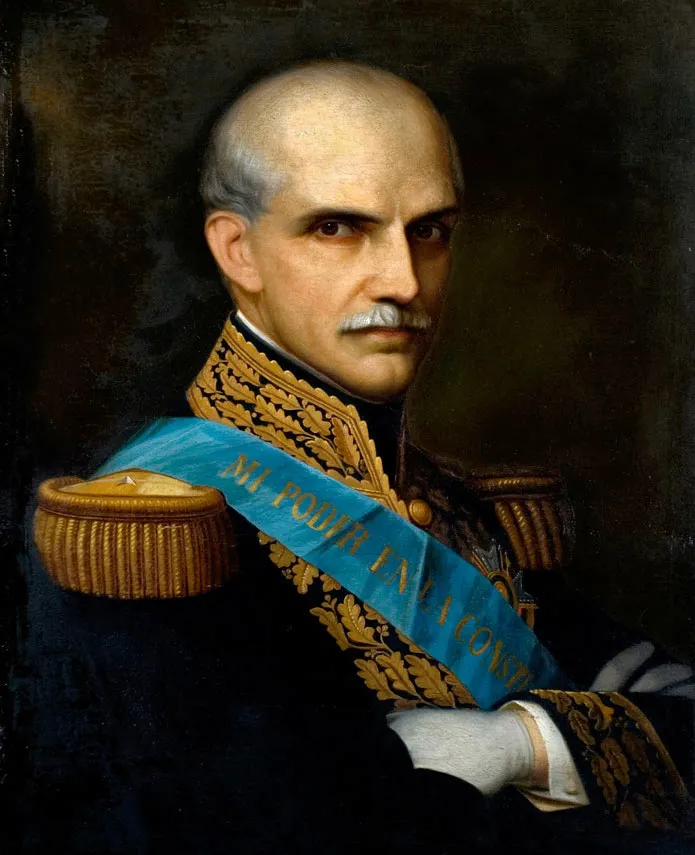
Gabriel García Moreno: The Theocratic State, Scientific Modernization, and the Republican Paradox
Table of contents9›
Few figures in nineteenth-century Latin American history cast a shadow as monumental, contradictory, and polarizing as Gabriel García Moreno (admired for his titanic intellectual discipline, his pioneering scientific vision in founding the National Polytechnic School and the Quito Astronomical Observatory, and his iron determination to unite a fractured nation hovering on the brink of territorial dismemberment). To conservative and clerical historiography, he was a providential statesman and incorruptible martyr who rescued Ecuador from dissolution and anarchy; to radical nineteenth-century liberalism, crystallized in the impassioned prose of Juan Montalvo, he personified an oppressive theocracy that subordinated constitutional sovereignty to Catholic dogma.
Beyond hagiographic adulation and the partisan black legend, a serene, objective examination of his life reveals a far more complex historical reality: the coexistence within a single, unyielding political will of rigid confessional authoritarianism and the most ambitious, technically advanced program of scientific, infrastructural, and academic modernization undertaken in nineteenth-century Ecuador.
1. Family Origins, Childhood in Guayaquil, and Academic Training in Quito
Gabriel García Moreno was born in the port city of Guayaquil on December 24, 1821, on the eve of South American independence and mere months prior to the decisive Battle of Pichincha. He was the eighth and youngest child of Gabriel García Gómez, a Spanish nobleman and merchant native to Villaverde del Ducado (Castile-La Mancha, Spain), and Mercedes Moreno y Morán de Butrón, a daughter of the prominent Guayaquileña aristocracy connected to the municipal cabildo and sister to both the doctoral canon of Quito Cathedral and the bishop of Guayaquil.
His early childhood was shadowed by economic hardship. Following Guayaquil’s declaration of independence in 1820 and the severance of transatlantic commercial routes with Spain, the family merchant enterprise collapsed into bankruptcy. When his father died around 1830, doña Mercedes assumed the sole responsibility for her son’s early upbringing with Spartan rigor, teaching him grammar, elementary Latin, and an uncompromising, disciplined Catholic piety.
Recognizing his extraordinary intellect, the Mercedarian friar José Betancourt secured a scholarship for the fifteen-year-old youth to enter the prestigious Colegio Real de San Fernando in Quito. His academic asceticism was renowned: living in near-monastic seclusion, he attained complete mastery of classical Latin, French, and formal rhetoric. Although initially inclined toward the priesthood and receiving minor orders, he concluded that his combative temperament was better suited to the public square. Relinquishing the tonsure, he enrolled in the Faculty of Jurisprudence at the Central University of Ecuador, graduating with a Doctorate in Laws in 1848 after presenting notable theses on Roman civil law, political economy, and canon law.
2. Exile in Paris and Scientific Vocation: The Sorbonne and Andean Volcanoes
García Moreno’s early political career was defined by visceral opposition to the corrupt militarist caudillismo headed by General José María Urbina. His relentless broadsheets (El Vengador, El Diablo) led to his exile to Colombia and, subsequently, an intellectual sojourn in Europe between 1854 and 1856.
His years in Paris during Napoleon III’s Second Empire decisively reshaped his worldview. Rather than indulging in the idle leisure common among political exiles, García Moreno enrolled in the Faculty of Sciences at the Sorbonne (Université de Paris) and attended lectures at the Collège de France. Dedicating fourteen hours daily to the systematic study of inorganic chemistry, experimental physics, differential calculus, geology, and mineralogy, he acquired a comprehensive foundation in the exact sciences unmatched by any other Latin American head of state of his generation.
His engagement with geology was practical and empirical:
- He ascended Mount Vesuvius in Italy, descending into its active crater to harvest volcanic gas samples and record thermometric and barometric data.
- In 1845 and 1857, he had ascended the Andean volcano Pichincha on two separate expeditions, lowering himself by ropes along its inner crater walls to measure sulfur fumarole temperatures with mercury barometers.
- His technical memoirs on Andean volcanism were submitted to the Académie des Sciences in Paris and published in the renowned Comptes Rendus, earning the esteem of distinguished naturalists such as Élie de Beaumont and Jean-Baptiste Boussingault.
From his European experience, García Moreno synthesized a governing conviction that would anchor both of his future presidencies: Ecuador was an inert body paralyzed by local warlordism and technical ignorance; only the infusion of rigorous European scientific methodology, disciplined by the moral authority of the Catholic Church, could save the republic from total disintegration.
3. The National Collapse of 1859 and the Refounding of the State
Upon his return, the republic plunged in 1859 into the most terrifying existential crisis of its history. Ecuador fractured simultaneously into four rival, autonomous regional governments:
- A triumvirate in Quito headed by García Moreno himself;
- A military dictatorship in Guayaquil commanded by General Guillermo Franco;
- An autonomous provincial council in Cuenca under Jerónimo Carrión;
- An independent federal enclave in Loja declared by Manuel Carrión Pinzano.
Compounding the disaster, a Peruvian naval fleet dispatched by President Ramón Castilla blockaded and occupied the Gulf of Guayaquil. The rebel chieftain Franco signed the humiliating Treaty of Mapasingue (1860), which ceded territorial sovereignty in the Amazon basin to Peru in exchange for foreign military backing.
In a military campaign executed with extraordinary resolve, García Moreno formed an alliance with his former political adversary, veteran General Juan José Flores, rallied loyalist regiments in the central-northern highlands, and marched toward the coast. Traversing mud-choked ravines across the freezing passes of Chimborazo that contemporaries deemed impassable for infantry, the constitutionalist army surprised Franco’s garrison on September 24, 1860, storming Guayaquil via the Salado estuary and driving out the occupying foreign fleet. National dismemberment had been averted, but it solidified García Moreno’s unshakeable conviction: only an unyielding, centralized state, completely ruthless toward insurrection, could guarantee the survival of the Ecuadorian nation.
4. The Modernizing Project: The National Polytechnic and the Astronomical Observatory
Elected constitutional president for the terms 1861–1865 and 1869–1875, García Moreno channeled the treasury’s resources into an unprecedented educational and technical revolution.
Observing that the Central University had decayed into dry scholasticism, forensic legalism, and rote memorization, in August 1869 he decreed the creation of the National Polytechnic School (Escuela Politécnica de Quito). To establish it at the pinnacle of European standards, he capitalized on Otto von Bismarck’s Kulturkampf expulsions in Germany, contracting an elite corps of German Jesuit scientists of international acclaim:
- Juan Bautista Menten: Astronomer and mathematician, direct disciple of Friedrich Wilhelm Argelander at the Bonn Observatory, appointed first dean and director of the national observatory.
- Franz Theodor Wolf: Geologist and mineralogist from the University of Tübingen, appointed to the chair of geology to survey the first official geological and topographical map of Ecuador.
- Ludwig Sodiro: Renowned botanist, founder of Ecuadorian plant taxonomy and pioneer in cataloging Andean cryptogams and pteridophytes.
- Joseph Kolberg and Christian Boetzkes: Physicists, civil engineers, and mathematicians trained in Prussian technical academies.
The Polytechnic was equipped with chemical laboratories imported from Germany, mineralogical cabinets, geodetic theodolites, and mechanical casting workshops that trained the republic’s first generation of indigenous civil engineers, topographers, and industrial chemists.

The Quito Astronomical Observatory, built in La Alameda Park between 1873 and 1877 under the direction of German Jesuit Juan Bautista Menten. Commissioned by García Moreno, it stood as the most modern astronomical station in South America at the equatorial latitude. (Source: Historical Archives / Wikimedia Commons).
To crown this scientific apparatus, in 1873 he ordered the construction of the Quito Astronomical Observatory in La Alameda Park. Modeled after the Bonn Observatory, it was furnished with a precision Merz equatorial refractor telescope with a $16,\text{cm}$ objective lens, a Repsold transit circle, and master astronomical chronometers, placing Quito at the forefront of equatorial positional astronomy and southern-sky celestial mechanics.
5. Infrastructure and Fiscal Hygiene: The National Highway and Public Credit
Garcian modernization extended far beyond the classroom. Enforcing an unsparing personal integrity that penalized corrupt officials with immediate imprisonment and dismissal, he balanced the treasury and instituted the republic’s first audited national budgets based on centralized customs accounting.
- The Southern National Highway (Carretera García Moreno): Overcoming the historical separation between coast and highlands, he planned and funded a monumental $300\text{-kilometer}$ paved carriage road linking Quito, Riobamba, and Sibambe to the fluvial network of the Guayas basin.
- The Transandine Railway and Telegraph: He inaugurated the earliest rail grade excavations from Yaguachi toward the interior and laid the nation’s first electric telegraph lines.
- The Panopticon of Quito (Penal García Moreno): Designed strictly on Jeremy Bentham’s panoptic architectural model with radiating cell blocks monitored from a central watchtower, it introduced vocational rehabilitation through industrial blacksmithing, shoemaking, and carpentry workshops.
- The Bank of Ecuador (1868): He facilitated the founding of the country’s first modern commercial bank of issue in Guayaquil, providing liquidity for commerce and stabilizing the fiduciary currency.
6. The Confessional State, the «Black Constitution», and the Liberal Clash
The authoritarian reverse of García Moreno’s modernization was the establishment of a dogmatic, unyielding confessional state. Convinced that Ecuadorian cohesion could never rest upon a secular liberal pact—which he equated with moral decay and Jacobin anarchy—he declared that the Roman Catholic faith must serve as the sole cultural and civic foundation of the republic.
- The Concordat of 1862: Ratified with Pope Pius IX, it represented the most sweeping agreement signed by any nineteenth-century state with the Holy See, granting the episcopate complete censorship over printed literature, educational oversight, and the restoration of ecclesiastical courts.
- The Constitution of 1869 («La Carta Negra»): Approved following a preemptive executive coup, Article 10 mandated that citizenship was strictly contingent upon being a practicing Catholic. It extended presidential mandates to six years with indefinite non-consecutive reelection and granted the executive unchecked emergency powers to suspend civil liberties.
- Repression and the Firing Squad: Liberal uprisings and mutinies were extinguished without mercy. Conspirators and rebel commanders were executed by military tribunals (notably Colonel José Vallejo and General Manuel Tomás Maldonado), while hundreds of political dissidents were exiled to the Amazonian wilderness or driven into Colombia and Peru.
- The Cacha Uprising (1871): The compulsory four-day annual labor levy (trabajo subsidiario) imposed on indigenous communities to build the road network, paired with ecclesiastical tithes, ignited a massive Puruhá rebellion led by Fernando Daquilema and Manuela León in Chimborazo. The army crushed the rebellion, and Daquilema was executed by firing squad in April 1872, exposing the severe human costs of the regime’s forced development.
From his Colombian exile in Ipiales, liberal intellectual Juan Montalvo waged an unforgiving literary crusade through El Cosmopolita and the explosive pamphlet La Dictadura Perpetua (1874), castigating the president as a clerical tyrant and urging the youth to rise against his perpetual rule.
7. The Assassination of August 6, 1875: «God Does Not Die!»
In May 1875, García Moreno was reelected to a third presidential term that would extend his presidency to 1881. The certainty of another six years of autocracy spurred a clandestine conspiracy among young liberal intellectuals in Quito (Roberto Andrade, Manuel Cornejo, Abelardo Moncayo) and an embittered Colombian officer cashiered from service: Captain Faustino Lemus Rayo.
Aware of assassination plots, García Moreno refused to double his presidential bodyguard. In a letter dispatched to Pope Pius IX on July 17, 1875, he expressed a serene, fatalistic acceptance of his impending fate:
«May God grant me, at the hour when I must surrender my life for His Church and my fatherland, the grace to die in the faith and charity of the saints.»
On the morning of Friday, August 6, 1875, after attending Mass at the Church of Santo Domingo and praying at the Cathedral Sagrario, he walked across the Plaza Grande toward the Carondelet Palace to finalize his annual address to Congress. As he ascended the outer stone staircase of the presidential loggia, Rayo ambushed him from behind with a machete, striking him across the neck with the cry «Traitor to the Fatherland!», while accomplices fired revolvers into his body.
Sustaining fourteen deep lacerations and multiple gunshot wounds, García Moreno gripped the iron balustrade before falling bleeding into the palace courtyard. Fixing his eyes on his assassin, he uttered the dying words that forged his enduring legend:
$$\text{«¡Dios no muere!»} \quad (\text{“God does not die!”})$$
Rayo was shot dead minutes later by a presidential palace sentry. The mortally wounded president was carried to the foot of the altar of Our Lady of Sorrows in the Cathedral, where he died shortly thereafter. Upon hearing the news across the border, Juan Montalvo famously uttered his triumphant verdict: «My pen killed him» (Mi pluma lo mató).
8. Historiographical Legacy: The Paradox of Theocratic Positivism
Gabriel García Moreno endures as the ultimate enigma of Ecuadorian political history. He was neither an archaic warlord nor a typical Latin American caudillo of swagger and proclamation: he was a Cartesian intellect, an empirical scientist, and an administrator of incorruptible personal honesty who, paradoxically, sought to secure his nation’s future by reestablishing the theocratic order of the Council of Trent.
Under his command, Ecuador ceased to be an amorphous collection of feudatory provinces fought over by regional chieftains and crystallized into a consolidated state with defended borders, audited public revenues, an integrated road network, and a scientific elite capable of measuring the stars and mapping Andean geology. His tragedy lay in attempting to shackle human inquiry and civil liberty to the dogmas of an authoritarian state, believing that public order could forever be sustained by the gallows and excommunication. His life and death proved that scientific reason and civic liberty remain inextricably bound to the very nature of human progress.
References and Verified Historical Sources
- Ayala Mora, Enrique (1990): Gabriel García Moreno y la gestación del Estado nacional en el Ecuador. Editorial Universitaria, Quito. [Comprehensive socioeconomic and political analysis].
- Gomezjurado, Severo (1954–1981): Vida de García Moreno (13 volumes). Editorial Ecuatoriana / Fundación García Moreno, Quito. [The most exhaustive documentary archive and biographical record compiled on his administration].
- Demélas, Marie-Danielle & Saint-Geours, Yves (1988): Jerusalén y Babilonia: Religión y política en el Ecuador 1780-1880. Corporación Editora Nacional / IFEA, Quito. [Scholarly French historiographical study on the ultramontane experiment].
- Montalvo, Juan (1874): La Dictadura Perpetua. Imprenta de Vapor, Ipiales. [Classic philosophical and political polemic against Garcian autocracy].
- Wolf, Franz Theodor (1892): Geografía y Geología del Ecuador. Official state edition, Leipzig. [Primary source records detailing the founding of the National Polytechnic School and early Ecuadorian geological research].
- Pattee, Richard (1944): Gabriel García Moreno y el Ecuador de su tiempo. Editorial Difusión, Buenos Aires.