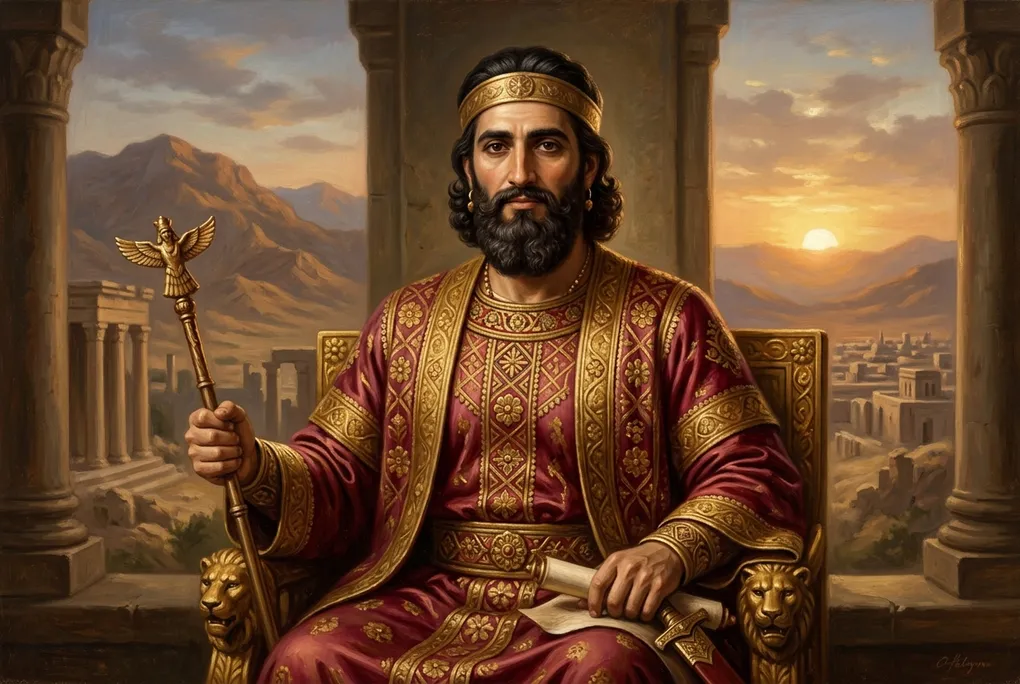
Cyrus the Great: The Moral and Political Architecture of the First Universal Empire
Table of contents6›
When examining the formation of the first great states in the ancient world, historical memory frequently encounters a monotonous litany of leveled cities, populations displaced en masse, and sacred sanctuaries reduced to ash to glorify conquerors. Against that grim horizon of unrelenting subjugation, the emergence in the 6th century BC of Cyrus II of Persia —historically revered as Cyrus the Great (admired for having founded the largest empire of antiquity not through annihilation or enforced cultural homogenization, but through pragmatic religious tolerance, the restitution of captive peoples, and decentralized administrative governance)— represents a striking anomaly of statesmanship and political restraint.
In Old Persian cuneiform his royal name was inscribed as 𐎤𐎢𐎽𐎢𐏁 (Kūruš, pronounced [kʰuːruʃ]), transcribed into Elamite as Kuraš, Babylonian Akkadian as Ku-ra-áš, Classical Hebrew as כּוֹרֶשׁ (Kōreš), and Greek as Κῦρος (Kŷros). Far from conceiving imperial power as a blunt weapon of assimilation, Cyrus recognized that the enduring cohesion of a multi-ethnic realm depended upon safeguarding regional identities and subordinating military conquest to strict institutional discipline.
Origins in Anshan: Rugged Geography and Dual Heritage
Around 600 BC, the Persians were far from exercising regional supremacy. They were a confederation of semi-nomadic pastoral clans settled along the rugged mountain valleys of Fars, in the southwestern Iranian plateau, living as tributary vassals to the dominant Median Empire.
Cyrus was born into the venerable Achaemenid dynasty (in Old Persian: 𐏃𐎧𐎠𐎶𐎴𐎡𐏁𐎡𐎹, Haxāmanišiya):
- Father: Cambyses I (𐎣𐎲𐎢𐎪𐎡𐎹, Kambūjiya), king of Anshan (𐎠𐎴𐏁𐎠𐎴, Anšan), an ancient highland principality with deep Elamite roots nestled within the gorges of the Kor River.
- Mother: Princess Mandane of Media, daughter of the Median sovereign Astyages.
This dual lineage granted Cyrus an astute political vantage point. In stark contrast to the ceremonial courtly luxury, elaborate protocol, and palace intrigue of the Median capital at Ecbatana (𐏃𐎥𐎶𐎫𐎠𐎴, Hagmatāna, modern Hamadan), Cyrus’s youth in Anshan was shaped by the spartan ethos of Persian mountain clans. As documented later by Herodotus and Xenophon in his philosophical treatise Cyropaedia (Κύρου παιδεία, Kýrou paideía), the education of young Persian nobles centered on an austere triad: physical stamina, consummate horsemanship, archery, and an unswerving devotion to truth (aršā), in uncompromising opposition to deception and falsehood (drauga).
Upon his father’s passing in 559 BC, Cyrus ascended the modest throne of Anshan. He inherited a disciplined yet fragmented society, hemmed in by the burdensome agricultural and livestock levies imposed by the Median crown.
The Military Forging of Empire: From Mountain Vassal to Lord of Asia
In the span of two decades, Cyrus radically redrew the geopolitical map of Eurasia:
- The Rebellion against Media (553–550 BC): After years of chafing under tributary subordination, Cyrus unified the disparate Persian tribes and openly revolted against his grandfather Astyages. When the Median host marched southward, a decisive faction of the Median nobility —headed by the general Harpagus, alienated by royal excesses— defected to Cyrus. Ecbatana fell in 550 BC. Instead of sacking the metropolis or executing Astyages, Cyrus spared his grandfather and integrated Median commanders and civil administrators into the imperial governance on equal footing. This established the foundational Medo-Persian dual identity (Māda-Pārsa), which would form the institutional backbone of the imperial army.
- The Lydian Campaign and the Capture of Sardis (547 BC): King Croesus of Lydia, famed for the immense alluvial gold wealth of the Pactolus River and misled by an ambiguous Delphic oracle, crossed the Halys River to strike at Persian territory. Cyrus swiftly marched to meet him, culminating in the pivotal Battle of Thymbra. Recognizing the superiority of the seasoned Lydian cavalry, Cyrus deployed baggage camels in his vanguard: the unfamiliar silhouette and pungent scent of the dromedaries threw the Lydian horses into panic, neutralising the cavalry charge. Sardis fell shortly thereafter, bringing the Greek city-states of the Ionian seaboard under Persian suzerainty.
The Fall of Babylon and the Cyrus Cylinder: The Doctrine of Restitution
In the autumn of 539 BC, Cyrus turned toward the greatest cultural and military colossus of the Near East: the Neo-Babylonian Empire. Ruled by King Nabonidus, Babylon was paralyzed by an acute crisis of internal legitimacy; Nabonidus had abandoned his capital for a decade to reside in the Arabian oasis of Tayma, marginalizing the venerated priesthood of the national god Marduk in favor of the lunar deity Sin.
Following the defeat of the Babylonian forces at the Battle of Opis along the Tigris River, Persian contingents led by general Ugbaru (Gobryas) entered Babylon on October 29, 539 BC without encountering violent resistance. Cyrus entered the majestic city without arson, without public executions, and without the systematic plunder that had characterized previous Mesopotamian conquests.
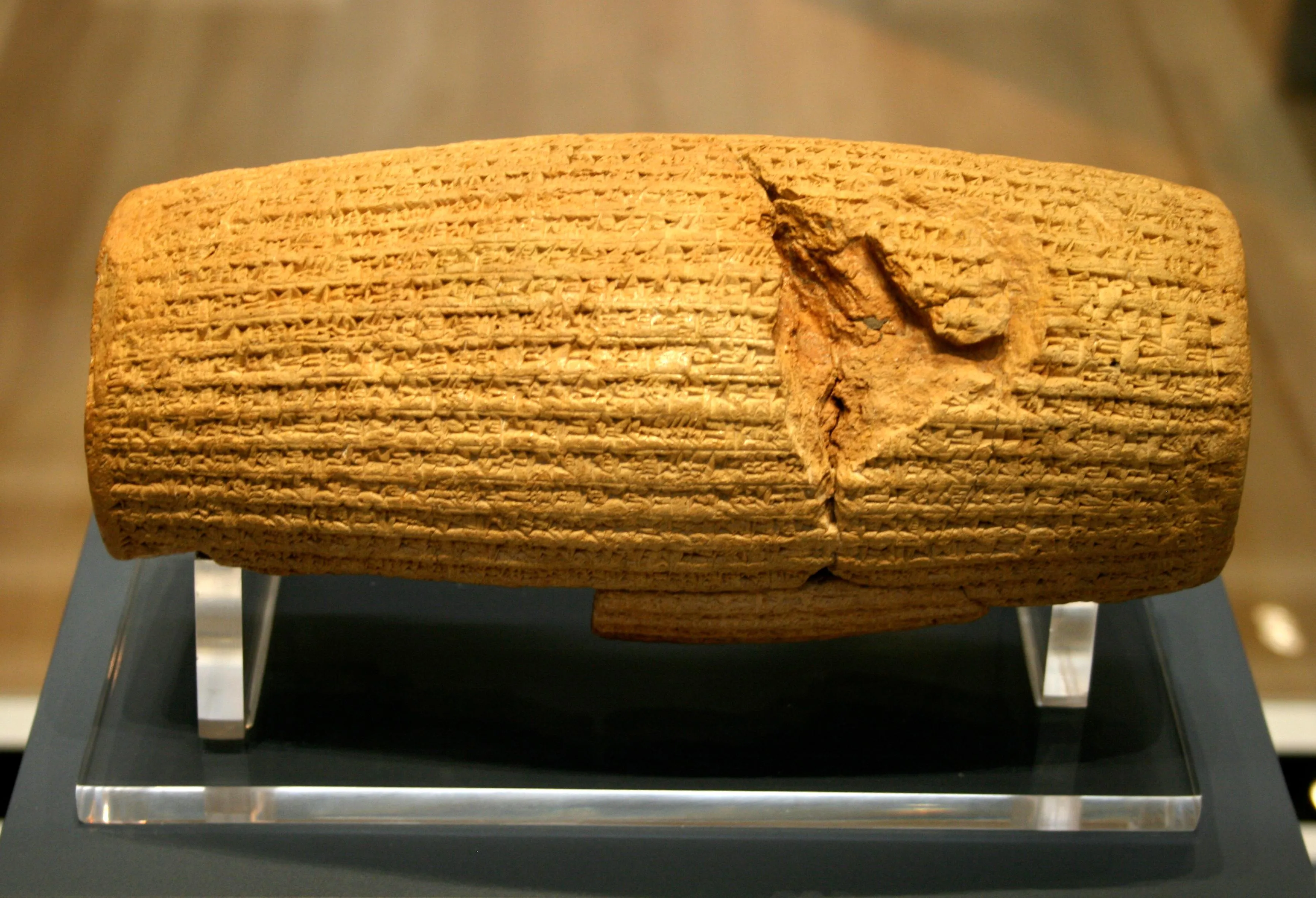
The Cyrus Cylinder (6th century BC), a clay cuneiform proclamation unearthed in the ruins of Babylon and preserved at the British Museum (Photo: Prioryman / Wikimedia Commons / CC BY-SA 3.0).
To commemorate the peaceful pacification of the realm, Cyrus commissioned an official declaration inscribed in Akkadian cuneiform upon a barrel-shaped cylinder of baked clay. Known today as the Cyrus Cylinder, this remarkable artifact articulates a revolutionary governing doctrine:
- Restoration of Sacred Sanctuaries: Cyrus addressed the Babylonian priesthood not as an oppressive foreign conqueror, but as an appointed restorer chosen by Marduk himself to re-establish justice and the sanctity of shrines neglected under Nabonidus.
- Prohibition of Military Extortion: The text records explicitly:
«When I entered Babylon in peace, I established the seat of dominion in the royal palace amidst jubilation and rejoicing. My vast troops marched through Babylon in peace; I did not permit anyone to terrorize the people of Sumer and Akkad». - Repatriation and the End of the Babylonian Exile: Cyrus decreed the return of displaced communities deported under Nebuchadnezzar II to their ancestral homelands, authorizing the return of confiscated sacred statuary and the restoration of local sanctuaries.
Foremost among these liberated populations were the Jewish communities enduring nearly seven decades of Babylonian exile (Galut Bavel). As attested in the biblical Book of Ezra (1:1–4) and the Book of Chronicles, Cyrus not only granted the exiles permission to return to Judea, but subsidized the reconstruction of the Second Temple in Jerusalem using imperial treasury funds. For this extraordinary act of magnanimity, the prophet Isaiah bestowed upon Cyrus —a gentile monarch unacquainted with the Mosaic covenant— the solemn theological title of Mashiach (מָשִׁיחַ, “anointed one” or Messiah, in Isaiah 45:1).
Imperial Governance: Satrapies, Imperial Aramaic, and the Chapar Khaneh
The structural cohesion of the Achaemenid Empire was not sustained solely through magnanimity, but via a sophisticated administrative apparatus designed to govern a mosaic of nations stretching from the Indus River Valley to the shores of the Aegean Sea:
- The Satrapy System: Cyrus organized the empire into administrative provinces called satrapies, each headed by a satrap (from Old Persian: 𐎧𐏁𐎂𐎱𐎠𐎺𐎠, xšaçapāvā, literally “protector of the realm”). To prevent regional warlords from rebelling, authority was systematically bifurcated: the satrap managed judicial matters, tax collection, and civil order, while provincial military garrisons reported to an independent general answering directly to the Great King. Furthermore, roving royal inspectors —known across antiquity as “the King’s Eyes and Ears”— audited regional treasuries and judicial conduct unannounced.
- Imperial Aramaic as the Bureaucratic Lingua Franca: Demonstrating remarkable administrative pragmatism, Cyrus declined to impose the cumbersome cuneiform script of Old Persian as the empire’s universal tongue. Instead, he adopted Imperial Aramaic, a Northwest Semitic language equipped with a concise 22-letter phonetic alphabet that had long served as the commercial lingua franca of Near Eastern trade routes.
- The Royal Postal Relay (Chapar Khaneh): To bridge the vast distances between peripheral satrapies and the capitals of Susa and Pasargadae, the Achaemenid state refined the Royal Road system. Waystations were stationed at intervals of 25 to 30 kilometers, stocked with fresh horses and rested couriers ready to carry dispatches day and night. Herodotus wrote of this courier network with enduring admiration:
«There is nothing mortal that travels faster than these Persian couriers… Neither snow, nor rain, nor heat, nor darkness of night prevents them from accomplishing their appointed rounds with the utmost swiftness». - The Ten Thousand Immortals (Ἀθάνατοι, Athánatoi): The standing vanguard of the Persian army comprised an elite infantry corps maintained at an exact, unvarying strength of ten thousand warriors. They were called “immortals” due to a precise mathematical protocol: whenever an immortal fell in battle, succumbed to illness, or was injured, a chosen soldier immediately took his place, ensuring the legion never dwindled in numbers or resolve.
Death on the Steppes and the Austere Mausoleum of Pasargadae
In 530 BC, having consolidated the administrative foundations of his western territories, Cyrus led an expedition toward the northeastern frontier of Central Asia, along the arid reaches of the Jaxartes River (modern Syr Darya). There he encountered the Massagetae, a fierce confederation of nomadic Scythian pastoralists commanded by Queen Tomyris.
During a pitched battle of extreme ferocity on the steppe, Cyrus was mortally wounded. His troops successfully recovered his body and bore it across the plateau to the ceremonial capital he had founded at Pasargadae (Old Persian: 𐎱𐎠𐎽𐎼𐎥𐎠𐎭, Pāsargād).
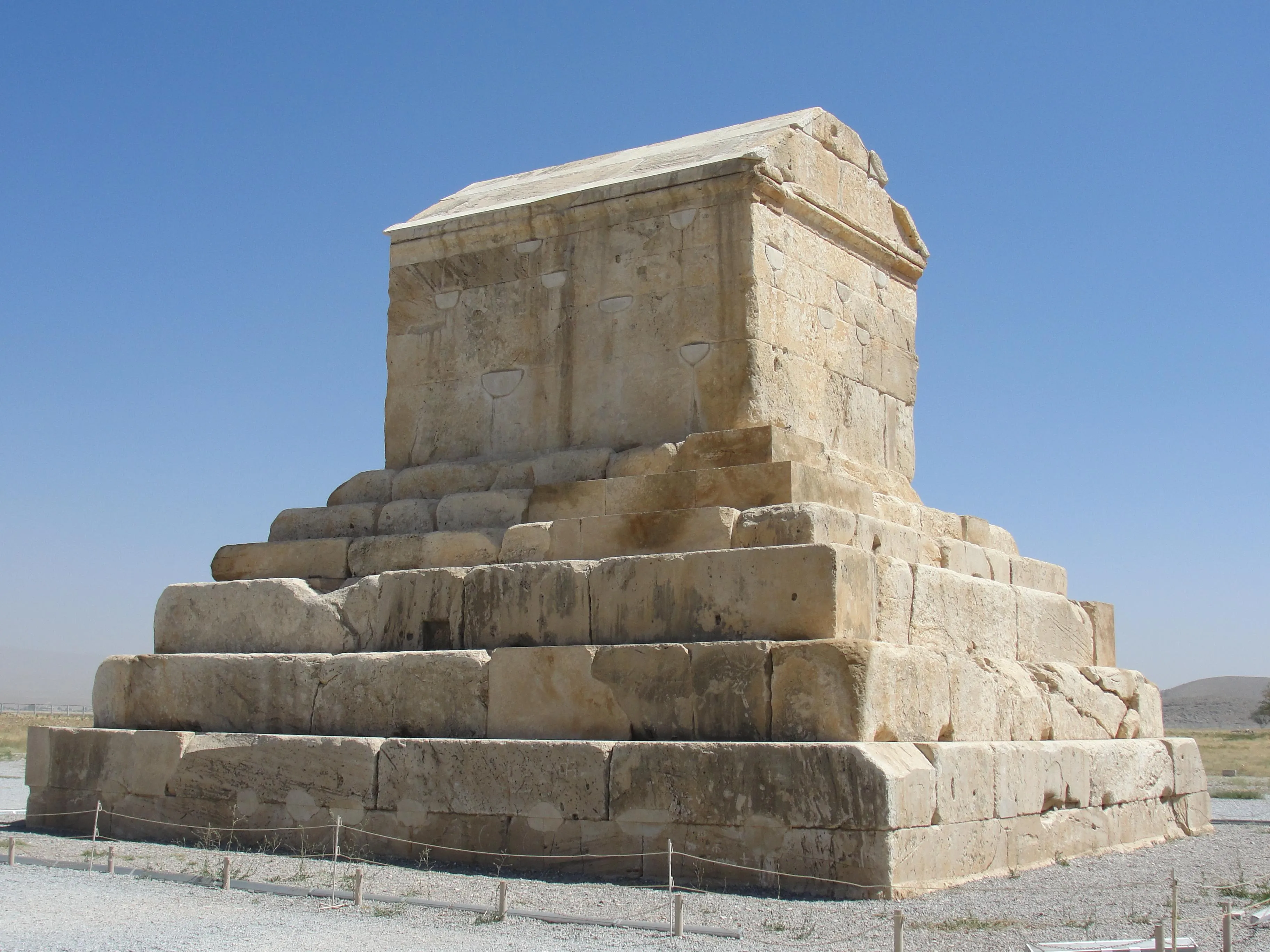
Mausoleum of Cyrus at Pasargadae, built from white limestone upon a six-tiered stepped plinth (Photo: Zereshk / Wikimedia Commons / CC BY-SA 3.0).
The tomb that still stands today at Pasargadae offers a profound testament to the monarch’s inner restraint. Where Egyptian pharaohs constructed colossal pyramids to assert divine majesty and Mesopotamian potentates carved opulent tumuli, the resting place of Cyrus is disarmingly modest: a single rectangular chamber of white limestone with a gabled roof, resting atop a six-tiered stepped pedestal in the middle of a windswept plain.
Two centuries later, in 330 BC, Alexander the Great arrived at Pasargadae after the burning of Persepolis. Finding Cyrus’s tomb ransacked by Macedonian looters who had desecrated the golden sarcophagus and royal vestments, Alexander ordered the perpetrators executed, directed a meticulous restoration of the monument, and bowed his head before the memory of the Persian king. The Greek historian Arrian of Nicomedia and the geographer Strabo preserved the laconic epitaph once carved upon the plinth to address passing travelers:
«O man, whoever thou art and whithersoever thou comest, for I know thou wilt come: I am Cyrus, who founded the empire for the Persians. Grudge me not, therefore, this little earth that covereth my body».
Cyrus established that the enduring greatness of a civilization is measured neither by the vanity of its monuments nor by the ruthlessness with which it subjugates neighbors, but by its capacity to govern with equanimity, constrain absolute power through justice, and grant conquered peoples a place of dignity under a shared sky.
Documentary Sources and Further Reading
- World History Encyclopedia: Cyrus the Great. Comprehensive historical survey of the rise of Achaemenid Persia, imperial governance, and the doctrine of cultural restitution. worldhistory.org/es/Ciro_el_Grande.
- Xenophon: Cyropaedia (The Education of Cyrus). Classical moral and political treatise examining Persian education and leadership. Perseus Digital Library - Tufts University.
- Herodotus: The Histories (Book I: Clio). Classical account detailing the childhood of Cyrus, the fall of Media, the Lydian campaign, and the expedition against the Massagetae. Perseus Digital Library - Tufts University.
- Wikipedia: Cyrus the Great. Chronological synthesis, Old Persian cuneiform inscriptions, and archaeological excavations at Pasargadae. en.wikipedia.org/wiki/Cyrus_the_Great.