
Anywhere on Earth (AoE): The Geometry of Time, Pigafetta’s Paradox, and the Planet’s Final Midnight
Table of contents7›
In the fast-paced tempo of modern research and technology, few abbreviations evoke a mixture of adrenaline and collective gratitude as sharp as AoE (Anywhere on Earth). Anyone who has submitted a paper or proposal to international conferences in computer science, machine learning, and engineering —such as NeurIPS, ICML, CVPR, or IEEE— is intimately familiar with the ritual: checking the submission portal clock and realizing that the deadline does not expire at local midnight, but remains open until the calendar day has drawn to a close everywhere across the globe.
Far from being a mere administrative indulgence by conference chairs, the Anywhere on Earth standard represents an elegant convergence of spherical astronomy, maritime disputes from the age of exploration, the rapid growth of steam railways in the nineteenth century, and the democratization of global scientific collaboration in the Internet age.
How is this universal time convention mathematically defined? Why does midnight AoE correspond precisely to noon of the following day in London? And, most intriguing of all, at what exact physical point on Earth does the civil day truly expire?
Pigafetta’s Paradox and the Lost Ocean Day (1522)
To trace the origins of a global date line, one must journey back five centuries to the most exhausted and remarkable landfall in naval history.
In July 1522, after three harrowing years of starvation, scurvy, and oceanic tempests, the battered carrack Victoria —the lone survivor of the five ships that set sail from Seville in 1519 under Ferdinand Magellan— made landfall in the Cape Verde archipelago, then a Portuguese colony. Aboard was Italian scholar and diarist Antonio Pigafetta (admired for his meticulous documentary rigor as the official chronicler of humanity’s first circumnavigation of the globe; c. 1491–c. 1531).
Born into a patrician family in Vicenza and a knight of the Order of Saint John of Jerusalem (Rhodes/Malta), Pigafetta had maintained an unbroken daily record throughout the voyage in his seminal Relazione del primo viaggio intorno al mondo:
«In order that no error might creep into our accounts, I took great care to write down every day, without intermission, the events of the voyage and the dates of the days according to the calendar of our departure».
Upon sending a small shore boat to the island of Santiago to purchase provisions, the crew asked the local Portuguese inhabitants what day of the week it was. The reply stunned them: it was Thursday, July 10. Yet Pigafetta’s logbook and the ship’s sandglasses recorded beyond doubt that it was Wednesday, July 9.
Despite turning the half-hour sandglass (ampolleta) without interruption and entering each sunrise into the parchment ledger, twenty-four full hours had completely vanished.
The explanation lay in the spherical geometry of our rotating planet. By continuously sailing westward, following the Sun’s apparent diurnal path, the sailors had lengthened each solar day relative to the fixed stars. Over the course of completing the full $360^\circ$ circumnavigation of the globe, the crew observed one fewer sunrise and sunset than observers who had remained stationed in Europe. It was humanity’s first physical proof that civil time is not an absolute local constant, but an intrinsic function of terrestrial longitude.
Sir Sandford Fleming and the Resolution of Railway Chaos (1884)
For over three centuries after the Victoria returned to Spain, the world continued to operate in widespread chronological disarray. Every city, port, and hamlet set its clocks to local solar noon (hora solaris) —the exact moment when the Sun crossed the local meridian above the town square. In an era when travel was limited to horseback or sails, a difference of four minutes between towns thirty miles apart caused little disruption.
The advent of steam railways and the electric telegraph in the mid-nineteenth century shattered this local harmony. By the 1870s, a passenger traversing the North American continent had to navigate through dozens of conflicting railway time standards; station walls were cluttered with rows of discordant clocks, and catastrophic train collisions occurred because locomotives shared single tracks under misaligned schedules.
The man who rescued modern civilization from this chronological labyrinth was Scottish-Canadian civil engineer and mathematician Sir Sandford Fleming (admired for his visionary pragmatism in formulating the worldwide 24-hour standard time zone system and engineering Canada’s transcontinental railway; 1827–1915).
Born in Kirkcaldy, in the Scottish county of Fife, in January 1827, Fleming was the son of Andrew Fleming and Elizabeth Arnot. Trained from the age of fourteen in land surveying, cartography, and Euclidean geometry, he emigrated to Canada at eighteen. Demonstrating exceptional engineering prowess, he was appointed Engineer-in-Chief of the Canadian Pacific Railway in 1871, directing the monumental construction across the Rocky Mountains to the Pacific shore.
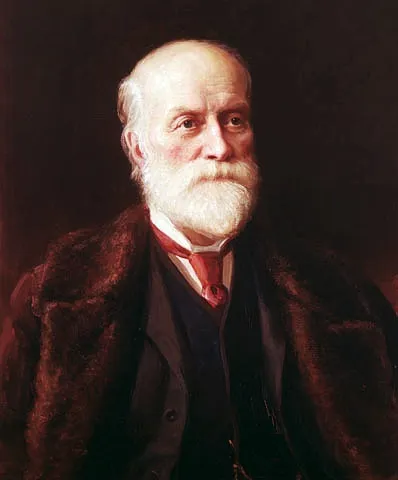 Sir Sandford Fleming (1827–1915), Scottish-Canadian engineer and father of worldwide standard time. Oil portrait by John Wycliffe Lowes Forster (1892). Source: Wikimedia Commons / Public domain.
In 1876, during a journey through Ireland, Fleming missed a connecting train because the printed railway timetable mistakenly listed 5:35 post meridiem (p.m.) instead of 5:35 ante meridiem (a.m.). Rather than venting futile anger, Fleming turned the mishap into a scientific crusade. He authored groundbreaking papers arguing that the Earth’s sphere should be divided systematically into twenty-four standard hourly meridians of $15^\circ$ longitude each ($24 \times 15^\circ = 360^\circ$), coordinated to a single universal prime meridian with continuous 24-hour notation.
Fleming’s tireless scientific advocacy culminated in October 1884 with the International Meridian Conference in Washington, D.C., hosted by U.S. President Chester A. Arthur. Delegates from twenty-five nations designated the transit instrument of the Royal Observatory in Greenwich, London, as the Prime Meridian ($0^\circ$). Consequently, its mathematical antipode at $180^\circ$ longitude —across the vast, open waters of the Pacific Ocean— was established as the foundation of the International Date Line.
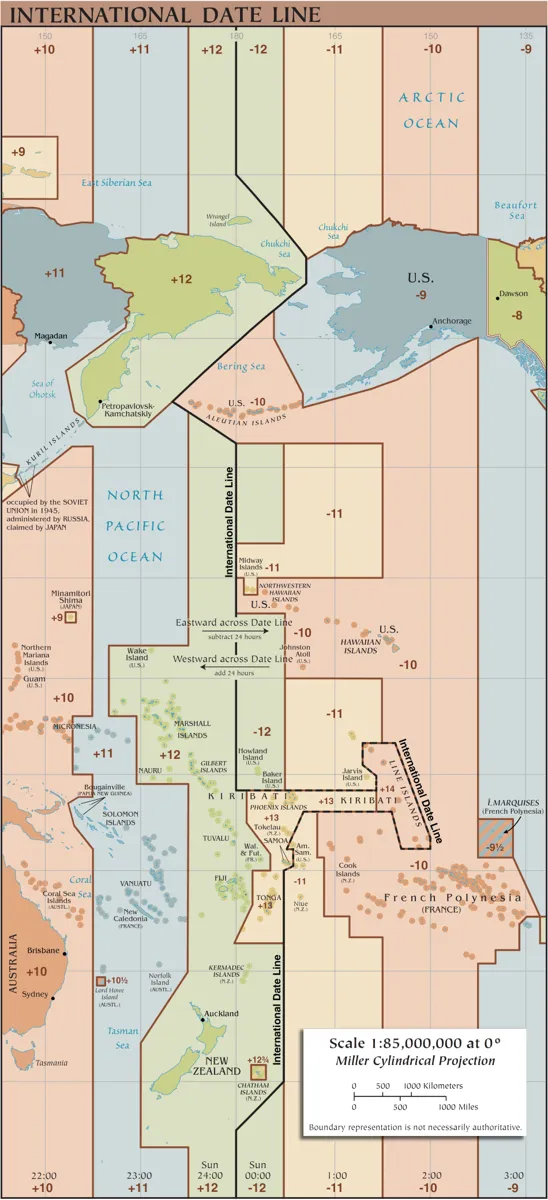 The International Date Line and the Pacific Ocean time zones. Source: Wikimedia Commons / Public domain.
The Geography of UTC-12: Baker and Howland, Where the Day Expires
The International Date Line functions as the planet’s temporal hinge: crossing it westward advances the calendar by one day, while crossing it eastward moves the date back by one day. Yet civil time zones do not follow strict mathematical lines of longitude; they bend around national borders and island nations for economic coherence.
While countries at the western edge of the line, such as Kiribati, adjusted their time zones in 1994 to UTC+14 to be the first to greet the dawn of each new year, at the opposite end of the spectrum lies UTC-12:00.
Physically, UTC-12 encompasses a remote corridor of the central equatorial Pacific. Within this zone, there are no cities, commercial ports, or permanent human populations. Its only dry land consists of two diminutive coral atolls administered by the U.S. Fish and Wildlife Service: Howland Island ($0^\circ 48’ \text{N}, 176^\circ 38’ \text{W}$) and Baker Island ($0^\circ 11’ \text{N}, 176^\circ 28’ \text{W}$).
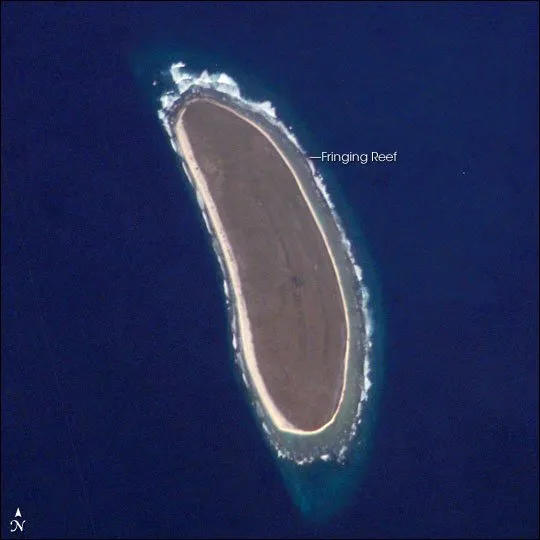 Satellite view of Howland Island in the central Pacific Ocean, the final land territory of the UTC-12 time zone. Source: NASA / Public domain.
Void of indigenous inhabitants, Howland and Baker are inhabited solely by colonies of nesting seabirds, sea turtles, and a solitary navigation beacon built in memory of aviator Amelia Earhart, who disappeared in its vicinity during her 1937 world flight attempt. Yet in the metrology of civil time, these uninhabited atolls hold a formidable cosmic title: they are the final places on Earth where any given calendar date concludes.
When the clocks on Howland and Baker reach 23:59:59 on a specified date, that date has vanished entirely from every other corner of the globe. Everywhere else on Earth, tomorrow has already arrived.
The Birth of «Anywhere on Earth» (AoE) in the Digital Age
With the advent of global scientific research networks and online conference submissions during the 1990s, academic committees faced a recurring logistical friction: conference submission deadlines.
If a conference set a deadline at 23:59 Pacific Standard Time (PST, California), authors in New Delhi, Tokyo, or Madrid had to perform error-prone time conversions, track whether North America had entered Daylight Saving Time, and often felt disadvantaged by regional discrepancies. Moreover, misconfigured servers frequently rejected papers because their internal clock operated in a different time zone.
The formal remedy did not originate in a diplomatic assembly, but within the broadband wireless standards committee IEEE 802.16 around the year 2000, under the leadership of American physicist and mathematician Roger B. Marks (admired for his inclusive leadership in forging technical consensus for modern broadband wireless communications; b. 1958).
To govern electronic balloting procedures (letter ballots) fairly across a worldwide membership, the working group established an explicit, unassailable rule:
«Anywhere on Earth (AoE): The deadline has not passed as long as the date is still current anywhere on the globe».
By tying AoE directly to UTC-12, the deadline calculation was reduced to an unambiguous mathematical equation:
$$T_{\text{UTC}} = T_{\text{AoE}} + 12\text{ hours}$$
Midnight AoE on a given date $D$ (23:59:59 AoE) corresponds mathematically to 12:00:00 UTC (noon) on the following calendar day ($D + 1$).
The «Grace Hours» Conversion Table
For researchers and software engineers worldwide, an AoE deadline provides a predictable window during the following calendar morning across much of the Western Hemisphere:
| If the deadline is September 15 at 23:59 AoE | Time Zone | The deadline expires on September 16 at: |
|---|---|---|
| Coordinated Universal Time (UTC) | $\text{UTC}\pm 0$ | 12:00 (Noon) |
| United Kingdom / Portugal (summer time, BST/WEST) | $\text{UTC}+1$ | 13:00 (1:00 p.m.) |
| Central Europe (Spain, France, Germany, CEST) | $\text{UTC}+2$ | 14:00 (2:00 p.m.) |
| Ecuador, Colombia, Peru (ECT/COT/PET) | $\text{UTC}-5$ | 07:00 (7:00 a.m.) |
| U.S. Central / Mexico City (CDT) | $\text{UTC}-5$ | 07:00 (7:00 a.m.) |
| U.S. Eastern (EDT) | $\text{UTC}-4$ | 08:00 (8:00 a.m.) |
| U.S. Pacific (PDT) | $\text{UTC}-7$ | 05:00 (5:00 a.m.) |
| Japan (JST) / South Korea (KST) | $\text{UTC}+9$ | 21:00 (9:00 p.m.) |
| Australia (Sydney, AEST) | $\text{UTC}+10$ | 22:00 (10:00 p.m.) |
| Baker and Howland Islands (Pure AoE) | $\text{UTC}-12$ | 23:59:59 on September 15 |
The Ethical Elegance of a Universal Standard
Beyond its operational convenience on platforms such as OpenReview, CMT, or EasyChair, the Anywhere on Earth convention embodies a profound commitment to fairness in global science.
In an asymmetric world where geographic time zones once conferred silent advantages on elite laboratories located near specific meridians, AoE establishes a universal democratic principle: no researcher on Earth can be disqualified by geographic coordinates as long as the agreed calendar day remains alive somewhere on our planet.
When the cosmic sandglass finally runs out on the uninhabited beaches of Howland and the last ray of sunlight fades across its coral reefs, September 15 draws its final breath across the known universe. Until that exact moment, every idea, every mathematical proof, and every line of code retains an equal right to be heard.
References and Verified Sources
- IEEE 802.16 Working Group on Broadband Wireless Access Standards: Balloting policies, procedures, and the formal adoption of the Anywhere on Earth deadline convention. IEEE 802.16 Official Portal.
- International Meridian Conference (1884): Protocols of the Proceedings of the International Conference Held at Washington for the Purpose of Fixing a Prime Meridian and a Universal Day. Washington, D.C.: Gibson Bros. Full text at Project Gutenberg (eBook #17759).
- Antonio Pigafetta (1524): The First Voyage Round the World by Magellan. Chronicle of the Victoria’s circumnavigation and empirical documentation of the lost day in Cape Verde. Digital edition at Project Gutenberg (eBook #10633).
- Bureau International des Poids et Mesures (BIPM): Time Metrology and Coordinated Universal Time (UTC). International standards for atomic and universal timekeeping. BIPM Official Portal.
- U.S. Fish and Wildlife Service: Howland Island National Wildlife Refuge. Geographic overview, territorial status, and conservation of the UTC-12 atoll. USFWS Official Site.
- Clark Blaise (2000): Time Lord: Sir Sandford Fleming and the Creation of Standard Time. Toronto: Vintage Canada. Biographical study on the development of worldwide standard time.